
The first time Tanner complained about chest pain, no one suspected the nightmare that lay ahead. He was just ten years old, a lively boy with an uncontainable energy. Basketball was his passion; he would ride his bike for hours, shoot hoops in the driveway, and laugh as the sun dipped behind the horizon. His parents, Amy and Michael, saw only a typical boy at play. When Tanner mentioned tightness in his chest, they tried not to worry. Maybe it was allergies. Maybe just a cough.
The doctor initially agreed. Asthma, they said. Inhalers were prescribed, and Tanner was sent home with instructions to rest. Life seemed normal. But the pain didn’t go away. The next morning, Tanner awoke tired, weaker than usual, and still complaining of a pressing ache in his chest. His energy, once boundless, was dwindling.

Within days, bruises appeared on his arms and legs—strange, dark patches that alarmed his parents. Fatigue set in quickly, leaving him unable to enjoy the activities that had always brought him joy. He no longer wanted to play outside. Meals lost their appeal. Something was clearly wrong, but no one could yet name it.
Returning to the hospital brought little reassurance. Doctors ordered more tests, hoping to pinpoint the cause of Tanner’s growing symptoms. Then came the call—the one that would change everything. Tanner had cancer, they said. Not just one type, but two. The words landed like thunder, shaking the family to its core. The doctors were certain. Tanner’s life, they explained, would be consumed by hospital visits, treatments, and battles against disease.
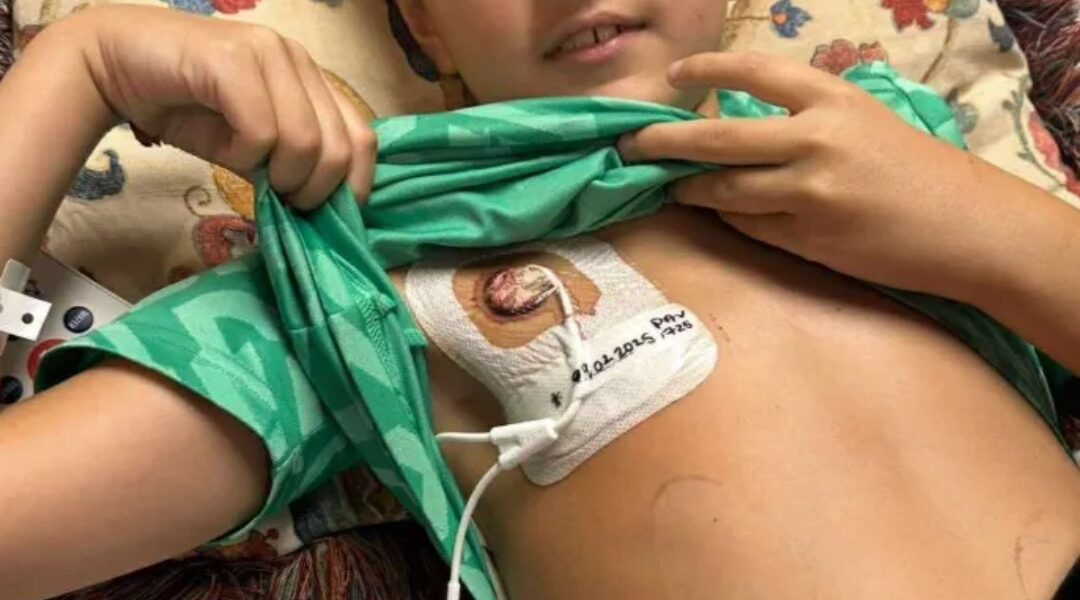
The days that followed were a blur. Specialists visited, consultations multiplied, and a flood of medical jargon overwhelmed Amy and Michael. In less than 48 hours, Tanner found himself in a hospital bed, hooked to IV lines, facing aggressive chemotherapy designed to fight a cancer he never actually had. The treatments were grueling. His hair fell out, his small frame weakened, and his bright eyes dulled under the exhaustion of invasive procedures.
He asked daily when he could go home. “I didn’t know what to tell him,” Amy recalled. “Every time I tried to be strong, he’d look at me and say, ‘It’s okay, Mom. I’ll be tough.’”

Days turned into a nightmare. Tanner endured relentless nausea, fever, and countless needle pricks. Every moment brought suffering that no child should ever experience. And all of it was unnecessary.
Finally, further testing revealed the truth. Tanner had never had cancer. Instead, he had been misdiagnosed. He suffered from a rare bone marrow disorder called Myelodysplastic Syndrome (MDS), a condition that disrupts the production of blood cells and is often confused with leukemia. The chemotherapy he received had been a mistake, a misapplied treatment for a disease he did not have.
When the correct diagnosis was confirmed, relief collided with outrage. Tanner’s body had already endured irreversible trauma. His immune system was weakened. His energy was gone. His spirit, while resilient, bore the marks of weeks of suffering. Amy and Michael tried to carry on, but the emotional scars ran deep. Every hospital hallway triggered memories of pain. Every medical form felt like a trap waiting to repeat itself.
For weeks, Tanner’s parents barely slept. Nights were spent researching treatments, second-guessing every decision, and replaying each appointment in their minds. “What if we had asked one more question?” Amy whispered. “What if we had waited? What if we had gone somewhere else?” These questions haunted them daily.
Even with a proper diagnosis, Tanner’s journey was far from over. MDS is serious, often requiring aggressive therapy. His doctors recommended another round of treatment and, ultimately, a bone marrow transplant. A donor had been found—a stranger somewhere in the world whose marrow could give Tanner a chance to live fully, to play basketball again, to reclaim the childhood that had almost been stolen.
The upcoming procedure was daunting. It was risky, complex, and life-changing. But for Tanner, it was hope. Hope that his laughter would once again echo through his home. Hope that he could return to the court, sneakers squeaking on polished floors. Hope that one day, he would look back on the pain and see the strength he had gained from surviving it.

Tanner’s story is not just about illness; it is a lesson in resilience and courage. His misdiagnosis exposed the limits of medicine. Even experts can be wrong. Yet Tanner’s spirit remained unbroken. “Trust your instincts,” Amy implores other parents. “If something feels off, don’t stop asking. Don’t settle for the first answer, even if it comes from someone in a white coat.”
The family created a Facebook page, “Tough Like Tanner,” to share updates on his journey. What began as a small circle of friends praying for him grew into a global community of thousands. Messages of encouragement, donations, and stories of personal struggle poured in. Tanner was not alone. Families who had faced misdiagnoses, children who endured unnecessary pain, and those who had rebuilt their lives after trauma found hope and connection through his story.
Medical professionals and parents alike took note. How could such an error occur? How could the system fail a child so profoundly? The answers are complex. Rare diseases can mimic cancer symptoms. Tests can mislead. But Tanner’s experience revealed the deeply human consequences: months of his life lost, confidence shaken, and innocence disrupted. Despite all, his spirit endured.
As Tanner prepared for his bone marrow transplant, optimism began to creep into his days. He smiled more often, spoke of basketball and school, and found joy in small victories. Even in the quiet moments between treatments, he learned lessons that many adults never do—finding strength in adversity and happiness in incremental progress.
To his mother, Tanner is a miracle. To his doctors, he is a fighter. To everyone who has met him, he is unforgettable. His story resonates because it confronts the reality that medicine, though advanced, is fallible. Errors occur, but the resilience of a child can redefine the outcome. Tanner does not want to be remembered as the boy misdiagnosed. He wants to be remembered as the boy who fought back.
In every shared photograph—bald head, wide smile, basketball in hand—Tanner proves that he is reclaiming his childhood. The road ahead will not be easy. Pain, setbacks, and uncertainty await. But light remains, as do hope and love. If his transplant succeeds, Tanner will rebuild not only his body but also his trust in the life beyond hospital walls.
His parents acknowledge that this battle has changed them forever. They also know that Tanner’s courage has already inspired countless others. His story emphasizes the importance of listening to parental instincts and advocating for children, even when faced with authority. Sometimes, the difference between tragedy and survival is a single question, a courageous moment to say, “I’m not sure that’s right.”
Tonight, as Tanner rests before his critical procedure, his parents ask for one thing: prayers. “Please keep this brave boy in your thoughts,” Amy says softly. “He’s fighting to be a kid again.”
Through all the uncertainty, Tanner exemplifies courage, resilience, and the unyielding spirit of a child determined to live fully. His journey is ongoing, a testament to the strength of the human heart and the power of hope.
She Lived Only 9 Years — But Brielle Nicole Bird Left a Faith That Shook Thousands

There are lives that do not need time to become eternal.
They need meaning.
They need depth.
They need light.
Brielle Nicole Bird was one of those lives.
She was born on February 1, 2016, quietly entering the world without fanfare, without warning anyone that she would change them forever.
Small in body.
Gentle in presence.
Yet carrying something rare — a purpose that many people spend decades searching for and never find.
From the very beginning, Brielle’s life was fragile.
Not fragile in spirit, but in the way a candle flame is fragile — easily shaken by the wind, yet capable of lighting an entire room.

Those who knew her quickly understood that Brielle was different.
She did not demand attention.
She did not need to be loud.
Her presence alone shifted the atmosphere around her.
When Brielle passed away on December 11, 2025, the silence she left behind was not empty.
It was heavy.
Sacred.
Almost unbearable.
Because Brielle did not leave quietly.
She left behind questions that had no easy answers.
Faith that was tested and, for many, unexpectedly restored.
And a grief so deep it felt shared by people who had never met her.
Some names slow the heart when spoken.
They ask for gentleness.
For reverence.
For pause.
Brielle is one of those names.

People often say, “You are a miracle,” as comfort.
As poetry.
As something nice to say when words feel inadequate.
But in Brielle’s case, it was simply true.
She was not a miracle because she survived.
She was a miracle because she lived — fully, intentionally, exactly as she was meant to.
Her life was never meant to be measured in years.
It was measured in impact.
In hearts softened.
In faith rekindled.
In prayers spoken again after long silence.
Those closest to her say that walking her home — even through the unbearable ache of goodbye — was the most sacred privilege of their lives.
A sentence that sounds impossible until you realize that holiness can exist even at the edge of loss.
Because Brielle did not vanish.
She returned.
Returned to the place her soul always belonged.
Without sermons.
Without explanations.
Without asking anyone to believe anything specific.

Brielle brought people closer to God simply by being who she was.
Through endurance wrapped in gentleness.
Through grace that remained intact even when pain had every reason to harden a heart.
Through a quiet faith that never needed to defend itself.
Her life whispered what many never hear shouted.
That God is good — not because life is fair, but because love does not leave.
Her faith was not dramatic.
It was radiant.
And that light traveled far beyond hospital walls.
It crossed state lines.
It crossed oceans.
Strangers followed her story and felt their hearts ache as if she were their own.
People who had never heard her voice felt changed by her presence.
There are children who come into the world needing protection.
And there are children who come into the world to protect others — by teaching them how to love more deeply.
Brielle belonged to the second kind.

Her family says they will continue to look for her in the details.
In moments too subtle to explain.
In warmth that arrives without reason.
And especially in dragonflies.
Dragonflies — symbols of transformation.
Of souls moving between worlds.
Of life continuing beyond what the eyes can see.
From now on, no dragonfly will ever be ordinary.
Each one will feel like a greeting.
A reminder.
A gentle “I’m still here.”
Brielle’s story will not end with her passing.
Not because pain needs to be reopened.
But because light does not exist to be buried.

Some stories do not break us.
They hold us together.
The bedroom door remains open.
Not in denial.
But in devotion.
The playroom light stays on.
Not to fight darkness.
But to say something wordless and profound.
“You belong here.”
“You were never temporary.”
“You are still part of this home.”
Even in leaving, Brielle carried grace.
She did not depart in anger.
She did not leave bitterness behind.
She left a quiet ache — the kind that feels holy rather than hollow.
Those who love her imagine the reunion.
And even imagining it is enough to undo them.
They imagine her running.
Not walking.
Running straight into the arms of Jesus.
No hesitation.
No fear.
Only recognition.
Only relief.

There is jealousy in that image — the most human kind.
Jealousy that she arrived first.
That she is already home.
That pain no longer touches her.
But wrapped tightly around that jealousy is faith.
Faith that Brielle is safe.
Faith that she is whole.
Faith that she is exactly where she was always meant to be.
Brielle Nicole Bird is not remembered only as a daughter.
She is remembered as a testimony.
Proof that a life does not need length to carry power.
Proof that purpose is not measured by age.
Proof that the brightest lights often burn briefly — and illuminate the most.

Her life has changed people.
People who pray differently now.
Who love more patiently.
Who notice the small miracles they once rushed past.
Her story leaves behind a truth that is difficult, yet undeniable.
Meaning is not promised in time.
Purpose is not guaranteed by years.
Sometimes, the shortest lives leave the longest shadows.
Brielle’s name will continue to be spoken.
In tears.
In gratitude.
In quiet moments when someone feels God a little closer than before.
She will be remembered not only for what she endured.
But for what she gave.
Hope.
Faith.
Love without condition.
There are stars that appear only for a moment.
Yet their light travels for generations.
Brielle Nicole Bird is one of those stars.

And even now, beyond our sight, her light continues to guide hearts through darkness.
We will remember her — not only by grieving.
But by living differently because she existed.
By choosing kindness.
By choosing faith.
By loving as if every day is sacred.
Because Brielle did not simply pass through this world.
She changed it.