
It’s a bye week for Alabama football — a time when the Crimson Tide rests, recovers, and prepares for what comes next.
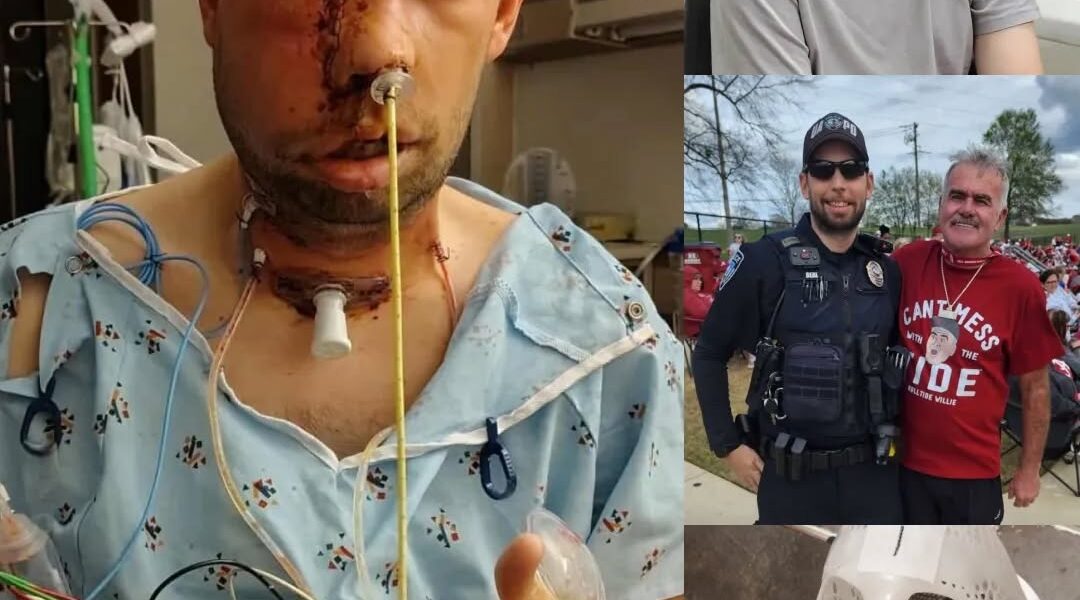
But for University of Alabama Police Officer Justin Beal
, this week isn’t about football scores or practice schedules. It’s about something far deeper.
It’s about healing.
It’s about fighting.
It’s about faith.
💔

Exactly one month ago, Justin underwent the fight of his life — a
16-hour surgery at UAB Hospital. Surgeons worked through the night, removing a tumor that had invaded spaces most of us never even think about: his sinus cavity, the bones behind his upper jaw, the roof of his mouth, the ridge beneath his eye.
He’s only in his thirties — a husband, a father, a proud University of Alabama police officer. The man who once stood tall along the sidelines of Bryant-Denny Stadium, keeping fans safe, now finds himself standing face-to-face with a different kind of opponent:
Adenoid Cystic Carcinoma.
It’s rare. It’s relentless. And it’s cruel.
First discovered in 2019, Justin fought hard and thought he had it beat. But the cancer returned — and not just on any day, but
on 9/11, a date already carved into the nation’s memory for its pain and resilience. This time, the tumor settled deep into his head — beneath the right eye, across the nose, along the upper jaw and into the skull base. It destroyed bone and structure, and yet somehow, it didn’t destroy
him.
💪
Justin’s doctors told him recovery would be long and exhausting. Chemo and radiation are next — both known for taking almost everything out of a person. But Justin doesn’t flinch. He doesn’t complain. When others would break, he smiles and makes jokes about his treatment mask.
“I was fitted for my radiation mask this week,” he texted a friend.
“I had to lie still for an hour while they molded it. It sure was hot under that mask.”
Even now, when the days blur with pain and the nights are too long, Justin’s faith holds. He doesn’t ask why me? — he just asks when can I get back to work?
Because for him, being an officer isn’t just a job. It’s a calling.
He loves his community. He loves the Crimson Tide. He loves the game-day energy — the roar of the crowd, the pride of Tuscaloosa, the unity of fans in crimson and white. And though the next game against LSU is a likely no-go, Justin still plans to tune in, cheering for his team with the same determination he brings to this battle.

🏈
Those who know Justin describe him as steady, kind, humble — the kind of man who would stop to help anyone in need, no matter the hour. A husband who adores his wife. A dad who lights up when he talks about his kids. A man whose faith never falters, even when life delivers its hardest hits.
But now, it’s his turn to be lifted up.
The community he once protected is rallying around him — through prayers, donations, and messages of love. Friends stop by to check in. Fellow officers send updates and encouragement. Football fans who don’t even know him by name still whisper his story in prayer: “God, please help the officer who’s fighting cancer. Help him heal.”
And somehow, you can almost feel those prayers weaving through the halls of his home in Northport, where Justin rests and recovers — waiting for the day he can put his uniform back on and return to the sidelines.
🙏

It’s hard to make sense of it — how someone so good, so young, so giving, can face such darkness. The question why this man? hangs in the air, unanswered.
But maybe the answer isn’t in the why — maybe it’s in the how.
Because Justin Beal shows us how to face suffering with faith.
How to keep courage alive when fear threatens to swallow it.
How to walk through the fire and still believe that there’s light on the other side.
He’s not wallowing in pity. He’s not letting cancer define him. He’s preparing — for the next surgery, the next treatment, and eventually, the next game day when he’ll walk again beneath those stadium lights, a survivor in crimson and white.
💥
When the Crimson Tide takes the field next week, Justin will be watching — not just as a fan, but as a symbol of everything Alabama football stands for: grit, brotherhood, and the will to rise again.
So this week, as the Tide rests, let’s send our strength where it’s needed most — to Officer Justin Beal, the man who guards their gates and now fights his greatest battle.
Let’s pray for his healing, for his family’s peace, and for the doctors who hold his care in their hands.
Because heroes don’t just wear helmets.
Sometimes, they wear badges.
Sometimes, they lie in hospital beds, whispering prayers between treatments, still believing that faith — like football — is about getting back up after the hardest hits.

💫
Roll Tide, Justin.
Keep fighting. Keep believing.
Your team — your family, your community — is right behind you.
When You Are Old and Alone: The Simple, Sacred Need to Be Seen

There comes a time in life when the noise begins to fade. The house grows quiet, the calls become fewer, and the days stretch longer than they used to. The mirror shows the years you’ve lived, but your heart still remembers the sound of laughter, the warmth of familiar voices, and the comfort of someone’s presence.
Old age — that gentle, aching twilight of life — is not just about growing older. It’s about learning how to live with silence, with memories, and with the invisible weight of time. And in that silence, one truth becomes clear: more than medicine, more than comfort, more than anything else, we need someone who stays.
When you are old and alone in this world, you don’t crave the noise of crowds or the distraction of endless entertainment. You crave a voice — soft, kind, unwavering — that whispers, “Don’t worry. I’m here.”
Because presence, not perfection, is what keeps the human heart alive.
The Loneliness No One Sees
There are millions of elderly people around the world who wake up each morning to empty rooms. They make tea for one. They sit in chairs where someone else once sat. They tell stories to the air, hoping someone will hear.
Loneliness is one of the quietest forms of suffering, and yet it is everywhere — behind closed doors, in quiet apartments, in nursing homes where time moves slowly and the air hums with the sound of old memories.
When you have lived a long life — when you’ve raised children, built dreams, loved, lost, and seen the world change before your eyes — you carry with you a library of stories. And stories are meant to be shared.
But sharing them requires an audience — someone who will listen, not out of duty, but out of care. Someone who will smile as you describe the first time you fell in love, or the summer you danced barefoot in the rain, or the tiny, ordinary miracles that made your life what it was.
That’s why, when you start telling those old, sweet memories, what you need most is not an answer or advice. You just need someone to say, “Go ahead, I’m listening.”
The Healing Power of Being Heard
There is something profoundly human about being heard — truly heard. When we speak our memories aloud, they stop belonging only to the past. They become alive again.
And when someone listens with patience and warmth, it reminds us that our lives — our joys, our pain, our stories — mattered. That we still matter.
For an old soul sitting in a quiet room, that simple acknowledgment can be a kind of medicine. The kind that no pill can offer.
Because the heart doesn’t age like the body does. It still wants to be seen, to be understood, to be held in someone else’s compassion.
When the Tears Come
There are days when memories feel heavy instead of sweet. Days when the loneliness presses down so hard it becomes physical — a lump in the throat, a sting behind the eyes.
In those moments, what we need isn’t someone to tell us to “be strong.” What we need is someone to sit close, wipe away the tears, and say gently, “Don’t cry. Smile. I’m with you.”
Those words don’t erase the pain — but they share it. And shared pain, even for a moment, becomes lighter.
Because at any age, the truest comfort is knowing that we don’t have to face our hardest moments alone.
The Nighttime Prayer of the Soul

And then comes the night. The house goes still. The air cools. You lie down and watch the shadows move across the ceiling, and somewhere deep inside, the same childhood fear rises again — that fear of being alone in the dark.
But this time, it’s not monsters under the bed that you fear. It’s the echo of your own heartbeat in an empty room.
What every soul longs for in that moment is simple — the warmth of another hand reaching for yours, a voice saying softly, “Don’t be afraid. Go to sleep. I’m here. And I always will be.”
That’s not just a wish for the elderly. It’s a wish for all of us — because no matter how young or strong we are now, one day, we too will crave that same presence. The comfort of knowing that our existence matters to someone.
The Quiet Lesson of Growing Old
Growing old teaches us many things: patience, humility, resilience. But perhaps the greatest lesson of all is this — in the end, it’s not the years that define a life. It’s the people who stayed.
We spend our lives chasing so much — success, wealth, recognition — yet when the years take everything else away, the only thing that remains is love. Not the grand, movie kind of love, but the quiet, everyday kind. The kind that holds your hand when you cry, listens when you ramble, and sits beside you in silence when there’s nothing left to say.
That is the love that outlives us. The love that turns an empty room into a home. The love that makes the final chapters of life not lonely, but peaceful.
So, if you are lucky enough to still have someone in your life — an old parent, a grandparent, a neighbor, a friend — call them. Visit them. Sit with them. Listen. Let them tell their stories again, even if you’ve heard them before. Let them know they are not alone.
Because one day, you’ll want someone to do the same for you.
And maybe then, in the quiet of your own old age, you’ll hear a gentle voice beside you saying, “Don’t be afraid. I’m here. I will be with you — forever.”
That voice — that presence — is not just the sound of love. It i