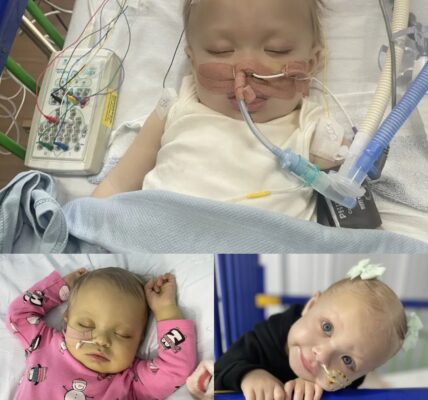

Olaf’s life has never followed the path a child’s life should. From the very beginning, he has lived at the fragile edge between survival and loss, between unbearable pain and stubborn hope. His story is not one moment of tragedy, but a long, relentless journey—one that has tested the limits of the human body, the resilience of a child’s spirit, and the strength of parents who have refused, again and again, to let go.
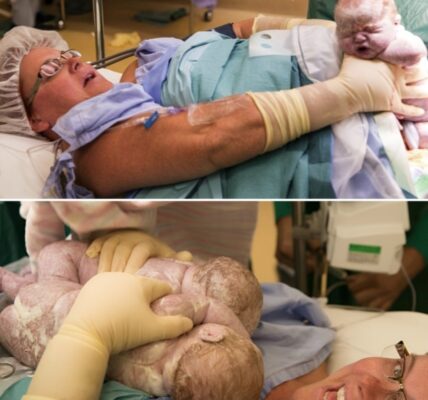
Olaf was born far too early, at just 28 weeks of pregnancy. On his third day of life, catastrophe struck. He suffered cerebral hypoxia and cardiac arrest. In those moments, his parents were told goodbye. Olaf died for the first time that day. Somehow, against all odds, he came back. But survival came at a devastating cost.
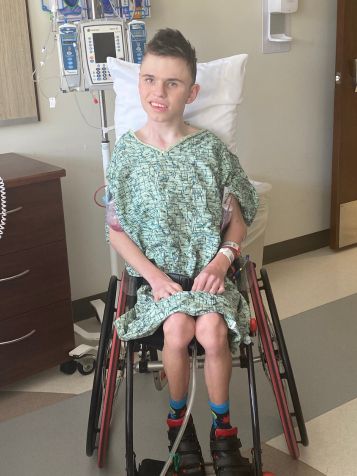
What followed was a cascade of medical horrors no newborn should ever face. Olaf developed sepsis and meningitis. His body was invaded by E. coli bacteria. He suffered a quadriplegic stroke that left deep, permanent damage to his developing brain. Post-hemorrhagic hydrocephalus required the placement of a peritoneal shunt to keep pressure from crushing his brain. Alongside this came anemia, retinopathy, and ultimately a diagnosis of cerebral palsy. From his earliest days, Olaf’s life became a constant fight—for breath, for stability, for another day.
His parents, Izabela and Robert, have already said goodbye to their son three times.
And yet, Olaf stayed.
As the years passed, survival did not mean peace. Olaf’s childhood was shaped by operating rooms instead of playgrounds. Over his 17 years of life, he has undergone countless complex surgeries—on his heart valve, his eyes, his spine. Each procedure carried hope, and each carried fear. Each one asked the same impossible question: would this finally ease his suffering, or would it create new pain?
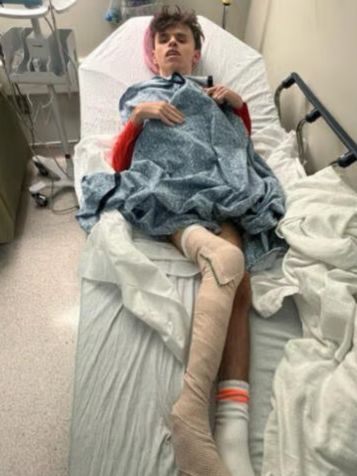
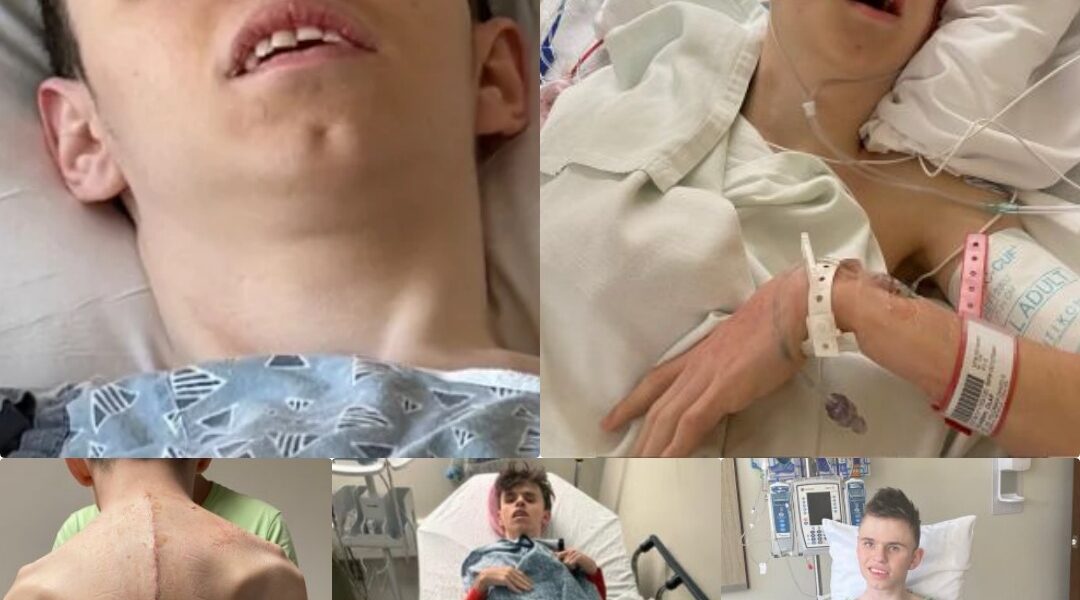
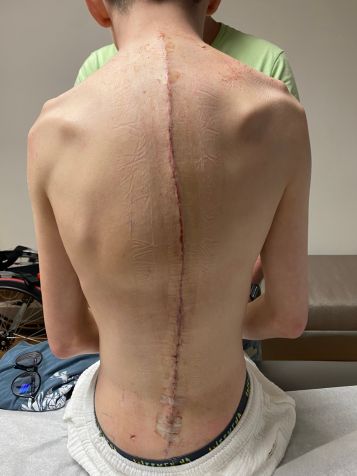
When Olaf was six, another devastating challenge emerged. His spine began to curve rapidly, developing severe kyphoscoliosis. The deformity crushed his internal organs, stealing his breath and making eating painful. By 2022, his condition had become life-threatening. Surgery was the only option left.
At the Paley Clinic in the United States, Olaf underwent a spinal operation that quite literally saved his life. For the first time in years, his parents saw something they had almost forgotten how to imagine: relief. Olaf could breathe deeply. He could eat without pain. His organs returned to their proper place. He began a new chapter—one that felt, finally, like hope.
But with Olaf, happiness has never been allowed to last for long.
In 2024, another surgery became necessary—a femoral derotation intended to protect his spine and loosen the leg muscles that had been painfully tense for years. The goal was to help him move with less pain, to preserve what progress he had gained. Instead, a catastrophic complication occurred. Olaf’s peroneal nerve was damaged.
The consequences were brutal.
His leg shortened. His foot twisted into a painful clubfoot position. The pain became constant, unrelenting. Olaf stopped sleeping at night. The joy drained from him. Even singing—something he loved deeply—no longer brought comfort. And as if that weren’t enough, his epilepsy returned with terrifying force, the seizures growing more frequent and more severe.
An urgent gluteal muscle transplant became necessary. The cost alone exceeded 200,000 PLN, followed by six months of intensive rehabilitation costing another 100,000 PLN. Travel required special arrangements because Olaf must remain bedridden. And even this is not the end—another tibial derotation surgery still lies ahead.
Still, his parents did not stop fighting.
In April 2025, Olaf underwent the muscle transplant and additional leg surgery. The excruciating pain he had been living with finally eased. For the first time in a long while, the agony that ruled his nights loosened its grip. It was a small victory—but for this family, it meant everything.
Yet the epilepsy remained, violent and relentless.
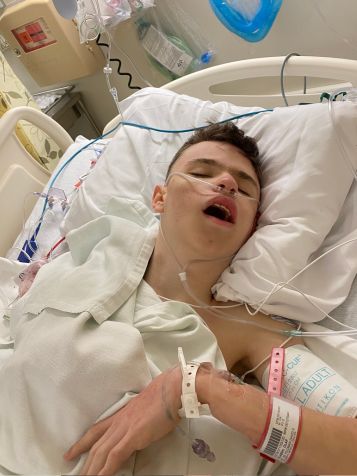
During their stay in the United States, doctors told Izabela and Robert about something that felt almost unreal: NeuroCytotron therapy—an innovative neurological treatment offered in only one place in the world, in Monterrey, Mexico. The therapy aims to rebuild damaged neuronal connections in the brain, connections destroyed in Olaf’s case by his quadriplegic stroke. For children like Olaf, where traditional medicine has exhausted its options, this treatment offers something rare and dangerous to hope for: real neurological recovery.
Thanks to funds raised earlier, Olaf was able to complete his first NeuroCytotron protocol.
The results were impossible to ignore.
Day by day, small but undeniable changes appeared. Olaf became calmer, more focused. His vision improved—he could see more clearly at a distance. His speech became more logical; he began forming sentences, choosing words more accurately, relating better to situations around him. His sleep deepened. For the first time, he began sleeping on his back, stretching after waking—something he had never done before. His facial expressions softened; spasticity eased. He even began closing his mouth, which had previously remained constantly open.
These changes may sound small to the outside world. For Olaf’s parents, they were monumental.
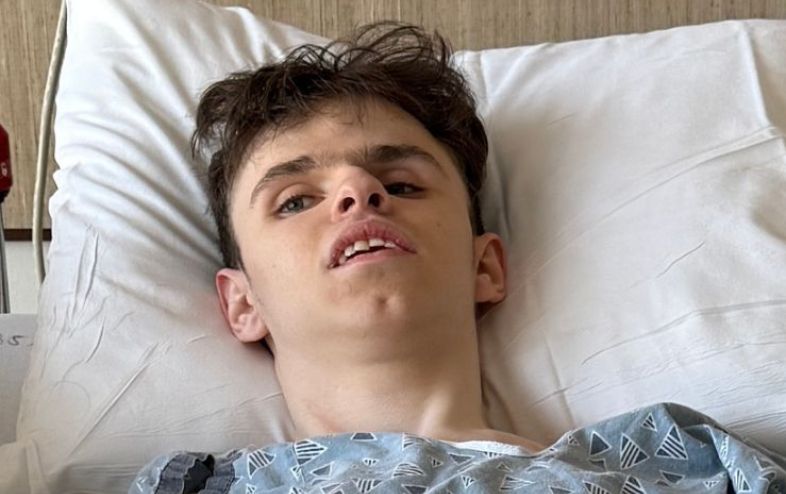
Olaf has now qualified for a second NeuroCytotron protocol, scheduled for April 2026. But the cost is staggering—approximately 300,000 PLN per cycle, not including travel and accommodation. And Olaf needs four more cycles.
The gluteal muscle transplant, heartbreakingly, did not deliver the results doctors hoped for. His leg remains shorter. His foot remains deformed. His parents are now seeking help at another clinic in the United States.
They are exhausted.
They are overwhelmed.
They are terrified.
But they are not giving up.
Olaf’s life has been defined by pain—but also by resilience that defies explanation. He is living proof that even when medicine says “there is no hope,” the human spirit may still have something to say. His parents have poured everything they have—emotionally, physically, financially—into keeping him here, comfortable, and fighting.
They are asking for help not because they want miracles, but because they believe Olaf deserves a chance at less pain, fewer seizures, and more dignity in his life.
This is not just a medical battle.
It is a fight for quality of life.
For peace.
For hope.
And as long as Olaf is still fighting, his parents will fight with him—no matter the cost.