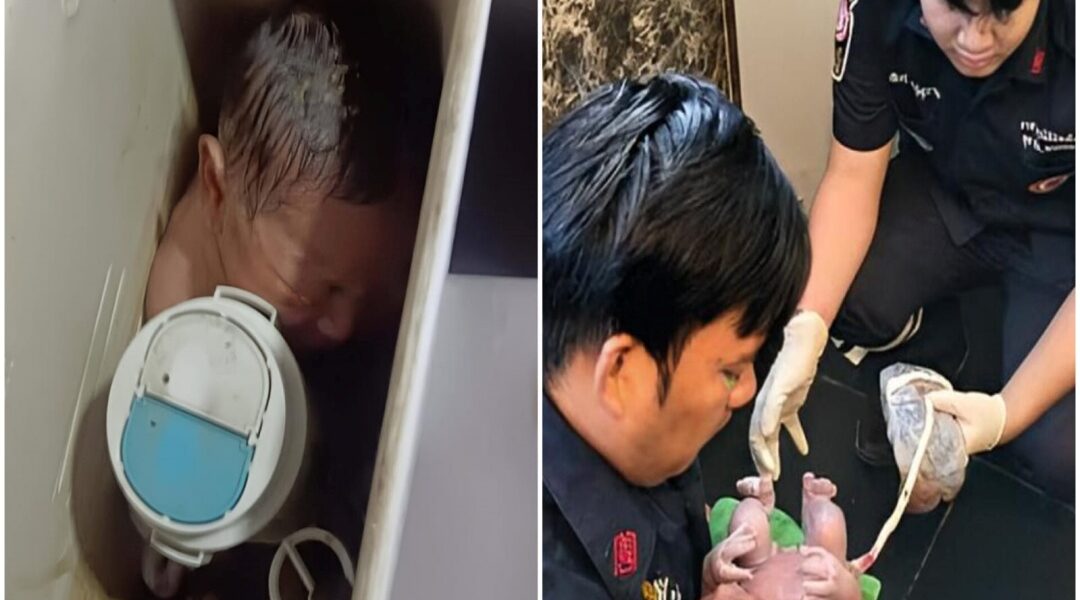

On November 15, 2025, an ordinary cleaning shift turned into a moment of extraordinary heroism in Bangkok, Thailand. A housekeeper was performing her routine duties on the third floor of an office building when she noticed a faint, almost imperceptible crying coming from the restroom. At first, she thought it might be a stray animal or even her imagination. But the sound persisted — a fragile, tiny cry that demanded attention. Following the noise, she lifted the lid of the toilet tank, and her eyes widened in disbelief: a newborn baby girl was inside, partially submerged in water, naked, and wriggling. The infant’s tiny hands were pale and wrinkled, signs of prolonged exposure to water and distress. Investigators later estimated that she had been placed there shortly after birth, her life hanging by a thread.

Emergency responders were called immediately, and officers from Lat Krabang Police Station arrived around 11 a.m. The baby was carefully removed and transported to Sirindhorn Hospital, where medical staff confirmed that she weighed approximately six pounds and had miraculously survived without serious injuries. According to Police Captain Kritsada Saikhong, the infant was less than a day old when found. “She was clearly a newborn,” he said, “but there was no sign of her mother. We are investigating to determine who abandoned her.” Thai law classifies child abandonment as a criminal offense, with penalties under Section 306 of the Penal Code, including up to three years in prison, a fine, or both. Authorities are reviewing CCTV footage to identify anyone who entered the building and used the restroom that day.

The survival of the baby is nothing short of miraculous, highlighting how small actions can mean the difference between life and death. The housekeeper, by simply listening carefully and following her instincts, saved a life that might otherwise have been lost. The baby’s rescue immediately drew attention on social media, with many praising the cleaner’s vigilance and the swift response of local authorities.

This shocking incident bears a striking resemblance to another remarkable newborn rescue that occurred earlier this year in Rio de Janeiro, Brazil. There, sanitation workers were collecting garbage early in the morning along the road connecting the neighborhoods of Quintino and Cascadura. As they emptied a bin into their truck, one worker noticed a bundle wrapped in a blanket that he initially assumed was a toy doll. When the bundle moved and began to cry, the crew realized that a newborn baby had fallen into the trash and required immediate help. They named her Vitória, and the workers were profoundly affected by the experience. “Just knowing we saved her life was overwhelming,” said Samuel Santos, one of the sanitation workers. Another worker, Anderson Nunes, who has spent 16 years in the sanitation service, shared that he hoped to visit Vitória and her family one day to see the child they had rescued.

Both cases underscore the extraordinary vulnerability of abandoned infants and how random acts of attention, vigilance, and quick action can be lifesaving. In Thailand, the newborn’s survival is a testament to the crucial role played by ordinary people who notice the small, quiet signs that could indicate someone in danger. In Brazil, the chance observation of a bundle in a trash truck led to another child being given a second chance at life. In each scenario, the lives of these newborns hinged on the split-second decisions of people who noticed and acted.
While authorities continue to investigate the circumstances of the Bangkok case, the focus remains on the incredible survival of the baby. Medical staff at Sirindhorn Hospital are monitoring her carefully, ensuring that she receives every necessary check-up and care to thrive despite the traumatic start to her life. The community has been deeply moved, expressing hope that her mother or family can be located safely and that justice will be served if the abandonment was intentional.
These events also raise awareness about the dangers of abandoning newborns and the need for public education on safe alternatives, such as hospital surrender programs or safe-haven laws. Both incidents are stark reminders that when life hangs by the slimmest thread, awareness, action, and compassion can create miracles that otherwise seem impossible.
Ultimately, the survival of these infants highlights not only the vulnerability of the youngest among us but also the extraordinary impact that ordinary people can have when they act with vigilance and care. In Bangkok, a simple act of listening and following instincts saved a newborn girl’s life. In Brazil, sanitation workers unwittingly became heroes when they noticed a tiny bundle in their truck. Both stories resonate worldwide as testaments to human compassion and the fragile, precious nature of life.
Nola, 81, Worked Her Whole Life to Survive — Until the World Stopped and Helped Her Breathe 2729

At 81, many dream of rest. They imagine gentle mornings, slow walks without the weight of schedules, afternoons by the sea, the sweet quiet of retirement. But for
Nola Carpenter, that dream never existed. Every day, for over twenty years, she faced another dawn not with anticipation but with duty—working long hours in the back of a supermarket, lifting boxes, stocking shelves, enduring endless shifts, all while carrying a mortgage that had never been fully paid.

It wasn’t passion. It wasn’t choice. It was survival. Every day demanded more than strength—it demanded silence, perseverance, and resilience. Nola bore it all without complaint. She asked for nothing. Applause was unnecessary. She moved with quiet dignity, a life defined by duty rather than desire.
Until one day, something shifted.

A young coworker noticed her during a break. Nola was seated in the staff room, eyes weary but steady. Something about her presence, the weight she carried silently, compelled him to act. He recorded a short video and shared it online with a few words:
“Life shouldn’t be this hard.”
The response was instantaneous. Thousands of hearts connected with Nola’s story. People shared the video, commented, donated. Within 24 hours, over $100,000 was raised. The donations kept coming, surpassing
$186,000, enough to lift the weight that had pressed on her for decades. Enough to give her freedom.
For the first time in years, Nola could stop. She could leave her job, pay off her mortgage, and breathe. The life she had been denied—of choice, of ease, of dignity in her old age—was suddenly possible. A lifetime of sacrifices could finally be met with security and comfort.

Even in her relief, Nola’s heart remained humble. She promised to return to the supermarket occasionally during the holidays, but only if she wanted to—not out of necessity. Those coworkers, once a second family born of proximity and routine, had become cherished companions, but now she was free to choose.
Her story is a reminder of several truths. First, no one should reach old age burdened by the struggle merely to survive. Dignity is not something earned through exhaustion; it is a right that must be protected. Second, the impact of small, thoughtful actions—sharing a video, noticing someone’s unseen hardship—can ripple outward to create monumental change. One glance, one act of empathy, can rewrite a life.

Nola Carpenter’s life, once defined by relentless labor and quiet perseverance, now stands as a testament to human compassion and societal responsibility. It is a story of resilience rewarded, of decades of endurance meeting the generosity of a world willing to see. It reminds us that sometimes, we only need to look, truly see, and act. Because even the smallest gesture, when offered with heart, can change everything.
In the end, Nola can finally live her life on her own terms—free from the burdens of obligation, free to choose rest, joy, and dignity. And the world, through a simple act of noticing and sharing, proved that it is never too late to make a difference.