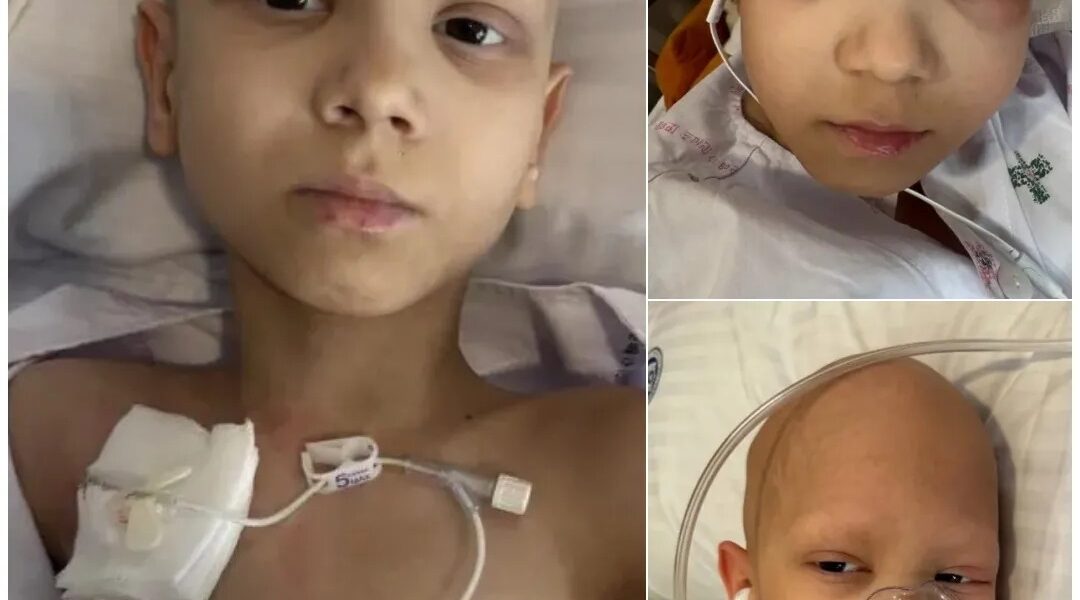

He should be outside, running barefoot through sunlit fields, chasing butterflies, or building castles in the sand with friends. Instead, five-year-old Kostya lies in a hospital bed, surrounded by the steady hum of machines, the cold scent of antiseptic, and a world far too small for a child whose dreams are anything but small.
For five long years, hospitals have been his second home. His tiny body, weakened by relentless treatments, has endured pain that no child should ever face. His mother, Anya, has been there for every injection, every blood test, every sleepless night, clinging to one impossible hope: that one day, her son could live like any other child. But now, that hope is slipping away.

In recent days, Kostya’s condition has taken a frightening turn. His blood levels have dropped sharply, his oxygen saturation has fallen dangerously, and doctors are fighting to stabilize him hour by hour. The child who once laughed at cartoons now lies quiet, his small hand gripping his mother’s, carrying a fear too heavy for words. He’s tired—tired of hospitals, tired of needles, tired of battling a disease that never seems to relent.

“He doesn’t want to go back,” his mother whispers. “He’s afraid of the walls, of the machines. He just wants to be home.” But home isn’t an option—not now. The progression of his illness is so rapid that hospitalization is unavoidable. Each test brings new numbers, darker than the last. Every hour feels like a countdown. The risk of infection rises, and his frail body has little strength left to fight.

For most parents, bedtime is a simple act: tucking a child in with a kiss. For Anya, it means sitting beside Kostya’s hospital bed, praying that her son will still be breathing in the morning. She hasn’t slept properly in months. Her eyes are swollen, her voice hoarse from crying. Yet she remains composed—because mothers don’t get to crumble when their child’s life depends on them. Her phone overflows with messages from doctors, pharmacies, and donors—reminders of bills she cannot pay and deadlines she cannot miss. Every treatment, every injection, every test costs more than she can afford. Yet when asked what she wants most, her answer is simple: “Just relief for my son. That’s all I pray for—that the pain will stop, even for a little while.”

Kostya’s story began when he was barely a year old, a time when children are supposed to be learning to walk, to speak, to explore the world. Instead, he was diagnosed with a rare and aggressive form of blood cancer, one that attacks the immune system and leaves the body defenseless. Since then, his life has been a blur of hospital rooms, transfusions, chemotherapy, and constant monitoring. There were moments of hope—when numbers looked good, when doctors smiled and said, “He’s getting stronger.” But the cancer always returned, each time crueler than before. Through it all, Kostya has fought with astonishing courage. He smiles when he can, jokes with nurses, and reassures his mother that he will get better, even when his body tells a different story. He still dreams—of going to school, of playing soccer, of celebrating a birthday without needles, machines, or doctors looming over him. But dreams are fragile when reality keeps knocking at the door.

There’s one word more haunting than “cancer” for Kostya’s mother: money. The next phase of treatment—a complex combination of medication and bone marrow therapy—could save his life. But the cost is staggering. Anya has sold everything she owns—jewelry, furniture, even the family car. Friends have helped where they could, but the bills keep mounting. Without this critical treatment, doctors warn, Kostya will not survive. His mother sees the signs daily: pale skin, trembling hands, shallow breaths, the weakening body of a little boy whose life hangs in the balance. She is living a nightmare no parent should endure: watching her child fade away when a cure exists, yet being powerless because of the prohibitive cost.

For most people, a hospital is a place of healing. For Kostya, it is a place of fear. He knows every hallway, every smell, every mechanical beep. He knows the pain each needle brings and the way the nurses whisper when numbers drop. “Please, no more,” he sometimes whispers when the IV cart approaches. Then, clenching his tiny fists and closing his eyes, he mutters, “Okay, let’s do it.” That’s who he is—a fighter in the body of a child. He dreams of being a firefighter one day. “Because firefighters save people,” he tells his mom. “Like you’re saving me.” Anya forces a smile every time he says it, knowing that right now, she’s the one who needs saving.

The doctors are doing everything they can, but medicine has its limits. The biggest threat now isn’t just the cancer—it’s time. Each day without treatment increases the risk of relapse. Each relapse lowers the chances of survival. The bone marrow therapy that Kostya desperately needs must begin immediately. The donor is ready. The hospital is ready. But the money isn’t. The bill sits on the table like a silent sentence, a number so large it might as well be another language. “How do you put a price on your child’s life?” his mother asks. She doesn’t expect an answer. There isn’t one.

She’s not asking for miracles, only compassion. Help to cover the next phase of treatment. Enough support to keep her son alive long enough to see another birthday, another sunrise, another smile. Because no parent should have to watch their child die knowing that money could have saved them. Kostya’s story isn’t just about illness—it’s about injustice. About a world where a five-year-old boy has to beg for his life while adults debate numbers and paperwork. He doesn’t understand why he’s sick. He just knows he wants to live. And that, somehow, should be reason enough.

When asked how she keeps going, Anya says, “Because he’s still here.” She listens to the rhythm of his breathing, the faint rise and fall of his chest, the fragile proof that her child is still fighting. That is all the motivation she needs. She dreams of the day she can finally take him home—not for another hospital break, but for good. A day when she can cook his favorite meal, tuck him into bed, and hear him say, “Good night, Mama,” without the sound of machines in the background. It’s a small dream—but right now, it is everything.

We can’t cure cancer overnight. But we can give Kostya a chance—a chance to keep fighting, to grow, to live. He doesn’t need pity. He needs help. Every donation, every share, every prayer brings him one step closer to the miracle his mother has been begging for. He has the heart of a warrior, but even warriors need an army behind them. He’s tired. He’s scared. But he hasn’t given up. And neither should we. Because sometimes, the fight for one small life can remind the world what it means to be human.
Help Kostya keep his promise to live—because every child deserves more than pain,