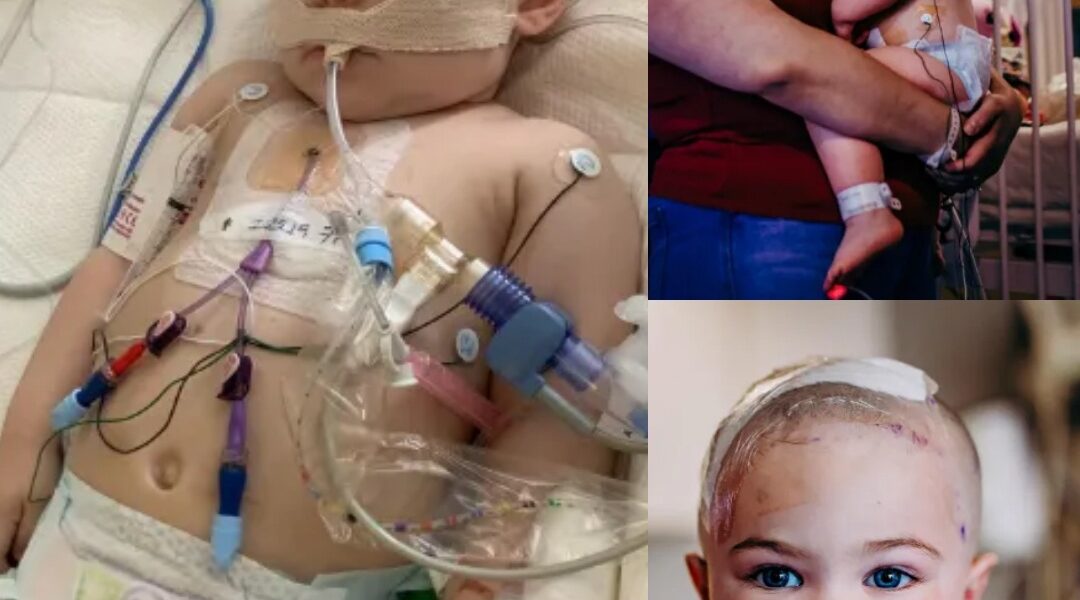

There are moments in life that divide time forever into before and after. For our family, that moment came when our daughter, Jocelyn, was just seventeen months old. She was still a baby—barely learning how to say new words, still discovering the world with wide eyes and curious hands—when childhood cancer entered our lives without warning. One day we were parents planning for her first day of preschool and birthday parties. The next, we were thrust into a world filled with scans, specialists, and words no parent should ever have to hear.
The diagnosis was ATRT—Atypical Teratoid/Rhabdoid Tumor. Rare. Aggressive. Devastating. The doctors explained it carefully, but no amount of softness could dull the impact. Brain cancer. In our baby. We nodded, asked questions, and tried to stay strong, but inside, everything shattered. Seventeen months old should mean stuffed animals and bedtime stories, not oncology wards and surgical consent forms.
Suddenly, our lives were filled with medical terms instead of lullabies. MRI results replaced milestone charts. We learned how to read monitors, how to recognize the sound of alarms, how to hold our breath while waiting for doctors to speak. The childhood cancer world has its own language—one learned quickly, painfully, and without choice.

Jocelyn’s first brain surgery came swiftly. Watching your child wheeled away into an operating room is a kind of terror that cannot be described—only endured. We clung to hope, to statistics, to the belief that modern medicine could save her. When she came out of surgery, wrapped in wires and bandages, we told ourselves this was the beginning of healing.
Over the next two years, Jocelyn endured eighteen different chemotherapy drugs. Eighteen. Her tiny body, barely built for toddlerhood, fought battles meant for no one—especially not a child. She lost her hair, her appetite, her energy. But she never lost her light. Even on the hardest days, she found ways to smile, to reach for us, to remind everyone around her that she was still a child who deserved joy.
Then came six weeks of proton radiation. Every session required precision, sedation, and courage far beyond her years. We held onto hope fiercely. We told ourselves that this treatment—this one—would be the turning point. We celebrated small victories: stable scans, good blood counts, moments when she laughed despite everything.
When traditional treatments failed, we turned to immunotherapy. Two different drugs. Two more chances. Each time, we dared to believe. Each time, we waited. Waiting became its own form of suffering—waiting for results, waiting for answers, waiting to see if cancer would finally loosen its grip.
In total, Jocelyn underwent five brain surgeries. Five times her skull was opened. Five times we signed papers knowing the risks but refusing to give up. Each surgery took something from her—strength, comfort, innocence—but never her spirit. She fought with everything she had, even when her body was tired.
Hospitals became our second home. Birthdays were celebrated beside IV poles. Holidays passed under fluorescent lights. We learned which nurses could make her smile, which songs soothed her fears, and which moments were precious enough to remember forever. The outside world continued, but ours revolved entirely around her survival.
People often call children with cancer “brave,” but Jocelyn was more than that. She was resilient in a way that defies understanding. She endured pain without knowing why. She trusted us completely. She taught us what true strength looks like—not loud or fearless, but quiet, enduring, and full of love.
There comes a moment in some cancer journeys when hope changes shape. It becomes less about cure and more about comfort. Less about winning and more about loving deeply for as long as possible. When doctors told us the treatments had failed, our hearts broke in ways we didn’t know were possible.

Jocelyn died when she was three years old. Three. An age when children should be running, learning, and dreaming. Cancer stole her future, her laughter yet to come, the person she would have grown into. No parent should ever have to bury their child. No words can fully capture that loss.
After she was gone, the house felt unbearably quiet. Toys remained untouched. Clothes still smelled like her. The world kept moving, but ours stood still. Grief is not just sadness—it is love with nowhere to go. And we loved her more than words can ever express.
Through this journey, we met other families living the same nightmare. Parents who understood without explanation. Children who fought beside her. The childhood cancer community is bound by shared pain, shared hope, and shared loss. It is a community no one chooses, but once inside, you are never alone.
Childhood cancer research is underfunded. Rare cancers like ATRT receive even less attention. Families are forced to fight not only the disease but the lack of resources available to stop it. Awareness is not just about ribbons or posts—it is about saving lives.
Today is not only for Jocelyn. It is for the children still in hospital beds, still enduring treatments, still fighting battles they never asked for. It is for the parents sleeping in chairs, whispering prayers in the dark. They need support. They need hope. They need us.

And it is for the children who didn’t survive. The ones whose names deserve to be spoken. The ones who mattered deeply, fiercely, endlessly. Jocelyn matters. Her life mattered. Her fight mattered.
Use today to listen to cancer stories. Donate to an organization fighting for better treatments. Share awareness. Advocate for research. Stand with families who are hurting. Childhood cancer is not rare to those living it—and it will not stop unless more people care.
Our daughter lived a short life, but it was filled with love, courage, and meaning. She changed us forever. If her story moves even one person to act, to give, to care—then her legacy continues. And that is how we honor her.
Noah – Our Brave Little Soldier Who Taught Us Strength, Hope, and Love.415

On the day of my 20-week scan, I was filled with excitement and anticipation. I couldn’t wait to see my baby again, and I couldn’t wait to find out their gender. I never imagined that those simple, joyful thoughts would be replaced with fear and uncertainty in an instant.
“There’s something wrong with the baby’s heart, and you need to go for an urgent scan at a specialist hospital tomorrow,” the sonographer said. My heart sank. I barely slept that night, trying to comprehend what those words could mean.

The following day, at the specialist hospital, my baby — our little Noah — was diagnosed with a large ventricular septal defect (VSD), tetralogy of Fallot (ToF), and a right aortic arch (RAA). Words like VSD, ToF, and RAA became part of our daily life. From that moment on, my pregnancy was a whirlwind of appointments: growth scans, amniocentesis, detailed heart scans, blood tests, and an endless list of other checks. Each visit brought new medical terminology to digest, each conversation a mix of hope and fear.
I found myself under the care of three different hospitals, sometimes attending up to three separate appointments a week across different locations. As a first-time mum who had recently decided to parent solo, and who had moved hundreds of miles away from family and friends, it was overwhelming. I often felt as if I was navigating an endless storm with no safe harbor in sight.

Then, in July 2024, Noah arrived via C-section. Holding him for the first time, I felt a mixture of relief and worry. He was immediately taken to the NICU, where he was closely monitored around the clock. For a week, we watched from afar, only able to touch him briefly. When we were finally allowed home, our lives became a delicate balance of love, worry, and hospital appointments.
Over the following months, Noah faced numerous challenges. His heart rate would spike dangerously high while feeding, sometimes reaching 205 beats per minute. Breathing difficulties forced ambulance calls. He was fitted with an NG tube and placed on diuretics to support his heart. Through it all, the community nurses and hospital teams provided guidance and reassurance, helping us navigate the unknown.

Then came the hardest day — October 2024. Noah’s life-saving surgery was scheduled. I carried my little soldier down to theatre, trying to stay strong as he laughed and smiled, showing off his personality to the staff. Then, the moment came: I had to leave him. A part of me felt torn away.
For over eight hours, my mum and I walked the city streets, trying to distract ourselves, tears mingling with nervous laughter. Then the call came — he was out of surgery and in paediatric intensive care. Rushing through hospital corridors, I saw him: my tiny boy, intubated, wires and tubes covering his little body, a single tear tracing down his cheek.
Noah spent three intense days in PICU. His potassium levels were unstable, and pulmonary stenosis complicated his recovery. He required an external pacemaker to support his heart. Gradually, the storm calmed. He was moved back to the ward, the pacemaker removed, his chest drain and arterial lines taken out. Finally, I could hold him properly, a real cuddle that meant everything.

Even now, Noah still faces challenges with narrowed arteries, and there may be further medical interventions in the future. But for the moment, we are soaking up every precious second with our happy, vibrant, and adventurous little boy. His laughter, his curiosity, his sheer joy for life is inspiring.
We are endlessly grateful to everyone who helped us along this journey — from the sonographer who first spotted the heart issue, to the Tiny Tickers team who provided support packs and peer groups, to the surgeons, nurses, and hospital staff who cared for Noah. They are real-life superheroes.
To anyone facing a similar journey: These little soldiers are stronger than we can imagine. The medical teams are heroes. And you — yes, you — are far stronger than you believe. Noah’s story is proof that love, hope, and courage can carry a family through the darkest storms, and that even the smallest hearts can teach the biggest lessons