
In Fayette, Alabama, a quiet town cradled by the rolling hills and the hum of everyday life, a small boy named Carson Curry has already endured more than many could imagine in a lifetime. At just four years old, Carson’s life story is one of struggle, resilience, unwavering faith, and the indomitable will of a child determined to survive. Born with Hypoplastic Left Heart Syndrome (HLHS), a rare and often fatal congenital heart defect, Carson entered the world fighting for every heartbeat, every breath, and every chance at life.
HLHS is a condition in which the left side of the heart is underdeveloped. The left ventricle, which normally pumps oxygen-rich blood to the body, is too small or absent, forcing the right ventricle to overcompensate. Without immediate medical intervention, infants born with this condition rarely survive the first few days. For Carson, from the moment he drew his first breath, his body was engaged in a battle that would demand courage, medical expertise, and the unwavering support of his family.

Carson’s journey began with surgery. At just seven days old, he underwent his first open-heart procedure. For his parents, Tyler and Ashley Curry, it was a surreal and terrifying experience. “We had spent a week preparing for his arrival, and instead, we found ourselves in the ICU, watching monitors and hearing alarms, hoping and praying that he would survive,” Tyler recalls. The hospital corridors became their world, the beeping of monitors a constant reminder of their son’s fragility.
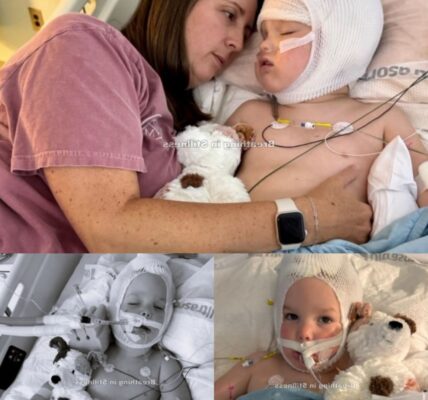
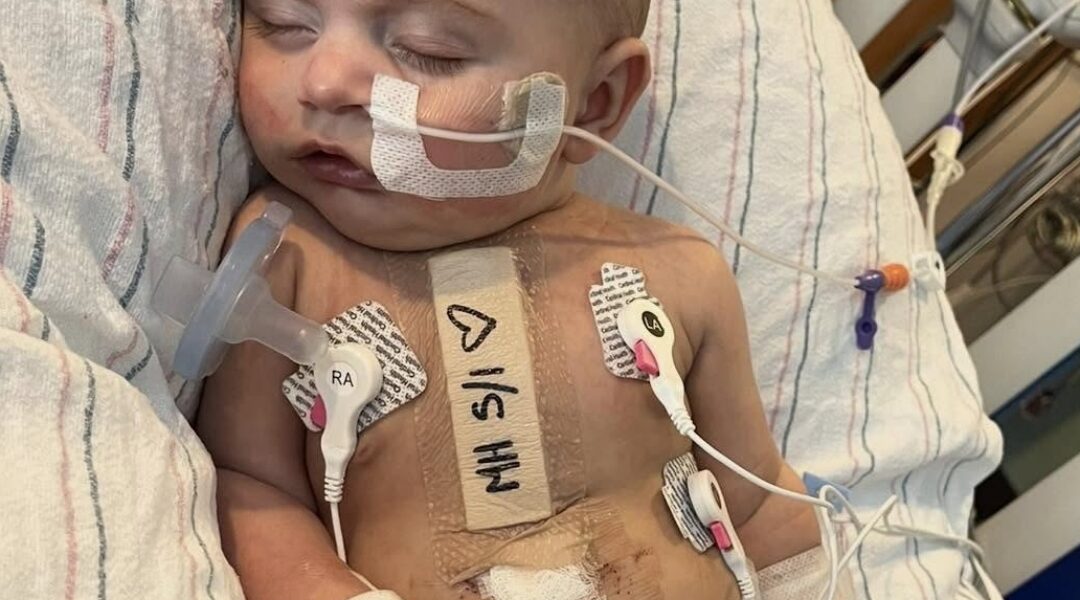
In those early days, Carson’s small body was connected to tubes and wires, his tiny chest marked by surgical incisions, and his life hanging by the expertise of surgeons and nurses. Each moment was weighted with uncertainty. Ashley remembers sitting by his bedside, holding his tiny hand, whispering words of encouragement and faith, hoping that her presence could somehow soothe the pain and chaos surrounding them. Even as professionals worked tirelessly, the Curry family’s belief in miracles anchored them, giving them the strength to endure.
At four months old, Carson faced his second major open-heart surgery. The procedure, like the first, was delicate, extensive, and fraught with risk. It demanded hours of precision, focus, and collaboration among an entire surgical team. Every parent’s worst fears seemed present in the sterile environment of the operating room. Yet, for the Currys, hope was never absent. They clung to their faith and to the love they held for their son. “We knew his heart was fragile, but we also knew that his spirit was stronger than we could ever measure,” Michelle, Carson’s grandmother, reflected.

The first year of life, a period usually filled with milestones—first smiles, first laughter, first steps—was instead a blur of hospital visits, intensive care, and constant vigilance. For Carson, milestones became measured in survival: another stable heartbeat, a day without complications, a successful feeding, or a period of restful sleep. For the Currys, each small victory was celebrated with tears, prayers, and whispered gratitude to the medical team who safeguarded his life.

Then, in December, another unimaginable challenge struck. While at home, Carson suddenly went into cardiac arrest. The nightmare unfolded in seconds. Tyler and Ashley, frantic and panicked, called for help, desperately trying to keep their child alive. First responders arrived swiftly, performing life-saving measures. “Those minutes felt like an eternity,” Ashley recalls, voice trembling. “Every second was filled with fear, with disbelief, with the knowledge that our son’s life hung in the balance.”

Miraculously, Carson’s heart began to beat again. It was, according to the family, nothing short of divine intervention. Michelle, his grandmother, described the moment: “We all believed in miracles, but seeing one happen in front of you, holding your child, is indescribable. Carson came back to us that day, and we knew his story wasn’t finished.” The Currys’ faith deepened, intertwining with the medical care he received, creating a delicate balance of human expertise and spiritual hope.

As winter turned to spring, the Curry family faced yet another arduous challenge. Carson’s heart, still fragile and struggling, required the implantation of a ventricular assist device (VAD), a mechanical pump designed to support his heart until a transplant could be performed. The procedure was a technical marvel, life-saving yet fraught with anxiety for all involved. The days leading up to surgery were filled with preparation, anticipation, and, for the Currys, prayers. They held onto hope with every fiber of their being, envisioning the day their son’s heart would receive the gift of renewal.
After the successful implantation of the VAD, Carson’s life entered a precarious waiting period. Every beat, every movement, was monitored. The Currys’ days and nights blurred together, marked by hospital lights, medical updates, and constant vigilance. Yet amid the uncertainty, a miracle came: a suitable donor heart was found. The possibility of a transplant had arrived, offering a second chance at life for their little boy.
The transplant surgery itself was both triumphant and terrifying. For hours, the family waited outside the operating theater, hearts heavy with hope and fear. Finally, news arrived: the surgery had been successful. Carson’s new heart was functioning, pumping steadily, giving him the life he so desperately needed. Relief washed over the family, tears of gratitude mingling with the exhaustion of weeks spent in limbo. For the first time, they allowed themselves to breathe deeply, imagining the normalcy that could, perhaps, return to their lives.
But life’s trials were not yet finished. Just one day after the transplant, Carson suffered a stroke. The devastating news tore through the Curry family like a storm. Their relief was replaced with terror, their joy with uncertainty. “We had just begun to feel hope,” Tyler said, voice thick with emotion. “And then it felt like the ground beneath us disappeared.” Yet, even in the face of this new obstacle, the Currys refused to surrender to despair. “We now need another miracle,” Michelle whispered, echoing the sentiments of every family member.

Two weeks after the transplant, Carson remained in Children’s of Alabama in Birmingham. Though unable to speak, his progress was evident in small, meaningful ways. He opened his eyes, moved his arms and legs, and displayed signs of awareness. His new heart functioned, giving hope that, with time, care, and the power of faith, he could recover. Every movement, however subtle, was a victory. Every flicker of life was proof that Carson was still fighting, still alive, and still determined to embrace the world.
Waiting, however, is perhaps the hardest part. For Tyler and Ashley, vigilance is constant. They remain at Carson’s bedside day and night, whispering encouragement, holding his hand, and praying with fervent devotion. Family members, like Michelle, provide support, ensuring that hope remains alive, coordinating updates, and rallying prayers. Each passing hour is both a challenge and an affirmation of their commitment to their child.
Faith has been the anchor throughout Carson’s journey. “We believe that God’s got this,” Michelle affirmed. The family’s unwavering belief in divine intervention has shaped their perspective, offering strength when the medical landscape seems uncertain, and reminding them that miracles are not just possibilities—they can be realities.
Carson’s resilience has inspired countless people. Friends, family, and strangers alike follow his journey, moved by the courage of a child so young and by the devotion of a family unwilling to relinquish hope. His story has become more than a medical case; it is a testament to the human spirit, to perseverance, and to the power of love in the face of overwhelming adversity.
Even in moments when he cannot speak, Carson communicates volumes. Every twitch of a finger, every blink of an eye, every sigh carries meaning. Those who love him interpret these signals as declarations of life, silent affirmations that he is aware, that he is fighting, that he knows he is loved. The unspoken language of a child in peril has taught the Currys lessons in patience, empathy, and attentiveness that extend beyond words.
Throughout his life, Carson has endured countless hospital stays, invasive procedures, and the discomfort of medical devices. Yet he has met every challenge with a courage that belies his age. He has endured pain that would test the fortitude of any adult and emerged with an unwavering spirit that inspires all who witness it. Every day, he demonstrates that resilience is not merely a trait but a choice, an act of will fueled by love, hope, and faith.

The impact of Carson’s journey extends beyond his immediate family. His story has touched communities across Alabama, the United States, and even globally, as news of his resilience and medical battles circulates online. Parents facing similar diagnoses draw strength from his example. Medical professionals reflect on the power of determination, observation, and family support. Children see that courage can manifest in even the smallest bodies. Carson has become a symbol—a tiny warrior whose battles remind the world that even when life is fragile, hope can flourish.
Tyler and Ashley have channeled their experience into advocacy and education. They speak openly about the challenges families face with congenital heart defects, emphasizing the importance of early intervention, medical support, and unwavering emotional presence. They encourage other parents to trust their instincts, to advocate fiercely for their children, and to celebrate every small triumph, no matter how modest it may appear.
Carson’s grandmother, Michelle, often reflects on the lessons they have learned: “Life is fragile, unpredictable, and sometimes terrifying. But it is also miraculous, filled with moments that defy logic and heal hearts. Watching Carson fight has reminded us all what it means to truly hope, to truly believe, and to truly love without reservation.”
The Curry family also notes the role of the broader community in Carson’s journey. From medical staff who provide care and reassurance to friends and strangers who send prayers, messages, and encouragement, every gesture contributes to a network of support that sustains the young boy through his trials. Carson’s life has reminded everyone involved that even small acts of kindness can ripple outward, influencing lives in ways that are immeasurable.

Through all the challenges—open-heart surgeries, cardiac arrests, VAD implantation, heart transplantation, and strokes—Carson has never stopped teaching those around him. He has shown that courage is not the absence of fear but the determination to face it. That resilience is not defined by age or size but by spirit. That love, when unwavering and persistent, can nurture life even against the steepest odds.
Carson’s story is also a profound reminder of the intersection between faith and science. Medical interventions save lives, but the belief in something greater, in hope, in miracles, provides the emotional sustenance needed to endure the darkest nights. For the Curry family, these two forces—expert medical care and unshakeable faith—have combined to create a lifeline for their son, reinforcing the idea that miracles, though rare, are not impossible.
At four years old, Carson continues to recover. While his path remains uncertain, every day brings progress—however incremental. He gains strength in his limbs, clarity in his awareness, and moments of joy and laughter that remind everyone watching why life is precious. Playful smiles, squeals of delight at a favorite toy, and the gentle comfort of a parent’s hand serve as testaments to the human capacity for endurance and love.
The story of Carson Curry is a story of the human heart—both literally and figuratively. It reminds us that even the smallest hearts, when supported by love, faith, and medical expertise, can endure and thrive in the face of overwhelming adversity. It is a story that encourages families, uplifts communities, and inspires all who hear it to never underestimate the power of courage, prayer, and perseverance.

In the quiet moments at the hospital, as Carson rests with his new heart beating steadily, his family watches, prays, and whispers encouragement. They know the road ahead may still be filled with uncertainty, but they are ready. They are united. And above all, they believe: their son is strong, their son is resilient, and their son knows, in every fiber of his being, that God has not finished with him yet.

Carson’s journey continues to unfold—each heartbeat a testament to survival, each smile a triumph over despair, and each small movement a quiet declaration of victory. For Tyler, Ashley, Michelle, and everyone touched by his story, Carson Curry is more than a patient or a child with a rare condition. He is a miracle in motion, a living reminder that even in the harshest storms, hope endures, love persists, and life—fragile though it may be—is worth fighting for.
The Tragic Death of Hannah Clarke: A Mother’s Fight for Justice and Change After Losing Her Children

On the morning of February 19, 2020, Brisbane woke quietly, unaware that tragedy was about to unfold.
Thirty-one-year-old Hannah Clarke was driving her three young children—Aaliyah, six, Laianah, four, and Trey, three—to school.
It was a morning routine she had performed countless times, filled with laughter, reminders to buckle up, and gentle encouragements for little hands to hold the seatbelt.
Hannah’s mind was calm, her heart full of love for her children.
She kissed their foreheads.
She whispered her usual words: “Be good, I’ll be back soon.”

She believed they were safe.
She believed the man she had once trusted, her estranged husband Rowan Baxter, would not harm the children she adored.
She could not have imagined the horror waiting for them.
As she pulled out of her parents’ driveway, Rowan approached the car, silently carrying a can of petrol.
Without a word, without hesitation, he poured the fuel over the vehicle.
In seconds, flames consumed the car, erupting into a roaring inferno.
The children, trapped inside, were pronounced deceased at the scene.
Hannah, engulfed in flames and writhing in agony, somehow managed to escape.
Her skin blistered. Her body scorched. Her heart shattered.
Despite excruciating pain, she gave a harrowing account to authorities.
She explained how Rowan had doused the car and ended the lives of their children.
Later that evening, Hannah succumbed to her injuries, leaving behind a void no one could fill.
At the scene, Rowan Baxter ended his own life.
His death closed his chapter, but it left nothing but grief and unanswered questions behind.
The destruction he caused would reverberate through Australia for years to come.

This act of brutality was not spontaneous.
It was the culmination of years of coercive control, manipulation, and escalating violence.
Hannah had endured emotional abuse, isolation, and fear throughout her marriage.
She had fought to survive each day.
She had sought help, legal protection, and custody of her children.
She had documented every threat, every act of intimidation, every lie.

Yet none of that could shield her or her children from the ultimate act of violence.
The system meant to protect victims had failed her.
Her story revealed the gaping flaws in domestic violence safeguards.
In the months leading up to the attack, Hannah had finally made a decision to leave Rowan.
She moved in with her parents, Sue and Lloyd Clarke, seeking refuge and a chance to rebuild a life for herself and her children.
She had done everything right: she planned, she documented, she sought support.

But even those careful steps could not prevent the tragedy that awaited her that February morning.
Hannah’s death and the loss of her children shook the nation.
Australia collectively paused, confronted by a reality many preferred to ignore.
The enormity of domestic violence became undeniable.
Sue and Lloyd Clarke were left to navigate a grief so profound it defied description.
The loss of a daughter and three grandchildren in a single act of cruelty is unimaginable.
Yet, in the midst of their heartbreak, they found purpose.
They refused to let Hannah’s story fade into silence.
They refused to let her death, and the deaths of their grandchildren, be meaningless.
They turned pain into advocacy, grief into action.
They founded Small Steps 4 Hannah, a charity dedicated to raising awareness of domestic violence and advocating for legislative reform.
Their mission was clear: to prevent others from suffering the same fate.
To ensure that victims would have stronger protections.
To push for accountability, education, and empowerment.
Through Small Steps 4 Hannah, Sue and Lloyd worked tirelessly to shine a light on the inadequacies of the legal system.
They lobbied for better support services.
They educated the public on warning signs.
They encouraged victims to speak up and seek help, providing resources for escape and safety.

The story of Hannah Clarke forced the nation to confront uncomfortable truths.
Domestic violence is pervasive.
It affects people across age, class, and background.
It often happens in the places where victims should feel safest—homes meant for love, not fear.
Sue and Lloyd’s advocacy expanded further, leading to the establishment of the Hannah Clarke Foundation, a pivotal initiative under Small Steps 4 Hannah.
The foundation focuses on funding domestic violence prevention research.
It provides support services for victims and campaigns for education on abuse.
It advocates for stricter enforcement of laws and better protection for those at risk.
Their work has already impacted countless lives.
It has saved children, empowered parents, and prompted policy discussions at the highest levels.
While nothing can undo the pain of losing Hannah and her children, their efforts have turned tragedy into a platform for change.

Hannah’s story is not only a tale of loss but also of courage.
Her decision to leave an abusive marriage, to seek refuge, and to protect her children speaks to her strength.
Her love for her children remained fierce and unwavering until the end.
The public continues to honor Hannah and her children through memorials, vigils, and charitable events.
Their story remains a stark reminder of the urgent need to address domestic violence proactively.
Every advocate, every social worker, every policymaker is called to action.

Domestic violence is not a private matter.
It is a societal issue that requires collective attention and intervention.
Hannah Clarke’s life and death highlight how critical it is to support victims before tragedy strikes.
Sue and Lloyd Clarke exemplify resilience in the face of unimaginable grief.
They have transformed their sorrow into advocacy that protects lives and raises awareness.
Their voices continue to challenge the systems that failed Hannah, ensuring her legacy inspires reform.

Every life lost to domestic violence leaves an indelible mark.
Every child taken, every parent harmed, every family shattered is a call to society to act.
Hannah’s story is that call incarnate.
Her courage, love, and determination to protect her children shine through the darkness of what happened.
Her memory fuels a movement.
Her legacy saves lives.
Through Small Steps 4 Hannah, policy has shifted.
Awareness has increased.
Victims now have more tools to escape abuse.
Hannah’s death was horrific, but her impact is saving lives and creating change.
Hannah Clarke and her children, Aaliyah, Laianah, and Trey, are remembered not only for the tragedy of their deaths but for the awareness their story has sparked.
They remind the world of the dangers of domestic violence and the importance of early intervention.
Their story continues to touch hearts, change laws, and empower those who might otherwise remain silent.

In the face of unspeakable loss, the Clarke family stands as a beacon of hope and strength.
They prove that even in the aftermath of unimaginable tragedy, one can turn grief into action.
One can honor loved ones by fighting for others.
One can ensure that no other family suffers the same way.
Hannah’s story continues to inspire.
It is a story of love, of courage, and of a mother’s unwavering fight for justice.
Her children’s memory lives on through the work of their grandparents and the lives they touch daily.

Though her life was cut short, the impact of Hannah Clarke’s choices, her love, and her determination will endure.
Her story is a powerful reminder that domestic violence is real, preventable, and must be addressed with urgency.
It is a call to action for all of us.
Hannah Clarke, and her beloved children, left a legacy beyond tragedy.
Through the tireless advocacy of Sue and Lloyd Clarke, change is happening.
Lives are being saved.
Awareness is spreading.
Systems are being held accountable.

This is their story.
A story of heartbreak, resilience, and justice.
A story that compels society to see, to act, and to protect.
A story that will not be forgotten.

Hannah Clarke’s life, and the lives of Aaliyah, Laianah, and Trey, continue to inspire courage, advocacy, and hope.
Their memory fuels the fight against domestic violence.
Their story reminds us that love and action can rise from the ashes of tragedy.
Hannah’s voice echoes still, urging society to protect its most vulnerable.
And through every step of advocacy, through every campaign, through every change in policy, their legacy grows.
From unimaginable loss, a movement was born.
From heartbreak, hope has emerged.
From tragedy, a nation learns, acts, and fights for the safety of its children.

Hannah Clarke’s story is far from over.
Her life and her children’s lives continue to drive change, awareness, and protection for countless others.
Though the pain of February 19, 2020, will never fade, their story ensures that their deaths were not in vain.
They remain a symbol of courage, a reminder of the stakes, and a call for justice that resonates across Australia and beyond.