
Ellie’s journey began before she even took her first breath. At 20 weeks, during a routine scan, her parents were told she had a rare heart defect — transposition of the great arteries (TGA). It was a diagnosis that turned hope into fear in an instant.
Her mother, Lauren, recalls the day vividly. “I couldn’t believe it. Everything felt like it was slipping away,” she says. The doctors explained that without immediate intervention, Ellie’s chances were perilously low.
Ellie was induced at 39 weeks. She came into the world fragile but surprisingly strong. Her early response to treatment gave her doctors a glimmer of hope. A cancellation slot allowed her first life-saving surgery at just five days old.
The day before surgery, a new complication emerged. One of her coronary arteries was embedded into the aorta — a condition so rare that survival rates plummeted. The surgeons reassured Lauren and her family, but the uncertainty was overwhelming.

The operation was complex, but Ellie survived. Her parents celebrated, believing the worst was behind them. Yet their relief was short-lived. Pulmonary hypertension and chylothorax kept her sedated and tethered to machines, her tiny body still fighting.
Just as the family began to breathe, disaster struck again. On what should have been a routine attempt at breastfeeding, Ellie suffered a cardiac arrest. Miraculously, an anesthetist on the ward stabilized her, but this was only the beginning.
Ellie’s next cardiac arrest happened in the cath lab. ECMO, a form of life support, became her lifeline. The sight of their daughter cold and unresponsive in PICU shattered Lauren and her husband, but they refused to give up hope.
The surgeons devised a daring plan: a coronary artery bypass graft normally performed on adults, now adapted for a baby no bigger than a loaf of bread. They compared her coronary artery to the thickness of an arm hair. Against all odds, they succeeded.

For five more days, Ellie remained on ECMO. When she finally came off, the surgeons declared her heart had regained full ventricular function. “A miracle,” they called her. But Ellie’s fight was far from over.
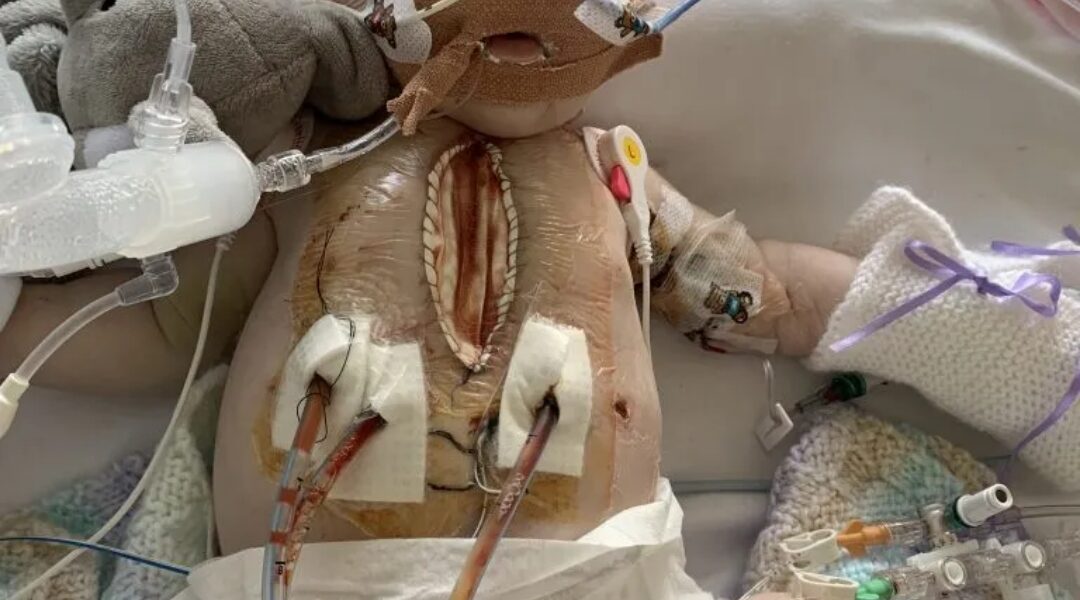
The following day brought necrotising enterocolitis (NEC), a devastating intestinal infection. Surgery was urgent, even with her chest still open from ECMO. The statistics were grim, but Ellie endured. A stoma was placed — a small reminder of the battles she had already won.
Recovery in PICU was relentless. A collapsed lung, repeated chylothorax, and diaphragmatic palsy challenged her tiny body. Each procedure and intervention demanded courage far beyond her age. Through it all, a dedicated medical team stood vigil.
Transitioning to the cardiac ward should have been a relief. Instead, feeding difficulties and stoma output slowed her progress. TPN, intravenous nutrition, became her main source of sustenance. Her parents stayed close, anxious yet determined.
Just before planned stoma closure, another crisis hit. Ellie developed rigors and a racing heart while resting. Tests revealed an infection in her Hickman line. Targeted antibiotics became her new armor in a seemingly endless battle.
Days later, Ellie was finally ready for surgery. The Hickman line was removed, her stoma closed, and her recovery accelerated. After twelve weeks in the hospital, Lauren and her husband brought Ellie home for the first time, their hearts heavy with exhaustion yet full of relief.
The family’s ordeal changed them forever. Ellie’s journey taught them the fragility and beauty of life, the importance of kindness, and the power of community. They have committed themselves to raising awareness for congenital heart disease, ensuring other families can face hospital journeys with information and support.
Ellie’s story is one of resilience beyond comprehension. Every setback was met with courage; every procedure was a battle she refused to lose. Her fight has inspired thousands to recognize the strength in even the smallest lives.

For Lauren, sharing Ellie’s story is both cathartic and purposeful. She hopes that through awareness, more children like Ellie can find the care and hope they deserve. “We will never take a single heartbeat for granted,” she says.
From the brink of death to miraculous survival, Ellie embodies hope. Her tiny heart endured impossibly complex surgery, repeated infections, and life-threatening complications. Each day she thrives is a testament to her will to live.
Ellie’s experience underscores a truth many take for granted: miracles often come in the quiet, relentless battles fought behind hospital doors. It is a story of tenacity, love, and unwavering faith in the human spirit.

Her family now looks to the future with cautious optimism. They know challenges remain, but every milestone — every smile, every breath, every beat — is victory. Ellie is living proof that even the smallest hearts can hold the greatest courage.
In the world of congenital heart disease, stories like Ellie’s are rare and precious. They remind us that science, skill, and hope together can defy the odds. And sometimes, against all probability, life prevails.
Ellie’s fight is far from over, but her survival is already a triumph. It’s a story that leaves the world in awe and families across the globe inspired. Every parent, doctor, and nurse involved witnessed the extraordinary strength of a life determined to endure.

From her first gasp to her homecoming, Ellie’s journey captures the essence of hope. Her parents share their story not to dwell on fear, but to shine a light on the miracles that happen when love, expertise, and faith collide.
Every heartbeat is a reminder. Every smile is a celebration. And every story like Ellie’s brings awareness, compassion, and hope to families facing similar battles.
Her fight continues, and so does the impact of her story. A tiny girl with an enormous heart has shown the world that courage knows no size, and miracles often arrive when we need them most.
A Drowning Dog’s Desperate Struggle for Survival: A Heartbreaking Rescue

There are moments in life when the world seems frozen. When every second stretches into eternity. When hope hangs by a thread, and a single act of compassion can mean the difference between life and death.
This is one of those moments.
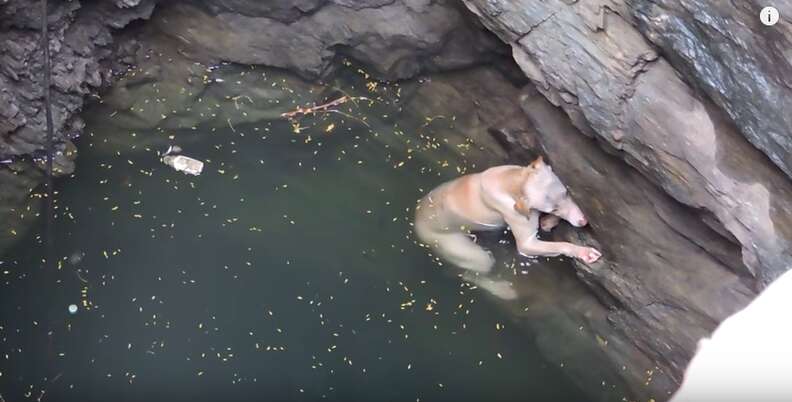
In a quiet, secluded corner, a dog clung desperately to a jagged rock amid a swirling, merciless river. The water surged and churned around her, cold and unforgiving, threatening to pull her under with every passing second. Her small body trembled. Her eyes, wide and full of panic, scanned the distance, pleading for a miracle. Someone—anyone—had to notice her, had to act.
Her struggle was not only for survival. It was a silent cry, a testament to the instinct to live, to fight, and to hope even when everything seems lost.

The Struggle for Survival
The morning had started like any other, but for this dog, it had quickly turned into a nightmare. Perhaps she had wandered too far, maybe the current had caught her by surprise. Whatever the reason, she found herself trapped in a perilous predicament—her claws gripping the slippery rock, her tiny body nearly submerged in icy water.
The river was merciless. Murky and swirling, it reflected no light, only a harsh, gray blur that seemed to mock her efforts. Every shift of the rock threatened to send her tumbling. Every wave that lapped against her legs sapped her strength. Yet, she refused to let go.
Hours passed. Her fur, soaked and matted, clung to her shivering frame. Each breath became a laborious task. Her heartbeat echoed in the cold, silent expanse around her. She was utterly alone—except for the tiny flicker of hope that someone might see her, might understand, might save her.
In the quiet desperation of that moment, the connection between humans and animals becomes visible. It exists not in words but in the possibility that help might arrive. And then, finally, it did.
The Rescue Effort Begins
Voices broke the oppressive silence. Footsteps echoed across the narrow, uneven path leading to the river. A team of rescuers had arrived, alerted by a concerned bystander who had witnessed the dog’s struggle.
The scene was tense. The dog was exhausted, her trembling body perilously close to being swept away. The team moved cautiously, acutely aware that every step mattered. They called out softly, urging her to hold on, to trust them even in her terror.
“Stay calm,” one rescuer said. His voice was gentle but urgent. “We’ll get you out. Hold on, just a little longer.”
Navigating the slippery rocks, water splashing against their legs, the rescuers approached. Every movement was measured. They knew the dog’s trust was fragile, her fear acute. One false motion could push her over the edge.
And then, for a fleeting moment, their eyes met. Recognition passed between them. She understood—somehow—that help had finally arrived. That hope was no longer a distant dream.

The Moment of Connection
Slowly, one rescuer extended his hand. His touch was soft, soothing. His voice, low and calm, whispered words of reassurance. The dog’s trembling subsided slightly. Fear still lingered, but for the first time, there was a flicker of trust.
Her tiny paws clung to the rock a little less tightly. Her body relaxed, ever so slightly. The human presence offered warmth, safety, and a promise that she was no longer alone.
With deliberate care, the rescuer lifted her from the rock, cradling her small, soaked body. Every inch of her shivering form was a reminder of the battle she had endured. Yet, even in her exhaustion, there was a spark—a spark that spoke of survival, of trust, of the human-animal bond.
As she nestled against the rescuer’s chest, she finally allowed herself to breathe fully. For the first time in hours, perhaps for the first time in her life, she felt secure. The storm of the river had not broken her spirit.
The Emotional Toll
This was not just a rescue; it was a moment of profound human-animal connection. The rescuers stood silently, breathing alongside her, feeling the weight of what had just occurred. Her eyes, once filled with panic and fear, now glimmered with quiet gratitude.
The dog had been saved, not by chance, but by deliberate acts of kindness. Each movement, each word, each gentle touch was a lifeline. And in that lifeline, there was hope—hope that she could survive, that she could heal, that she could trust again.
The bond formed in that instant was unspoken yet undeniable. It was a reminder that compassion has power beyond measure, that the smallest gestures can save lives.

A Road to Recovery
Once on solid ground, the dog was immediately transported to a veterinary clinic. She was weak, cold, and frightened, but she was alive. Every step of her recovery required patience, vigilance, and care. The veterinarians monitored her closely, offering warmth, nourishment, and gentle encouragement.
The road to health was not instantaneous. She had to relearn strength in her limbs, confidence in her steps, and trust in those around her. But slowly, with every meal and every tender touch, she began to regain vitality.
Her once-lifeless eyes brightened with curiosity. She explored her surroundings cautiously but with a growing sense of security. The physical scars of the ordeal were visible, but the emotional healing had begun, nurtured by the steady hands and kind hearts of her rescuers.
Emotional Recovery and Trust
Healing was not merely physical. Trauma leaves invisible marks, and the dog’s trust had been shaken. But each day, as she received gentle care, her spirit mended. She learned to approach humans with cautious curiosity, to accept affection without fear, and to believe that not all beings would abandon her in times of need.
Every wag of her tail, every hesitant sniff, every nuzzle was a small victory. The dog had survived the unthinkable. More importantly, she had begun to believe again. She was no longer just a stray; she was a creature whose life had value, whose presence mattered, whose heart had been recognized.
The Power of Compassion
This story is a reminder that compassion is not passive. It is active, deliberate, and urgent. It is the willingness to step into the unknown, to take risks, to save a life without expectation of reward.
The rescuers did not act out of fame or recognition. They acted because it was the right thing to do. They acted because they understood the sacred trust between humans and animals.
And the reward? The dog’s life, reclaimed. Her hope, restored. Her spirit, unbroken.
Universal Lessons
The story of this dog teaches lessons for us all. It reminds us that every creature, regardless of size or species, deserves care and respect. It demonstrates that even in moments of despair, hope can arrive. It shows that human compassion has the power to transform lives.
We are reminded that small actions—calling a rescue line, stepping into danger, offering warmth and care—can change the trajectory of a life. And in a world that often feels indifferent, these moments are proof that empathy still thrives.
Call to Action
Let this story inspire action. Support your local animal rescues. Volunteer your time. Donate resources. Advocate for those who cannot speak for themselves. Every act of kindness counts, and every life is worth saving.
The dog that clung to a rock in the rushing waters is now thriving, a living testament to human compassion and the unyielding desire to protect life. She is a reminder that in the darkest times, there is always hope. And it is up to us to be that hope.
Share this story, act with kindness, and remember: the difference between life and death can sometimes be a single act of courage.