
Picture a German infantry squad moving through a Belgian tree line in the winter of 1944. They know where the Americans are. They’ve done this before. You close the distance. You rush the position before the enemy can reload. And the fight is yours. That’s how it works against rifle fire. Then the Browning opens up.
Discover more
Digital news archive
Contact form service
Ad placement service
It doesn’t pause. It doesn’t cycle. It doesn’t give them anything to work with. The sound is flat and mechanical and absolutely relentless. Hundreds of rounds cutting through the treeine before a single German soldier can react. Men who trained their whole lives to read a firefight suddenly have nothing to read.
There is no rhythm, no gap, no moment to move. Just a steady stream of 30 caliber rounds that does not stop until the gun decides it’s done. German soldiers didn’t hate the M1919 Browning because it was sophisticated. They hated it because it was inescapable. It showed up on vehicles in fixed positions, on aircraft, and at roadblocks.
Every American formation seemed to have one, and once it started firing, the only real option was to get out of its way or die trying. So, how did a machine gun designed before the war even began become one of the most despised weapons on the Western Front? By the time Germany invaded Poland in 1939, the US Army’s machine gun situation was complicated.
The Browning M1917 had served well in World War I, a water cooled, belt-fed weapon that proved devastatingly effective in static positions. But water cooled guns were heavy, slow to set up, and tied to a defensive posture that modern mobile warfare was already leaving behind. What American planners needed was something lighter, air cooled, and versatile enough to follow infantry wherever they went.
John Browning had already provided the answer years earlier. Working from the same recoil operated action that defined his earlier designs, Browning developed an air cooled variant of the M1917 through the late 1920s and early 1930s. The result was the M1919, a weapon that kept the M1917’s fundamental reliability while shedding the water jacket, the bulk, and the fixed position requirement.
Discover more
WWII era posters prints
Military themed apparel
Website menu design
It fired the same 3006 Springfield cartridge from fabric belts, weighed roughly 31 lb, and could sustain fire at around 400 to 600 rounds per minute without catastrophic overheating. In September 1935, the Army Ordinance Committee formally recommended the M1919 A4 as the standard light machine gun. Production was modest at first.
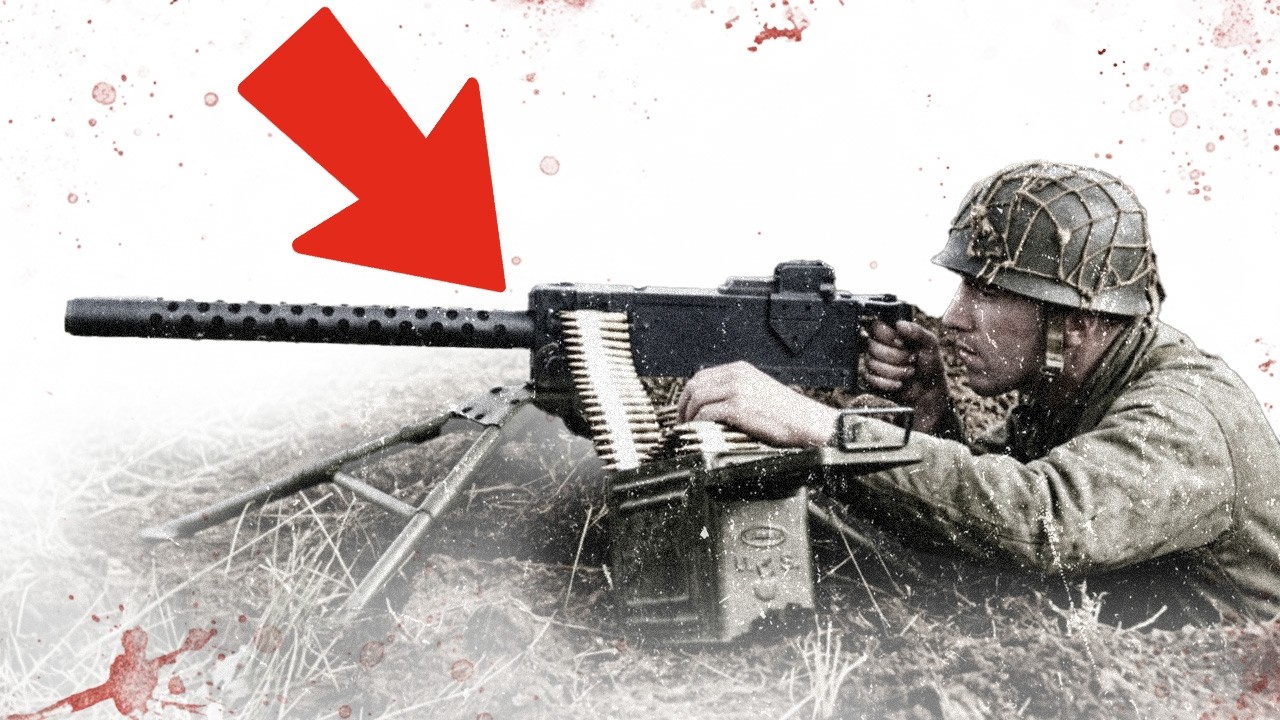
The military of the mid1 1930s was underfunded and politically constrained. But when Germany’s 1940 campaigns through France and the Low Countries made the scale of the coming war impossible to ignore, American industry pivoted with a speed that no other nation could match. Production contracts went to companies with no prior firearms experience.
Buffalo Arms Corporation, Sagenoth Steering Gear, and Rock Island Arsenal among them. By 1945, roughly 400,000 to 500,000 M1919s had been manufactured across multiple variants. That number mattered enormously. The MG34 was Germany’s precision masterpiece and a manufacturing nightmare. Slow to produce and expensive to replace.
Discover more
Historical map reproductions
News subscription service
Army Navy surplus gear
The MG42 was designed to solve that problem. and it did, cutting production time and cost dramatically. But neither gun could be built fast enough once Allied bombing and supply chain collapse began squeezing output. The M1919 was neither elegant nor flashy, but American factories could build it faster than German formations could destroy it.
For German soldiers on the receiving end, that industrial gap eventually became a physical reality. a Browning behind every hedge row, on every halftrack, at every crossroads. The M1919’s design was not revolutionary. Browning was not trying to reinvent machine gun theory. He was trying to build a weapon that would keep working when everything else was falling apart.
And he succeeded in a way that frustrated German soldiers for the entire length of the war. The M1919 ran on a short recoil beltfed operating system. When a round fired, the recoil energy drove the barrel and bolt rearward together. After a short distance, the barrel stopped and the bolt continued, extracting and ejecting the spent case before stripping the next round from the belt.
This system was mechanically simple and critically it was forgiving. The M1919 didn’t require tight tolerances to function. Dirt, cold, and salt water degraded its performance less than they degraded competing designs. The air cooled barrel was the weapon’s main mechanical weakness. Sustained fire would overheat it, and barrel changes under fire required training and time.
American crews learned to fire in controlled bursts, typically five to seven rounds, to preserve barrel life. That fire discipline actually made the M1919 more tactically effective. Short bursts were harder to pinpoint than a continuous roar, and American gunners could shift targets faster without burning through their ammunition.
The M1919 A4 was typically mounted on the M2 tripod, a lowprofile adjustable platform that allowed the gun to be set for fixed fire along pre-registered lines at night or traversed freely during a firefight. That combination, a stable platform, accurate ammunition, and a gun that rarely jammed, meant German infantry couldn’t count on suppressing an M1919 position with rifle fire alone.
You needed mortars or your own machine guns, and even then, the American gun often kept firing. German commanders had a separate problem with the M1919’s range. In fixed positions with the M2 tripod and a TN mechanism, trained crews could engage targets at distances beyond 1,000 yards with indirect plunging fire.
German infantry advancing across open ground discovered that the gun they thought was safely out of direct fire range was already tracking them. Units that expected to close with American positions before the machine gun became a factor were sometimes cut down hundreds of yards short of their objective.
Combat reports from the European theater tell the same story over and over. Wherever American infantry dug in, the M1919 defined the defensive position. It wasn’t just a weapon added to a squad. It was the anchor around which everything else was arranged. At the Rapido River crossing in January 1944, German defenders used terrain and artillery to savage American assault forces.
But American units that managed to establish bridge heads held their ground in part because M1919 teams laid down interlocking fields of fire that forced German counterattacks into killing grounds. Accounts from that engagement describe rifle company attacks stalling under automatic weapons fire before they could close to grenade range.
In Normandy, the situation reversed. American M1919’s defending hedro positions turned the Bokeage into a nightmare for German infantry trying to retake ground. The weapon’s low profile made it difficult to spot from a distance. Its sustained fire made it nearly impossible to approach without first silencing it. German soldiers learned to identify the sound.
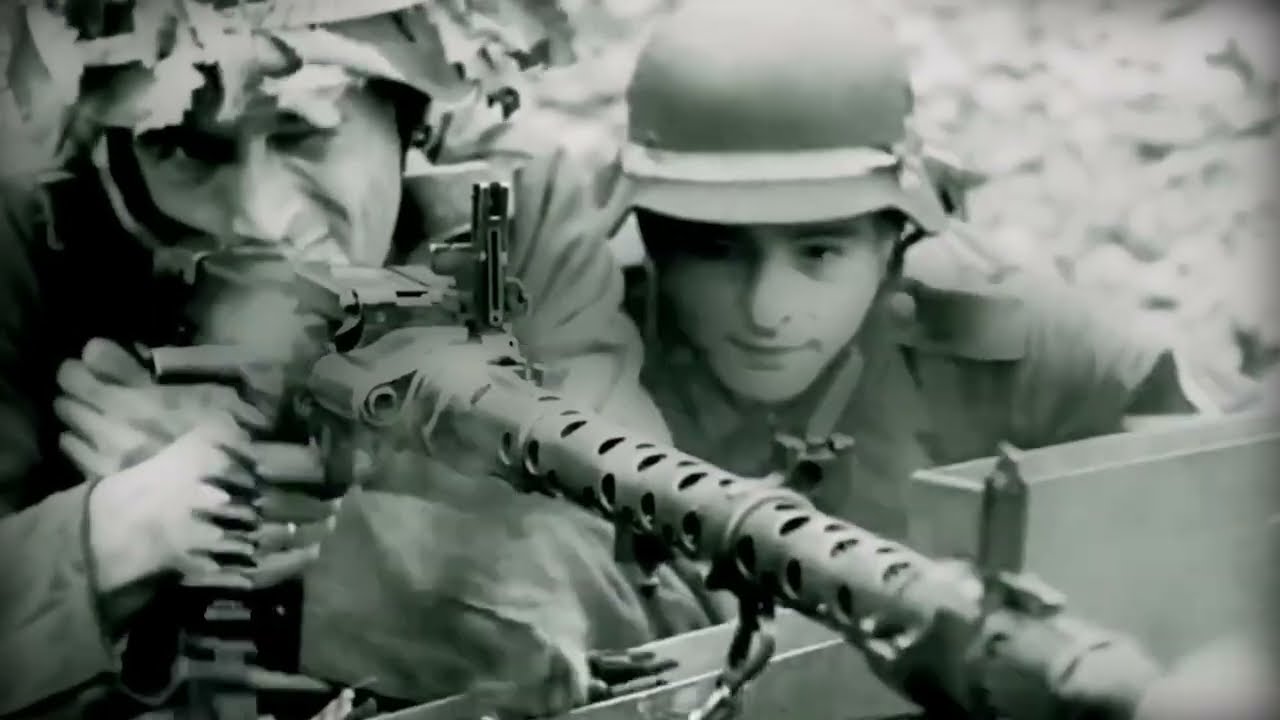
Lower and steadier than their own MG42, which cycled so fast it produced an almost fabric tearing noise. The Browning’s slower, more deliberate rhythm became associated with positions that could not be rushed. In the Arden, M1919 teens held road junctions long enough for reinforcements to arrive. Accounts from the second infantry division described guns firing until barrels had to be swapped and in some cases until belts ran dry in the Pacific.
Marine afteraction reports from Bugganville singled out the M1919 A4 specifically. One Marine officer testified before an Army Ordinance Committee in 1943 that it was the most dependable weapon that has ever come down the road. A compliment that said as much about battlefield conditions as it did about the gun. German accounts and American interrogation records from Normandy point to the same frustration.
American positions were hard to exploit because automatic weapons coverage left almost no ground uncovered. Night infiltration attempts were especially costly. The M1919 set to fire along pre-registered lines was dangerous even when no gunner was actively behind it. American crews trained specifically for that kind of discipline.
They drilled on range estimation, target selection, and coordinating with adjacent positions to eliminate dead ground. They learned to pre-register fixed lines before dark, so the gun could cover approaches without a muzzle flash giving away the position. A machine gun firing from a registered line in the dark with no visible operator, no sound until the rounds were already arriving was nearly impossible to locate in silence quickly.
It wasn’t just that Americans had more guns. They used them in ways that dismantled every gap German infantry had been trained to find. What made the M1919 particularly infuriating was its versatility. It didn’t stay in fixed positions. It turned up on every type of terrain German soldiers tried to use to their advantage.
The M1919 A4 on an M2 tripod was the infantry version, but the M1919 A5 was designed for tank coaxial mounts. Sherman tanks carried one alongside their main guns, meaning a German soldier who survived the tank’s 75mm rounds still had to contend with a coaxially aimed machine gun tracking him through a periscope sight. Knocked out tanks sometimes drew German soldiers looking for cover or salvageable equipment, only to find that American recovery teams had already stripped the Browning and put it on a field mount somewhere nearby. Halftracks and jeeps
carried pint-mounted M1919s. Aircraft used the&M2, a faster cycling aircraft variant, against ground targets during strafing runs. Some American trucks were armed with them at checkpoints and roadblocks. Military police units set up M1919s with overlapping fields of fire. German soldiers moving behind American lines, escaping encirclement or running infiltration raids found that automatic weapons fire could come from almost any direction at almost any time.
None of this happened by accident. American doctrine deliberately pushed machine guns forward and spread them widely. A German company attacking an American position might face M1919s from the front, from a flank it hadn’t identified, and from a vehicle-mounted gun that had repositioned mid-fight. Knocking out one Browning didn’t clear anything. There were always more.
By late 1944, German soldiers weren’t just frustrated by the M1919 as a weapon. They were exhausted by what it meant. Germany’s standard machine gun doctrine centered on the MG34 and MG42 weapons that were genuinely superior to the M1919 in several technical respects. The MG34 was beautifully engineered but slow and expensive to produce.
The MG42 was Germany’s answer to that problem. Designed around stamped steel and simplified manufacturing, it cut production time in half and cost less per unit. But by 1944, Allied bombing, raw material shortages, and collapsing logistics were strangling deliveries regardless of how efficiently the factories ran. German units were stretching their allocation of both guns and trained gunners.
Captured MG42s were prized partly because getting replacements through the supply chain was no longer reliable. The M1919, meanwhile, kept arriving. Damaged guns were replaced. Spare barrels were distributed in quantity. Ammunition was plentiful enough that American gunners could sustain fire without the rationing calculations that German machine gun teams increasingly had to make.
For German soldiers who understood the logistics of the war, the sight of American crews burning through belts of 3006 without visible concern carried a message that was hard to ignore. The Americans were not running out of anything. That realization demoralized German formations in ways that battlefield courage couldn’t fix.
The Browning wasn’t better than the MG42 in a straight technical comparison. It was simply everywhere, well-maintained, consistently supplied, and operated by soldiers who didn’t have to ration their fire. Germany had no answer to that arithmetic. Not in 1944. Not in 1945. The M1919 outlasted the war by decades.
It served in Korea, where American and South Korean forces used it against Chinese infantry assaults that came in waves across open terrain. Exactly the kind of attack the M1919 was built to stop. It remained in military inventories through Vietnam and into the 1990s. Foreign copies appeared across Asia, Latin America, and the Middle East.