
“I’ve been kidnapped.
Send help.
Don’t call.”
The message arrived in the early hours of February 25, 2024.
It was short, desperate, and terrifyingly clear.

For Mahogany Jackson’s family, it was the moment the world split in two.
Mahogany was just twenty years old.
Young enough to still be building her life, old enough to know when danger was real.
And in those final moments of freedom, she fought to be found.
Her family did exactly what she asked.
They didn’t call.
They reported her missing and began searching, racing against time they didn’t know was already running out.
Every minute felt heavier than the last.

Phones were clutched in shaking hands.
Hope flickered with every passing second.
But by dawn, fear began to harden into something darker.
Because when someone says they’ve been kidnapped, silence becomes unbearable.
And the absence of answers feels like a scream.
Around 2:00 a.m. on February 26, that silence broke.

Mahogany’s body was found on Laurel Avenue in Birmingham.
The road was known grimly by locals as “dead man road.”
She had been shot in the back of the head.
Her body was discarded as if her life meant nothing.
The cruelty of it left even seasoned investigators shaken.
But what investigators would later uncover was far worse than the location of her body.
This was not a sudden act of violence.
It was a prolonged nightmare.
Authorities revealed Mahogany had been abducted.

She was tortured.
She was forced to perform sexual acts at gunpoint.
And then came the detail that stunned even hardened detectives.
Her attackers filmed parts of the assault.
They shared it online.
Then–Birmingham Police Chief Scott Thurmond spoke with visible anger and grief.
“The facts of this case are deplorable and sickening,” he said.
“Saddest of all, they were made public by the suspects’ decision to videotape portions of this horrific act.”
The investigation moved quickly.
Digital trails, witness accounts, and electronic evidence painted a horrifying picture.
Within days, arrests began.
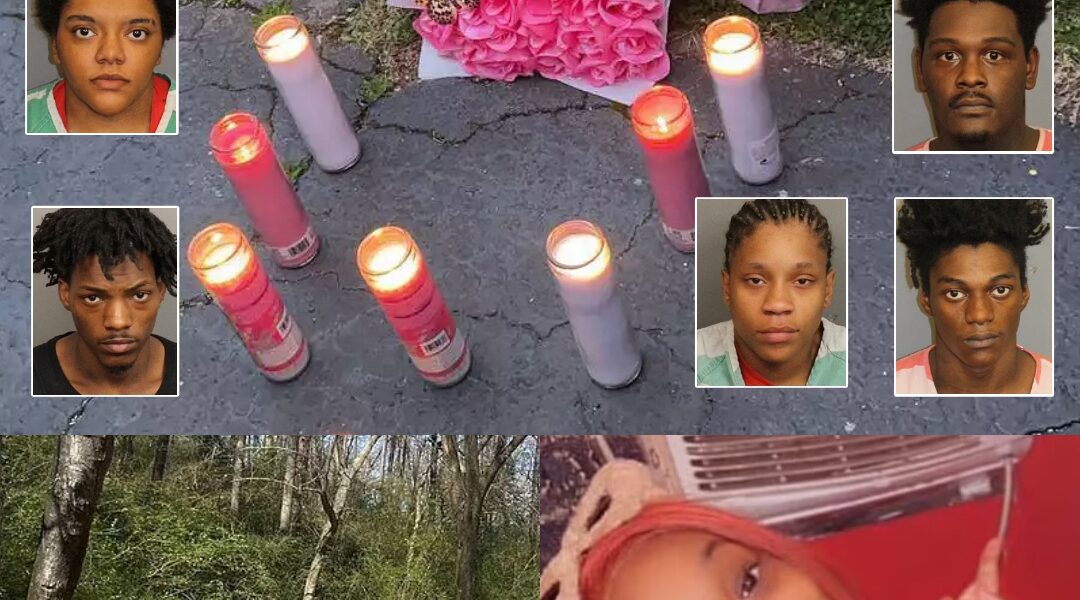
Eight suspects were taken into custody.

Not one.
Eight.
They were identified as:
Brandon Pope, 25.
Francis Harris, 25.
Jeremiah McDowell, 19.
Blair Green, 26.
Si’Niya McCall, 24.
Teja Lewis, 26.
Giovannie Clapp, 24.
And Airana Robinson.

Prosecutors did not hesitate.
All eight were indicted on capital murder charges.
The state confirmed it will seek the death penalty for each of them.
For Mahogany’s family, justice could never mean relief.
No arrest could undo what was done.
No sentence could bring her home.
They were left with one unbearable truth.
Mahogany knew she was in danger.

And she still tried to save herself.
That text message became everything.
Proof of her fear.
Proof of her fight.
She did not go quietly.
She did not disappear without a voice.
She reached out, even while surrounded by unimaginable terror.
The hours between her message and her death haunt everyone who reads them.
Each minute now feels like a question.

Each second feels like something that should have changed the ending.
Her family has spoken of the agony of waiting.
Of checking doors, streets, phones, and memories.
Of knowing something was wrong but not knowing how close the danger truly was.
Friends remember Mahogany as vibrant and full of life.
Someone who laughed easily.
Someone who deserved far more time than she was given.
Her name now joins a list no family ever wants to see.
Women taken by extreme violence.

Lives ended not by accident, but by deliberate cruelty.
The brutality of this case shook Birmingham.
It forced conversations about safety, accountability, and violence against women.
It left a city reeling.
And yet, amid the horror, Mahogany’s courage remains undeniable.
Her final act was not surrender.
It was resistance.
She tried to be found.
She tried to be saved.
She refused to disappear without leaving a trace.

Her message now echoes far beyond her family.
It is read by strangers who stop scrolling.
It is felt by parents, sisters, daughters, and friends.
“I’ve been kidnapped.”
Four words that should have triggered rescue.
Four words that now demand remembrance.
Mahogany Jackson mattered.
Her life mattered.
Her fear mattered.

And her name must never fade into silence.
Because forgetting would be the final injustice.
And remembering is the least the world owes her.
Florida Strip Mall Owner Convicted in Fatal Shooting of Friend.5688

Key West, Florida — A Florida man has been convicted of first-degree murder in a case that unfolded over a seemingly trivial act — one that many would simply ignore, but for 57-year-old Lloyd Preston Brewer III, it was enough to take a life.

On January 21, 2026, Brewer was found guilty of killing 21-year-old Garrett Hughes, a man he considered a friend. The dispute began on February 13, 2023, at a bar Brewer owned on his property in Key West, a quiet area of Monroe County.
What started as a casual evening of drinking would soon escalate into a senseless tragedy, shaking the community and leaving everyone to grapple with the absurdity of what transpired.

The incident began at the bar where Brewer and Hughes were drinking together. The two had known each other for some time and had likely shared many nights of drinking without incident. However, the events of that evening would forever alter the course of both of their lives.

Security footage from the strip mall bar would later reveal the chain of events that led to Hughes’ death. According to the footage, Hughes, in a drunken stupor, exited the bar without a shirt on, stumbling into the cold air of the Florida night.

He walked to the side of Brewer’s strip mall and, without a second thought, urinated on the wall of Brewer’s building. It was an act of disrespect, to be sure, but not one that would typically merit the kind of response that followed.

Brewer, visibly upset by the disrespect, followed Hughes outside, his anger already simmering beneath the surface. Witnesses later testified that there was no verbal altercation between the two men before Brewer decided to confront Hughes.

In a moment of what could only be described as rage, Brewer produced a firearm and shot Hughes in the abdomen. The sound of the gunshot echoed across the quiet parking lot, and in an instant, the scene turned from one of drunken amusement to tragedy.

Hughes collapsed to the ground, his life draining out of him quickly as bystanders scrambled to call 911. Paramedics arrived, but Hughes had already been pronounced dead at the scene. The damage from the gunshot wound had been too severe for any medical intervention to save him.
The case quickly garnered attention, not only because of the tragic loss of life but also because of the seemingly absurd reason for the shooting. The question on everyone’s minds was how such a small act could lead to something so catastrophic. How could an adult man, a property owner in Key West, allow his anger to escalate so violently over something as insignificant as public urination?

When Brewer was arrested and later charged with murder, he claimed that he had acted in self-defense. He insisted that Hughes had posed a threat and that he was simply protecting himself. Brewer’s defense lawyers would later argue that Hughes had been behaving aggressively, which supposedly justified Brewer’s actions.

However, the evidence presented during the trial painted a very different picture. Hughes was unarmed, and at no point had he posed a legitimate threat to Brewer. The security footage showed Hughes stumbling and urinating, but there was no sign of aggression. Brewer’s claim of self-defense was refuted by both the evidence and the testimonies of witnesses who had been present at the scene.

The jury deliberated for hours, carefully considering the circumstances and the arguments from both sides. The defense’s claim of self-defense seemed to fall apart under scrutiny. The prosecution argued that Brewer’s actions were not only unjustifiable but also entirely disproportionate to the offense committed. There was no threat to his life, no physical confrontation that would have necessitated such a drastic response.

In the end, the jury returned a guilty verdict, convicting Brewer of first-degree murder. The verdict sent shockwaves through the local community. How could something as trivial as urinating on a wall lead to the loss of life?
How could one man’s anger so completely overshadow any sense of reason or humanity? Brewer’s actions had turned an otherwise minor situation into something irrevocably tragic.
For the family of Garrett Hughes, the conviction was bittersweet. They had lost a son, a brother, and a friend. Hughes had been young, with so much life ahead of him.
His family described him as a bright and caring individual, someone who had the potential to do great things. But now, they were left with nothing but the pain of his absence and the knowledge that his death was senseless.

Hughes’ family later filed a wrongful death lawsuit against Brewer, seeking justice for the loss of their son’s life. The lawsuit would not bring Hughes back, but it was their way of ensuring that Brewer was held accountable for his actions. The family’s grief was compounded by the fact that Hughes’ death had been entirely preventable.
For them, there was no excuse for Brewer’s reaction. No one should lose their life over something so trivial. The wrongful death lawsuit was their way of ensuring that others understood the magnitude of what had happened and the deep pain caused by Brewer’s decision to take a life over an insult.

The trial itself had been emotionally charged.
Many people in the community had trouble understanding how such a tragedy could occur in their quiet town.
Key West, known for its laid-back atmosphere and picturesque views, was not the kind of place where violent crime was common. The idea that a man could take another’s life over a minor disrespect shattered the perception of safety and civility that many residents had taken for granted.
Throughout the trial, the prosecution made it clear that Brewer’s response had been grossly disproportionate to the situation at hand. There was no immediate danger, no threat to Brewer’s life.
There had been no altercation, no reason for Brewer to escalate things to the point of murder. The prosecution argued that Brewer had let his anger override any sense of reason, turning a minor disrespect into a fatal confrontation.

As Brewer’s sentencing date draws closer, many are left wondering how something like this could happen.
The defense has already signaled their intention to appeal the verdict, but the damage has been done. The reality of Brewer’s actions — and the tragic consequences that followed — will remain with the community for years to come.

On February 26, 2026, Brewer will be sentenced for his crime. The judge will determine his punishment, but for Garrett Hughes’ family, no sentence will bring their son back. His absence will be felt for the rest of their lives, and the senseless nature of his death will haunt them forever.

Brewer’s conviction serves as a painful reminder of the unpredictable and dangerous nature of human anger. What started as a minor disrespect quickly escalated into something far more serious. It begs the question: how many other lives are at risk when we allow our emotions to take control? How many times do we let small, seemingly inconsequential moments of anger dictate our actions? And what is the true cost of allowing those emotions to go unchecked?

Brewer’s actions cannot be undone, but the lessons learned from his conviction should serve as a warning. The smallest of offenses, when met with excessive violence, can have irreversible consequences.

And sometimes, a single moment of rage can tear apart not only one life but the lives of many others. Brewer’s actions have left an indelible mark on the community, and his conviction serves as a reminder that justice will not turn a blind eye to those who let their anger result in violence.

For the family of Garrett Hughes, the road to healing will be long. No verdict, no amount of justice, will ever fill the void left by their son’s death. But perhaps, just perhaps, this trial can help others understand that life is far too precious to be taken over something as inconsequential as an insult.

The tragedy of Garrett Hughes will not soon be forgotten, and the lessons learned from this senseless act of violence will stay with those who knew him, those who followed the trial, and those who, like Brewer, may one day face the consequences of letting anger destroy everything they hold dear.