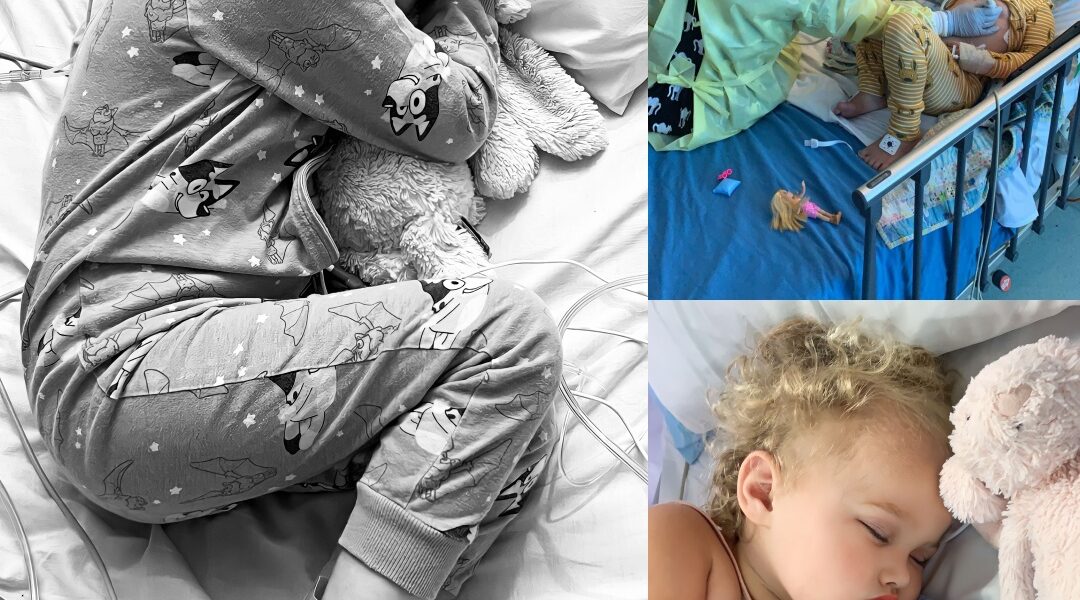

Three-year-old Lucy was a bright, energetic little girl who loved Barbie, imaginative play, and filling her home with laughter. But one night, as she was getting ready for bed, her mum Sarah noticed an unusual lump on her ribcage — a moment that changed their lives forever.
“As soon as I saw it, I had a terrible feeling that this was something very serious,” Sarah recalls. The next morning, fearing the worst, she rushed Lucy to their GP, who immediately ordered a chest x-ray. By 11 a.m., Lucy had been rushed to the children’s hospital. “The GP told me to pack a bag and go now,” Sarah remembers. “Scans showed a suspicious mass on her ribs, as well as lesions in her lungs. It all happened so quickly; it was surreal.”
Multiple scans and biopsies confirmed the family’s worst fears: Lucy had Ewing sarcoma, an aggressive childhood bone cancer that had already spread to her lungs, dramatically reducing her chances of cure. “Everything changed in the blink of an eye. One minute Lucy was playing with her brother and sister, the next she was fighting for her life,” Sarah says.

Despite the shock, Lucy’s parents focused on what they could control. “I knew I needed to be strong and guide little Lucy through this nightmare, so I put on my big girl pants and just got on with it — one step at a time,” Sarah recalls.
Lucy began treatment immediately, spending much of the next two years in the hospital. She endured 22 cycles of chemotherapy, radiation, and surgery. The side effects were relentless: a weakened immune system left her vulnerable to infections including COVID-19, along with bacterial and fungal infections, seizures, pneumonia, gastrointestinal inflammation, and life-threatening heart damage. “Lucy was so unwell and in so much pain. Our family felt trapped in a chaotic cycle of hospital visits, complications, and living in constant fear of the unknown,” Sarah says.
Hospitalization was isolating. Lucy missed time at home with her big sister Grace, eight, and brother Billy, four. “She would often stare out the hospital window and tell stories about what she planned to do when she got home,” Sarah recalls. “It was a very sad and lonely time for her.”

Amid the pain and isolation, Starlight Children’s Foundation brought light to Lucy’s dark days. “The Captain Starlights were often the only visitors Lucy saw. They brought laughter and entertainment to her hospital room, making long days just a little easier,” Sarah says.
When she was well enough, Lucy loved visiting the Starlight Express Room to play, laugh, and escape the hospital environment. She spent hours doing crafts, having her nails and face painted, and watching movies on the big screen. Most importantly, she loved seeing the Captains. “They always made her laugh and laugh,” Sarah says. “She would drag her IV pole chasing them around — she was unstoppable.”
One unforgettable moment came when Hollywood star Margot Robbie, dressed head-to-toe in sparkly pink, made a surprise visit to the Starlight Express Room. Lucy, a Barbie fanatic, was overjoyed to meet her. “Margot complimented Lucy on her outfit and gave her a big hug,” Sarah recalls. “It was magical, especially after everything Lucy had endured in the hospital.”
After countless challenges, Lucy was granted her Starlight Wish. She wished for a family holiday near the beach, with a pool to splash in with Grace and Billy, and, most importantly, to fly on a plane. The trip to Far North Queensland was a dream come true. For two years, Lucy had been unable to swim, so the chance to enjoy the pool and the beach was a transformative experience. “She swam until her fingers went wrinkly!” Sarah laughs. They explored the Great Barrier Reef, spotted crocodiles, and enjoyed water slides — creating precious memories far from the hospital.

Now six years old and in remission, Lucy’s life is filled with activity and play. She is mastering handstands, roller skating, digging in the sandpit, and swimming without floaties. While she still has regular checkups, her joy and resilience shine brighter than ever.
“Lucy was robbed of two years of her childhood,” Sarah reflects. “But Starlight provided so many bright moments during those dark days. The joy and laughter the Captains bring are vital for children’s mental health and wellbeing. Meeting Margot Robbie — a real-life Barbie — in the Starlight Express Room was definitely a highlight for us.”
Lucy’s story is a powerful testament to courage, resilience, and the transformative power of play and joy in the midst of life-threatening illness. It reminds us that even in the darkest moments, hope, laughter, and imagination can light the way.
Emilio’s Fight: A Tiny Baby Defying the Odds.2398

This is Emilio, a spirited little boy who has just celebrated his eighth month of life. Despite the incredible challenges he faces daily, he brings joy to everyone around him. Emilio loves his hydrotherapy sessions, where the warm water helps him exercise his muscles gently, and he delights in being outside, riding in his pram and feeling the world pass by. Yet behind these simple joys lies a story of resilience, struggle, and hope that is as remarkable as it is heartbreaking.
Emilio, also known as Leo, entered the world with a fight already written into his story. He spent the first three and a half months of his life in the Neonatal Intensive Care Unit (NICU), a critical period during which his parents first learned of the extraordinary challenges ahead. Just a few weeks after birth, he was diagnosed with an ultra-rare genetic disorder affecting his TBCD gene. This is a condition so rare that only 16 people worldwide have ever been identified with it, and it remains unnamed. Its devastating impact touches every aspect of Emilio’s life: his brain, central nervous system, and muscles are all affected, making his future uncertain and his daily life profoundly challenging.

Medical specialists have been candid with Emilio’s parents: there is currently no treatment to halt the progression of his disorder or prevent deterioration. Despite this grim reality, Emilio continues to defy expectations. He has epilepsy, low muscle tone, difficulty moving and supporting himself, and struggles with breathing, requiring BIPAP ventilation at night. Every milestone—every tiny movement, every moment of alertness, every small improvement—is a victory that astonishes his doctors and lifts his family’s spirits.
Emilio’s journey has been one of constant adaptation and unwavering advocacy. His parents have immersed themselves in learning everything about his condition, consulting specialists, and seeking out every possible intervention that could support his quality of life. They have become fierce advocates, refusing to accept that “nothing can be done.” They believe that with the right combination of medical expertise and technological innovation, there is hope for improvements that could enhance Emilio’s life, if not change the course of his condition entirely.
\
Hydrotherapy has become one of Emilio’s most cherished activities. In the water, his muscles move more freely, his body feels lighter, and he is able to practice movements that are difficult or impossible on land. These sessions are not just exercises; they are moments of empowerment, small windows of independence where Emilio can explore the limits of what his body can achieve. Watching him splash, kick, and reach, it’s clear that even a tiny child can exhibit enormous courage and determination.
Every day is a careful balancing act. Emilio’s care requires constant attention, specialized equipment, and a team of therapists and medical professionals who understand the intricacies of his disorder. Despite the complexity, his family celebrates the smallest signs of progress—a brief smile, a moment of coordination, a relaxed night of sleep. These victories, though small in appearance, are monumental in the context of a condition that so often limits what most children take for granted.

What makes Emilio truly remarkable is his indomitable spirit. He faces a future full of uncertainty, where each day brings new challenges, yet he continues to grow, to explore, and to surprise the specialists who watch him. The doctors who have known his condition for years continue to be amazed by his ability to achieve milestones that, according to medical literature, should be nearly impossible. His perseverance is a testament not only to his strength but also to the love, care, and advocacy of those who surround him.
Emilio’s story is far from over. His parents continue to seek medical breakthroughs, research opportunities, and innovative therapies that could offer new hope. They believe the technology exists to support children like Emilio, and they are determined to find the right experts to develop it. Every day, they navigate the complexities of an ultra-rare disease while nurturing a child whose courage and resilience shine brighter than any challenge.

In a world where most children grow up without thinking about survival, Emilio is teaching everyone around him the meaning of strength, determination, and hope. He is proof that even in the face of impossible odds, life can be full of wonder, achievement, and joy. Each small victory, each moment of progress, is a celebration of courage—a reminder that superheroes don’t always wear capes; sometimes, they lie in the smallest of bodies with the largest of hearts.
Through therapy, love, advocacy, and relentless hope, Emilio continues to show the world that a life touched by extraordinary challenges can still be extraordinary itself. His story is a call to action for medical innovation, community support, and belief in the impossible. For Emilio, every day is a triumph, every smile is a victory, and every small step forward is a reason to hope.