
Olaf came into this world far too early, born at just 28 weeks of pregnancy. From the very beginning, life tested him in ways most people will never understand. On the third day after birth, he suffered cerebral hypoxia and cardiac arrest. In that moment, his heart stopped. Olaf died for the first time — and was brought back. It was only the beginning of a journey marked by pain, resilience, and unimaginable strength.
He survived, but survival came at a terrible cost. In the weeks and months that followed, Olaf developed sepsis, meningitis, and a severe E. coli infection. He suffered a quadriplegic stroke that led to posthemorrhagic hydrocephalus, requiring the insertion of a peritoneal shunt. His tiny body faced anemia, retinopathy, and eventually a diagnosis that would define much of his life: cerebral palsy. Olaf’s childhood was never about play or carefree days. It was about survival. His parents have said goodbye to him three times already — each time unsure if it would be the last.
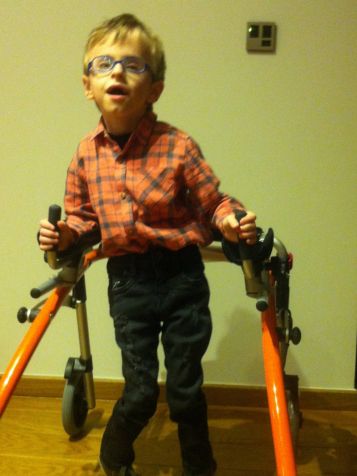
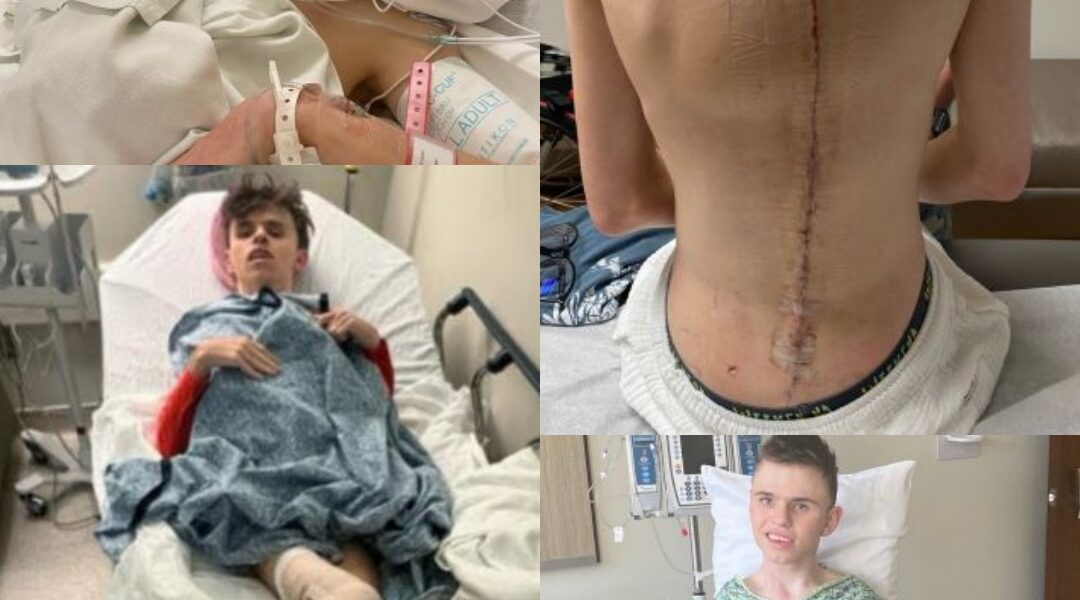
During his 17 years, Olaf has undergone countless complex surgeries. His heart valve, eyes, and spine have all required surgical intervention. At the age of six, he developed rapidly progressing kyphoscoliosis — a severe posterior-lateral curvature of the spine that compressed his organs and threatened his life. Breathing became difficult. Eating was a struggle. Pain was constant. In 2022, after years of searching for help, Olaf underwent a life-saving spine surgery at the Paley Clinic in the United States.
That surgery changed everything. For the first time, Olaf could breathe deeply. His organs returned to their proper positions. He could eat normal meals again. The pain that had dominated his life eased. His parents dared to hope that perhaps the worst was finally behind them.
But happiness, for Olaf, never lasts long.
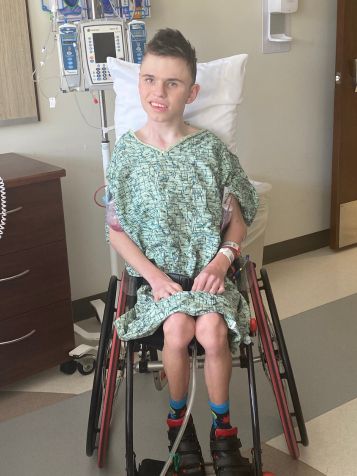
In 2024, he underwent another surgery in the US — a femoral derotation. The goal was to reduce tension in his legs and protect the reconstructed spine. Instead, tragedy struck again. A severe complication occurred: damage to the peroneal nerve. Olaf’s pain returned, stronger than ever. He could no longer sleep through the night. Nothing brought him joy — not even singing, the one thing he loved most. As if that weren’t enough, his epilepsy returned with increasing frequency and intensity.
An urgent gluteal muscle transplant became necessary. The surgery alone cost over 200,000 PLN, followed by six months of intensive on-site rehabilitation costing another 100,000 PLN. Because of Olaf’s condition, travel had to be arranged in a higher class so he could remain bedridden. And even this was not the end — a tibial derotation surgery still lies ahead. The fight seemed endless.
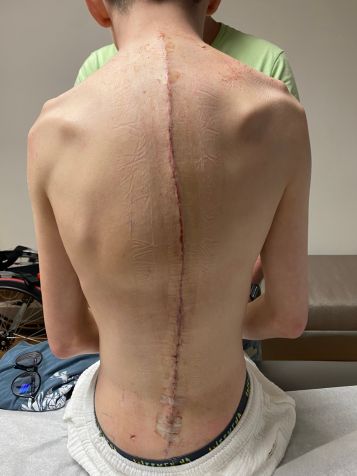
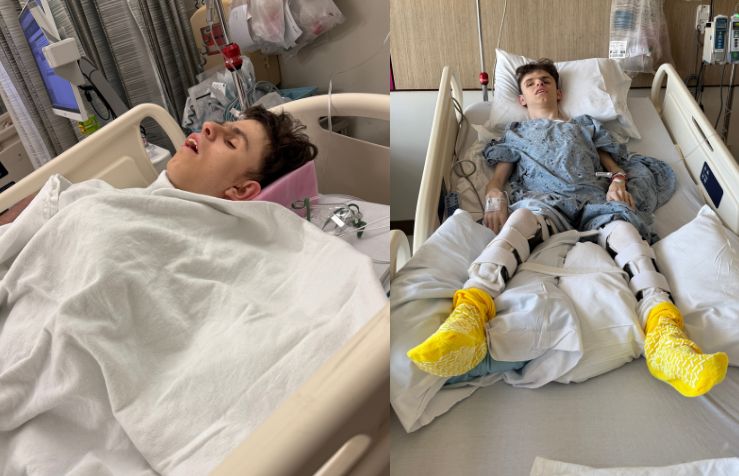
In April 2025, Olaf underwent the muscle transplant and leg surgery. The excruciating pain that had tormented him finally stopped — a small but meaningful victory. Long-term rehabilitation began immediately. Yet epilepsy continued to haunt him, refusing to let go.
During their stay in the United States, doctors told Olaf’s parents about something extraordinary: NeuroCytotron therapy. This innovative treatment, available only in Monterrey, Mexico, uses electromagnetic waves to rebuild damaged neuronal connections in the brain. For children like Olaf, whose brain was damaged after a quadriplegic stroke, this therapy represents a true breakthrough — hope where medicine had nearly given up.
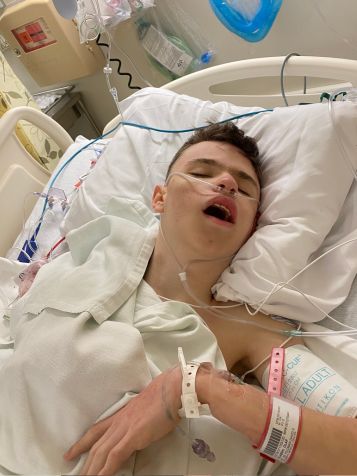
Thanks to funds raised earlier, Olaf completed his first NeuroCytotron protocol. The results, even after one cycle, were undeniable. His parents watched in amazement as small changes appeared day by day. Olaf became calmer and more focused. His concentration improved. He began seeing more clearly at a distance. His speech grew more logical — he started forming sentences, using more words, and connecting them to real situations. His sleep improved too. For the first time, he began sleeping on his back, stretching after waking, a sign of deeper, more restful sleep. His facial expressions softened; spasticity decreased. He even began, at times, to close his mouth — something he had never been able to do before.
These may seem like small things. For Olaf, they are monumental.
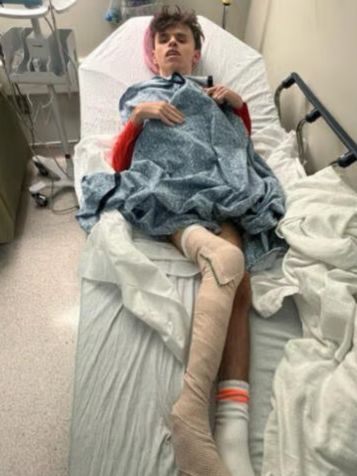
After completing the first protocol, Olaf qualified for the second NeuroCytotron cycle, scheduled for April 2026. However, the gluteal muscle transplant did not bring the full results doctors had hoped for. His leg remains shorter, and his foot is still positioned in a clubfoot posture. His parents are now seeking help at another specialized clinic in the United States.
NeuroCytotron therapy has already proven it can restore circulation in Olaf’s legs, reduce spasticity, and offer hope of controlling his epilepsy. It can rebuild neurons and their connections. But the cost is staggering. A single treatment cycle costs approximately
300,000 PLN, and Olaf needs several more. Travel and accommodation add even more to the burden — far beyond what his parents can manage alone.
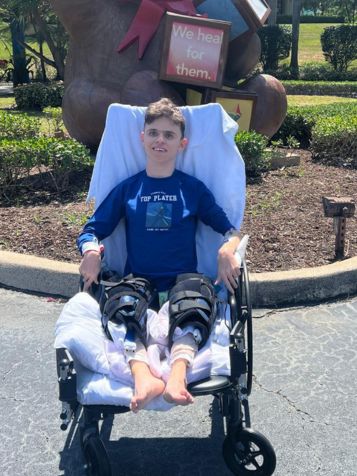
Today, Olaf is back in Poland, stronger in some ways, still fragile in many others. His parents are exhausted — physically, emotionally, financially. They have given everything. And yet, they keep going, because Olaf is still here. Still fighting. Still responding to treatment.
They are asking for help not because they want to, but because they have no other choice.
Olaf’s life has been saved more times than most people can count. With support, it can continue — with less pain, fewer seizures, and more moments of peace, clarity, and joy.
Sabinka’s Fight for Life: A Little Girl’s Battle Against the Impossible.1012

When the doctors uttered the words “stage IV neuroblastoma,” the world seemed to stop for Sabinka’s parents. Their little girl — full of laughter, dreams, and the boundless energy of childhood — was suddenly fighting for her life. A nine-centimeter tumor was growing inside her small body, spreading fast and mercilessly. It was a diagnosis no family should ever hear, one that changed their lives in an instant.
At first, there was only shock — and then came determination. Her parents promised each other that no matter how hard it would be, they would fight for their daughter. And Sabinka, though so small, proved to be the bravest of them all.
The family’s journey began in Israel, where doctors started an aggressive course of chemotherapy. The days blurred together in a whirlwind of hospital rooms, beeping machines, and the quiet hum of prayers whispered through tears. Each treatment drained her strength, but her eyes — bright and full of life — never lost their spark. She smiled even when it hurt. She laughed to make her mother smile again. Her courage became the family’s light.

After several rounds of chemotherapy, the doctors suggested a new phase of treatment — advanced immunotherapy in Spain that could give her a real chance at survival. The decision wasn’t simple. The costs were staggering, far beyond what her parents could afford. But love doesn’t know limits. They sold what they could, launched fundraisers, and reached out to strangers across the world. The kindness that came back was overwhelming. People who had never met Sabinka sent donations, messages, and prayers — proving that compassion knows no borders.
In Spain, the fight continued. The treatments were brutal. There were nights filled with fevers, tears, and fear that the cancer would win. But little by little, Sabinka began to respond. Scans showed the tumor shrinking, her body growing stronger. Hope, once fragile, started to take root again.
Then, one unforgettable morning, the doctors delivered the words her family had been praying for — “She’s in remission.”

It felt like the sun had finally broken through after years of darkness. There were tears, laughter, and embraces that seemed endless. For the first time in a long time, Sabinka’s parents dared to dream about the future — about birthdays, laughter, and normal days that once felt impossible.
But as any parent of a child with cancer knows, remission is not the end of the journey. It is the beginning of another — one filled with careful monitoring, follow-up treatments, and constant vigilance. Stage IV neuroblastoma can return without warning. Every scan, every test, every night of uncertainty reminds the family that their fight is not over.
Now, Sabinka must continue specialized therapies and checkups abroad to ensure the cancer never comes back. The medical costs, travel expenses, and recovery treatments weigh heavily on the family’s shoulders. They have already sacrificed everything, yet the bills keep coming. Still, they refuse to lose hope — because their daughter’s smile makes every battle worth it.

Through it all, Sabinka remains a symbol of strength. She paints pictures for her nurses, dances in her hospital room, and tells her parents she wants to be a doctor one day — “to help other kids feel better.” Her words are simple, but they hold the power of a survivor who has seen pain and chosen love instead.
Every person who has followed her story knows that this little girl is more than a patient — she is a reminder of how powerful hope can be. Her resilience has united people from around the world, each donation and prayer forming a thread in the tapestry of love that now protects her.
As her family continues the fight for her future, they humbly ask for continued support — not just financial help, but emotional strength, shared kindness, and awareness. Every contribution, no matter how small, helps Sabinka get one step closer to a future free from pain, fear, and hospitals.
💖 Sabinka’s story teaches us that miracles don’t happen overnight — they are built by love, one heartbeat at a time.

Her battle is not just about defeating cancer. It’s about refusing to let darkness win. It’s about a little girl who reminds us that even in the hardest moments, hope is the most powerful medicine of all.
Together, we can keep that hope alive. Together, we can help Sabinka grow up healthy, happy, and surrounded by the love that saved her once — and will sav