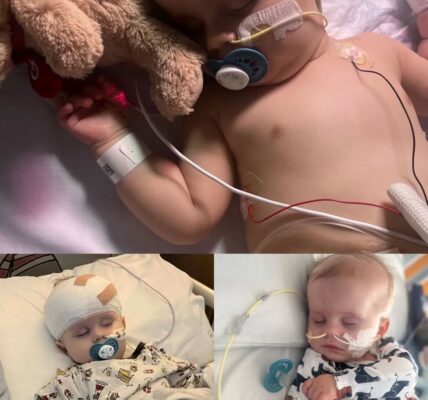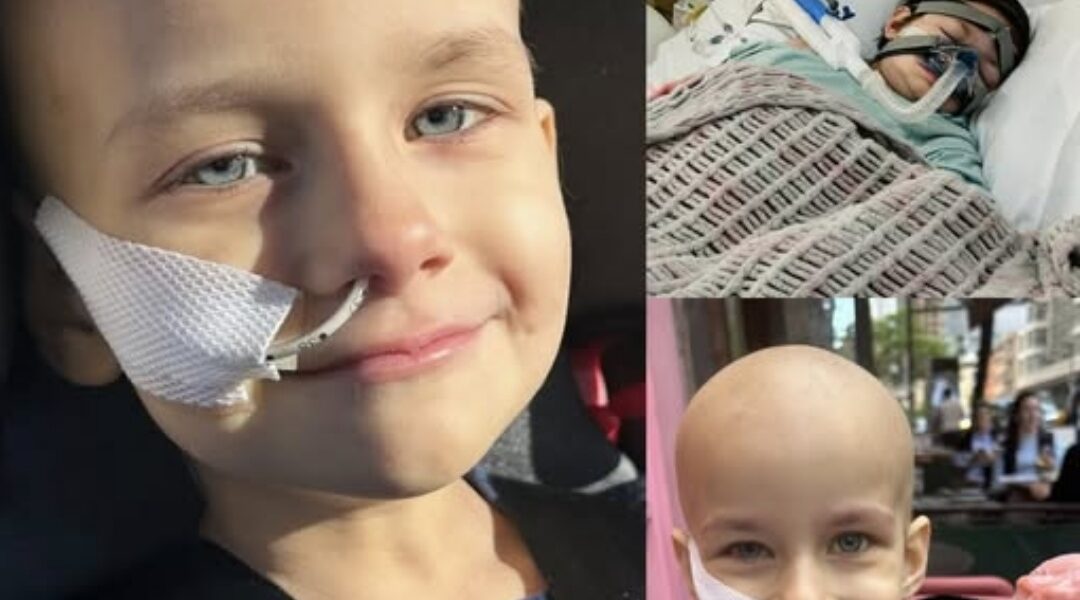

In the quiet corridors of Children’s National Hospital in Washington, D.C., the sound of a small hand striking a ceremonial bell echoed with a resonance that belied the tiny size of its owner. Five-year-old Halle Holloway rang that bell not once, but as the culmination of 794 days of treatment, struggle, and unrelenting bravery. To onlookers, it was a simple symbol of the end of treatment; to Halle, it was a declaration of survival, a moment of triumph over an adversity that would challenge even the strongest of hearts.
Two years and two months earlier, her life—and that of her parents, Chad and Ciara—had changed forever. Doctors delivered the news no family ever wants to hear: Halle had neuroblastoma, a rare and aggressive form of childhood cancer that attacks the adrenal glands. Her diagnosis was stage IV, meaning the tumor had spread, invading organs and stealing the simple joys of childhood: her appetite, her energy, and her innocence. At just a toddler, she was facing a life-threatening illness that would require constant vigilance, a rigorous treatment regimen, and the resilience of someone far older than her years.

From the first day, Halle exhibited a spirit that seemed impossible for a child so small. She endured countless weeks of chemotherapy, her tiny body weakened by the drugs that fought the disease but left her exhausted and frail. Her blonde curls fell away, revealing a face marked by determination. Her hands trembled with the intensity of treatment, yet she greeted nurses and family alike with a quiet smile, as if to remind them that courage could exist even in the smallest of forms.
Surgery soon followed, a painstaking operation to remove the primary tumor. Doctors warned of risks; the tumor was large, invasive, and aggressive. But Halle faced the procedure with the same quiet bravery she had shown during chemotherapy. For her parents, every monitored heartbeat, every beep from the machines, became a lifeline, and each successful intervention offered a glimmer of hope amidst the shadow of fear.
After the initial surgeries and chemotherapy, her journey only became more complex. Halle endured five additional rounds of chemotherapy, two stem cell transplants, seventeen rounds of radiation, and six rounds of immunotherapy. Each step brought new physical challenges, new uncertainty, and fresh emotional strain for both her and her family. Nights were long and sleepless, filled with the mechanical symphony of monitors, the quiet whispering of prayers, and the constant presence of fear lurking just beneath the surface. Yet Halle remained resilient, her spirit undimmed, her laughter a defiant testament to life itself.
The family’s journey eventually took them to Memorial Sloan Kettering Cancer Center in New York, where specialists performed a grueling 16-hour operation to remove the remaining tumor mass. The success of the surgery was a monumental relief, yet the aftermath introduced unforeseen complications. Halle’s bile duct became blocked, and her small intestine had suffered from overexposure to radiation, leaving her unable to digest food properly. Vomiting became a daily battle, and her body weakened further. Yet, even in these moments of extreme vulnerability, Halle’s optimism shone through.
Medical teams then revealed a staggering new challenge: Halle required an eight-organ transplant. Her small frame would need a new stomach, duodenum, liver, pancreas, colon, jejunum, ileum, and abdominal wall. The gravity of the situation was overwhelming. The family faced the reality that finding a suitable donor could take up to a year and a half, and until then, every day became a delicate balance of hope, vigilance, and courage.
Through it all, Halle’s character never wavered. At home in Sterling, Virginia, her presence was a beacon of resilience and joy. Her room, decorated with rainbows, suns, and hearts, was a testament to a child who refused to let illness define her. She colored, sang, and played with a vibrancy that reminded everyone around her of life’s enduring beauty. Her laughter became a shield for her parents, a momentary reprieve from the emotional weight of constant medical battles.
Ciara, her mother, marveled at her daughter’s strength: “Every day she wakes up smiling. She doesn’t talk about pain or fear. She talks about what she wants to be when she grows up.” Chad, her father, echoed the sentiment, noting that Halle’s courage often gave him strength when he needed it most. Their tiny warrior, through every hospital stay, surgery, and treatment, became the center of a support network that spanned family, friends, and even strangers touched by her story.
When Halle finally rang the hospital bell, the symbolism was profound. It represented not the end of her fight, but the resilience that had carried her this far, the victories both large and small that had made each day survivable. For 794 days, Halle had endured more medical procedures and physical strain than most people experience in a lifetime. And yet, she emerged with laughter, joy, and a determination to embrace the life she had fought so hard to continue.
Her story also illustrates the critical role of family and community in navigating pediatric cancer. Every act of care, from whispered encouragements in hospital halls to the meticulous administration of medications, reinforced the strength of their bond. Friends, neighbors, and volunteers offered emotional support, practical help, and sometimes just a comforting presence. Each gesture became part of the scaffolding that allowed Halle to endure and thrive despite overwhelming odds.
Looking ahead, Halle’s journey remains ongoing. She awaits the possibility of bypass surgeries and, ultimately, organ transplants, but her family focuses on celebrating progress and maintaining hope. Each successful meal, each moment of play, each day of growth is a victory in itself. Halle’s resilience is not only inspiring to those around her—it serves as a living lesson in courage, patience, and the human capacity to endure.
Halle’s story reaches far beyond her family. It reminds us all that strength comes in many forms and that the human spirit—and the spirit of a child—can shine brightly even in the face of profound adversity. Her laughter, her dreams, and her unwavering optimism are proof that hope is not just a word, but a daily practice.
Through her bravery, Halle has transformed what could have been a story of despair into a narrative of empowerment and inspiration. Each day she wakes, each smile she shares, each playful act is a declaration of life over fear, of determination over illness. And as her parents watch her grow, laugh, and dream, they are reminded that while cancer may challenge the body, it cannot touch the courage, the joy, or the unyielding spirit of a child determined to live.
Halle Holloway’s journey is far from over, but her story is already a testament to the extraordinary capacity of children to inspire, heal, and teach lessons of hope, resilience, and love. In her laughter, in her dreams, and in the way she refuses to be defined by illness, Halle shows the world that courage knows no age, and that even the smallest among us can shine with a light capable of guiding others through their darkest days.
He Brings a Crocodile to Schools and Nursing Homes — What This Pennsylvania Man Claims About “Wally” Has America in Shock

Most Americans grow up learning one thing about crocodiles: stay away, or you might not survive. They are predators, symbols of danger, animals people lock behind fences and warning signs. No one imagines them as gentle, comforting, or capable of emotional connection.
And yet, in a quiet corner of Pennsylvania, one man insists that a crocodile saved more than just his life — it helped heal others too.
His name is Joie Henney. And the crocodile’s name is Wally.
At first glance, the story sounds like a joke, a social media hoax, or the kind of viral headline people click only to shake their heads in disbelief. A crocodile as an emotional support animal? Walking into schools? Visiting nursing homes? Sitting calmly next to children with disabilities?
But this story is real. And once people learned the details, America couldn’t stop talking about it.

Wally is not a small reptile. He is a full-grown crocodile, measuring nearly four and a half feet long. His species is known to kill. His teeth are sharp. His reputation, by nature, is fearsome.
Yet Henney says Wally has never bitten anyone. Not once.
Henney first met Wally in September 2016, when the crocodile was just over a year old. A friend had rescued the animal from Florida, where it was living in unsafe conditions. When Henney agreed to take Wally in, he knew exactly what people would think.
They would say he was reckless. Dangerous. Unstable.
At the beginning, Henney admits, he was cautious. He used feeding tongs. He watched every movement. He respected Wally as a wild animal.
But something unexpected happened — quickly.
Within weeks, Wally began following him around the house. Not stalking. Not lurking. Following, the way a dog trails its owner from room to room.
“He wanted affection,” Henney later said. “He wanted to be loved.”
That statement alone ignited backlash online. Crocodiles don’t want love, critics argued. They want food. They want dominance. They want to survive.
But Henney didn’t see aggression. He saw calm.
Photos of Wally began appearing online. The crocodile resting quietly. The crocodile allowing gentle touches. The crocodile curled up inside a kitchen cabinet that had somehow become his favorite “bed.”
And then Henney did something that shocked everyone.
He took Wally out in public.
Not to show off. Not for attention. But for education — and comfort.

Henney started bringing Wally to schools and senior centers, carefully supervised, always controlled. He spoke about reptiles. About misunderstood animals. About fear and compassion.
But soon, he noticed something deeper.
Children with developmental disabilities reacted differently to Wally than anyone else.
They weren’t scared.
They were calm.
Some smiled. Some reached out gently. Some simply sat near him, relaxed in a way their parents and caregivers rarely saw.
Wally didn’t move suddenly. He didn’t snap. He didn’t react unpredictably. He stayed still, quiet, grounded.
In a world that often overwhelms children with sensory challenges, Wally became a presence that soothed rather than startled.
That realization changed everything.
Henney applied for official emotional support animal certification for Wally. The request alone raised eyebrows. The approval stunned people even more.
In December 2018, Wally was officially recognized as an emotional support animal.
Before that certification, Henney says he already brought Wally nearly everywhere — parks, public spaces, even stores. Walks that should have taken minutes stretched into hours because strangers stopped, curious and confused, needing to see for themselves.
Is this real? Is that safe? Is that actually a crocodile?
Yes. Yes. And yes.

At home, Wally lives a life no one would ever associate with a reptile of his kind. He watches television. His favorite shows feature swamp hunters and reptile experts. He rearranges blankets to build nest-like spaces. He spends hours resting inside a kitchen cabinet that Henney jokingly calls “his bedroom.”
Henney even built a 300-gallon indoor pond in his living room so Wally could swim comfortably.
To some, it sounds absurd. To others, irresponsible.
Henney does not pretend his situation should be copied.
He repeatedly warns people not to keep crocodiles as pets. He emphasizes that Wally is a rare exception, not a model.
“These animals are wild,” he says. “They’re not for everyone.”
And then he adds, with a laugh that only fuels the internet’s fascination: “But I’ve never been normal.”
That honesty — that refusal to sanitize or oversell the story — may be why it resonates so deeply.
Because beneath the shock value lies something more uncomfortable.
What if we are wrong about what we fear?
What if healing doesn’t always come from what looks safe?
What if comfort sometimes arrives in forms that challenge everything we think we know?
Social media exploded with debate. Some called Henney a hero. Others accused him of endangering lives. Animal experts weighed in. Parents argued. Comment sections turned into battlegrounds.

But one fact remains unchanged.
Wally has never hurt anyone.
And for a handful of children and elderly residents, he did something no one expected a crocodile could do.
He helped them feel calm in a loud, unpredictable world.
In an era obsessed with emotional support animals — dogs, cats, miniature horses — Wally’s story forces an unsettling question into the spotlight.
Is emotional connection defined by species, or by behavior?
And if a creature the world labels as dangerous can bring peace, what else have we misunderstood?
Whether you see Wally as a miracle, a mistake, or a ticking controversy, his existence has already done one thing.
He made America stop scrolling.
And start arguing.
And sometimes, that’s how the most uncomfortable truths begin to