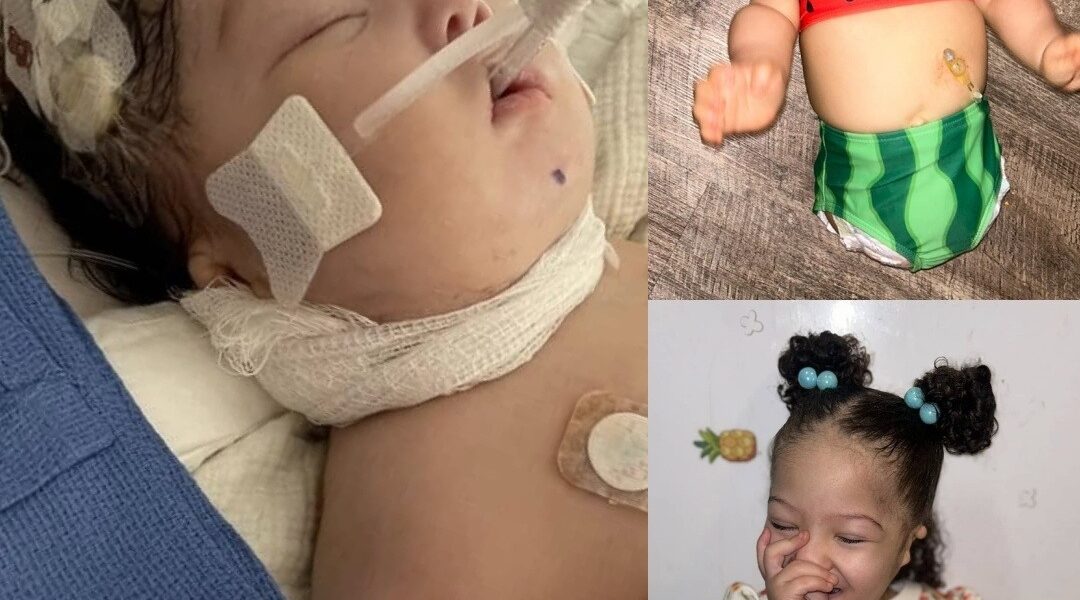

It began quietly, as most life-altering stories do.
Not with a bang, not with a warning, but with a small, almost imperceptible shift in a life that seemed ordinary.
Her name is Olivia, and she was graduating college in May 2021.
A cap, a gown, applause echoing through a crowded auditorium — all the markers of achievement, of life moving on a predictable path.
She had worked for years, balancing classes, jobs, and the expectations of those around her.
She had plans, dreams carefully mapped out: internships, professional opportunities, milestones she intended to reach on time.
Life felt controlled, linear, steady.
And yet, unbeknownst to her, life had already begun to whisper.
A few weeks later, as Olivia prepared to return to campus, a call from her doctor shattered everything.
“Your baby will be born without legs.”
The words hung in the air like a sudden, unexpected storm.

Time fractured into before and after.
Before, she had envisioned a typical pregnancy, the kind of joy that came with planning and anticipation.
After, she found herself staring at a world that terrified her, a future unknown and frightening.
It was not the first challenge she had faced.
Medical charts already bore ten prior diagnoses — each one a tremor, shaking her sense of security.
And now, another reality had been thrust upon her: her daughter, Amaya, would also be born deaf.
The room seemed to close in.

The air thickened with fear.
Dreams of classrooms, internships, and long-planned ambitions dissolved overnight.
Instead, she had to focus on navigating a world that had changed irreversibly.
She paused, broke down, then began again — the way so many mothers do when faced with impossible odds.
She put her studies on hold, delayed plans, and entered a slow, messy, and arduous process of rebuilding her life.
Amid the fear and uncertainty, she discovered something extraordinary.
Her purpose had been growing quietly, patiently, right in front of her.
It was waiting for her to notice.
The Moment That Changed Everything
Some moments divide life into before and after.
For Olivia, it was inside a sterile hospital room, beneath the hum of fluorescent lights, as a doctor’s words carved reality into her life.
Congenital limb deficiency.
Bilateral amelia.
Sensorineural hearing loss.
The words were clinical, cold, yet they explained everything and nothing at all.
“I remember thinking, ‘How can I love her enough to make this okay?’” Olivia later recalled.
“I already knew I would, but I didn’t yet understand what that would require.”
The road ahead was daunting: surgeries, therapies, sleepless nights, constant questions without answers.
And yet, beneath the fear, a quiet sense of faith began to grow.
Faith that would carry her through every challenge, every uncertain night, every milestone that seemed impossible.

The Burnt Toast Theory
In those early weeks, Olivia clung to a small, peculiar philosophy she called the “burnt toast theory.”
The idea was simple: when something minor goes wrong, like burning a piece of toast, perhaps life is redirecting you away from something far worse.
A missed bus, a delayed appointment, a small failure — all could be protective, preparing you for challenges ahead.
At first, it seemed impossible to apply.
She had spent years chasing a degree, perfecting her career path, and suddenly it all felt like it had collapsed.
Missing the return to school in August 2021 felt like failure.
Yet slowly, she began to see it differently.
That delay, that pause, was a gift.
It gave her time to learn American Sign Language.
It gave her time to connect with the Deaf community.
It gave her the tools to understand her daughter’s world in ways she never could have imagined.
What felt like a loss was really life rearranging itself into something truer.

The Road Back
Before Amaya’s birth, Olivia had switched majors ten times.
Psychology was her final choice — a subject she could endure, not one that called to her soul.
Yet every detour, every delay, every burnt toast moment had been preparing her.
Six years of higher education, on paper, looked like struggle.
In reality, it had been preparation.
Every setback, every unexpected twist, had shaped her into someone ready to meet the demands of a child with unique needs.
Her calling was no longer just academic.
It was deeply personal, bound to a life she hadn’t yet imagined.
Now, she returned to school — not for psychology, but for ASL-English interpreting.
Her minor remained complete, but her heart lived elsewhere — in the world of gestures, signs, and silent communication.
It was there she found her purpose.

Amaya: The Light in the Darkness
Amaya was born with more obstacles than most adults face in a lifetime.
She was born without legs and unable to hear.
Yet she radiated joy, laughter, and light.
“She’s my why,” Olivia said simply.
The phrase was not casual; it was a truth that guided every decision, every moment, and every breath.
Because of Amaya, Olivia found herself entering spaces she had never imagined: advocacy meetings, accessibility initiatives, and communities that had long existed at the margins of society.
She helped other parents of Deaf and differently-abled children.
She created bridges between worlds too often divided by misunderstanding.
Through it all, she learned a profound lesson: love can exist fluently in any language.

Redefining Success
The old definitions of success — timelines, degrees, milestones — no longer mattered.
Success had been rewritten.
It was measured in daily victories, in the ability to meet challenges with grace, and in the creation of a new normal.
College classes, ASL practice, therapy sessions, bedtime stories — all became intertwined with purpose and meaning.
Every gesture, every sign, every shared moment of understanding was a testament to resilience.
Olivia’s life, once paused, had been redirected to something more profound than she had ever imagined.

A Language of Love
ASL became more than a method of communication.
It became a lifeline, a bridge, a medium through which love traveled from mother to child.
At first, the grammar and movement were foreign, intimidating.
But soon, it became second nature.
When Amaya signed “mommy” or “love,” a universe of meaning passed between them, unspoken yet deeply understood.
Olivia found not only the ability to communicate, but also community: interpreters, Deaf advocates, and parents who shared similar journeys.
Through gestures, signs, and attention, a new world opened — one where she could listen with her heart.

Lessons From the Detours
Looking back, Olivia could trace the path of her life — the delays, the setbacks, the disappointments — and see them as guidance.
She called them her “burnt toast” moments.
Every small disaster had redirected her to something greater.
Every pause, every detour, every delay had prepared her to be the mother, advocate, and guide her daughter needed.
Even moments that once seemed catastrophic — missed classes, failed assignments, lost opportunities — now revealed themselves as protective steps.
Life had been quietly arranging her for purpose.

From Uncertainty to Purpose
Her story was not neat, not neatly packaged for Instagram or inspirational quotes.
It was messy, filled with fear, exhaustion, and uncertainty.
There were days of doubt, nights of anxiety, moments of questioning whether she was enough.
Yet each glance at Amaya — signing joyfully, thriving, laughing — reaffirmed everything.
She realized she was never meant to follow the old path.
Her life had been redirected, rewritten into a new story — one built on love, resilience, and unwavering faith.
The Bigger Picture
Olivia’s story is personal, yet universal.
We all face moments where plans fail, paths vanish, and certainty disappears.
What if these moments are not failures, but realignment?
Every heartbreak, every detour, every moment of “burnt toast” might be life guiding us to where we truly belong.
Olivia now believes this fully — not because life became easier, but because she learned to see purpose in the pauses.
“I wouldn’t change any of it,” she says.
Not the heartbreaks, not the setbacks, not the moments of doubt.
They all led to her calling, her purpose, her daughter.
The Burnt Toast Theory, Rewritten
Looking toward the future, Olivia carries one simple truth:
Every delay has meaning.
Every failed plan holds hidden protection.
Every burnt toast moment has a purpose.
And sometimes, when life seems to fall apart, it might be aligning perfectly, silently guiding us to where we are meant to be.
Her daughter taught her that.
Her purpose — once lost, never missing — had been waiting for her to notice.
Every morning, when Amaya laughs, Olivia smiles and signs “thank you.”
Because in every burnt piece of toast, every pause, every detour, she found grace.
She found direction.
She found herself.
And that is the kind of miracle that only life’s delays can create.
Carter’s Fight – From ICU to Hope

When Carter first entered the ICU, his tiny body looked almost swallowed by the machines surrounding him. Wires, tubes, and monitors filled the room, each one keeping track of a heartbeat that seemed far too fragile for someone so young.
The doctors spoke carefully to his family, explaining that every hour mattered. His condition was critical, his fight uncertain. In that moment, hope and fear became inseparable companions.
The ICU became a second home. His family stood by his side through long nights, listening to the constant rhythm of beeping monitors, holding onto every flicker of progress. They whispered prayers, sang lullabies, and told Carter stories as if their voices could anchor him to life.

Each day was a test of endurance. One moment his numbers would stabilize, the next they would fall again. The nurses worked tirelessly, adjusting settings, checking his responses, fighting for him as if he were their own child.
Carter’s battle was invisible to most, but to those who loved him, it was everything. He was not just a patient. He was a son, a grandson, a little boy whose laughter they longed to hear again.
Slowly, something remarkable began to happen. Against all odds, Carter started to respond. His breathing strengthened. His vital signs became steadier. The fragile thread holding his life grew stronger with each passing day.
For his parents, every tiny victory was celebrated. A stable night. A successful medication adjustment. Even the smallest signs were enough to spark tears of gratitude.
And then, one morning, the news they had prayed for arrived: Carter was stable enough to be transferred out of the ICU.
It was not just a medical step. It was a milestone. It was proof that their little fighter had endured the storm and was ready to move forward.
As nurses wheeled his bed down the corridor, his family walked beside him, overwhelmed by emotions they could hardly describe. The same hallway that once carried fear now carried relief, joy, and renewed faith.
Arriving at the HO floor felt like walking into a new chapter. The environment was calmer, quieter. It was not the battlefield of the ICU but a place of recovery, a place where Carter could begin to heal more gently.
For his family, this transition was a sign of hope. They knew the journey ahead would still be difficult, filled with therapy sessions, medical check-ups, and moments of uncertainty. But they also knew Carter had already proven something extraordinary: he refused to give up.
The resilience of a child is unlike anything else. Carter’s strength was not loud or dramatic. It was steady, unyielding, carried in every breath he fought to take.
His family drew strength from him. They realized that even in their weakest moments, Carter was showing them what courage truly looked like.
News of his progress spread to friends, neighbors, and extended family. Messages of encouragement poured in. People who had never met Carter felt connected to his fight, inspired by his determination.
Carter’s story began to symbolize more than one boy’s survival. It became a reminder to everyone that resilience lives inside us all — that even in our smallest, most fragile form, the human spirit can be stronger than anyone imagines.
As he settled into his new room, Carter’s parents decorated it with photos, toys, and reminders of home. They wanted him to feel surrounded not by fear, but by love and familiarity.
Day by day, Carter continued to make progress. Each smile, each moment of rest, each improvement in his condition gave his family new reasons to believe.
The road ahead remained long, but Carter had already taught a lesson that would last a lifetime: hope is never lost, and even the tiniest fighter can carry the greatest stren