
It was a bright Friday afternoon in Queens.
The kind of day when people walk without looking over their shoulders.
When danger feels distant, even in a busy city.
Seventeen-year-old
Josue Argudo was walking near Jamaica Avenue and 76th Street.
It was around 3:45 p.m., a time when the streets are alive with movement.
Students, shopkeepers, commuters — all moving through their own routines.
Josue had no reason to think this walk would be different.
He wasn’t meeting anyone.
He wasn’t running from trouble.
According to police, Josue encountered two teenagers he did not know.
One was later identified as Derek Trejo, 18 years old.
The other was a 17-year-old whose name has not been released because of his age.

What began as a brief dispute remains unclear.
Authorities have not said what sparked the confrontation.
There was no known prior connection between Josue and the suspects.
Witnesses say the tension escalated quickly.
Words were exchanged.
Then fear took over.
Josue turned and ran.
Down Jamaica Avenue, past storefronts and parked cars.
In full view of a neighborhood that would soon be changed forever.

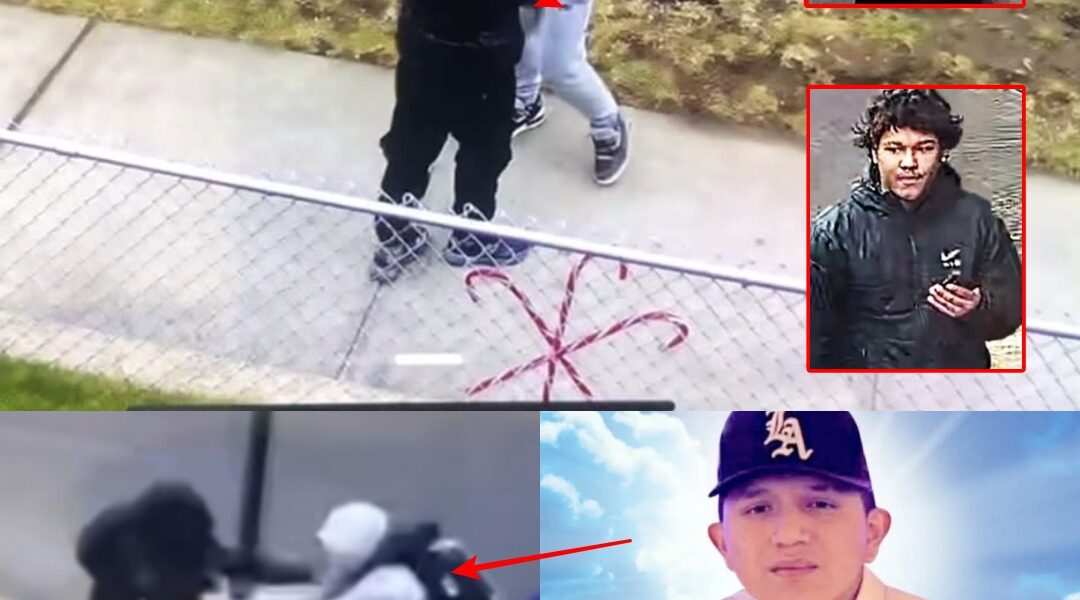
Security footage later showed what happened next.
The two suspects chased him down.
They caught up to him on the sidewalk.
The attack was sudden and brutal.
Neighbors initially thought punches were being thrown.
It took moments to realize a knife was involved.
“I thought he was punching him,” one witness later said.
“But the guy in black must have had the knife wrapped around his hand.”
By the time the truth was clear, it was already too late.

Josue was beaten.
Then stabbed in the neck.
The wound was catastrophic.
He collapsed onto the sidewalk.
Witnesses watched in horror as his body gave out.
The afternoon noise of Queens fell into stunned silence.
A nearby neighbor rushed to help.
Others gathered, panicked but determined.
Someone began CPR.
Josue was still alive when emergency responders arrived.
He was rushed to Jamaica Hospital Medical Center
in critical condition.
Doctors fought to save him.

But the injury was too severe.
Josue Argudo was pronounced dead.
He was seventeen years old.
News spread quickly through the neighborhood.
A teenager had been stabbed to death in broad daylight.
On a sidewalk where people walk every day.
Police from the New York City Police Department secured the scene.
Yellow tape cut across the block.
Detectives began canvassing for witnesses and video.
Security cameras told a grim story.
Both suspects were seen fleeing the scene.
Their faces and movements captured clearly.

Within days, arrests were made.
Derek Trejo was taken into custody.
The 17-year-old alleged accomplice was arrested as well.
Both were charged with murder.
They were also charged with criminal possession of a weapon.
Prosecutors say they acted together.
Investigators allege the teens chased Josue down intentionally.
They say the attack was not accidental.
It was deliberate.
What remains unknown is why it happened at all.
Police say Josue did not know his attackers.
There was no history, no feud, no warning.

That randomness has unsettled the community.
Parents are asking how something like this can happen so suddenly.
How a disagreement between strangers can end in death.
Neighbors near Jamaica Avenue describe the moment as surreal.
One second, it was an ordinary afternoon.
The next, a young boy was dying on the pavement.
“The kid sat down, and then he slumped over,” a witness said.
Her voice shook as she spoke.
“What a sin.”

Those words echoed through the block.
A sin — because that’s what it felt like.
A life taken without reason.
Josue’s family was left devastated.
A phone call no parent is ever prepared for.
A future erased in minutes.
Friends shared memories online.
Photos of smiles, birthdays, school moments.
A teenager frozen forever at seventeen.
At vigils held in the days that followed, candles lined sidewalks.
Strangers stood shoulder to shoulder.
United by grief for someone many had never met.

Teen violence has long haunted parts of New York City.
But each case feels new to the families involved.
Each loss cuts fresh.
This killing has reignited conversations about youth violence.
About knives on the streets.
About how quickly tempers escalate.
Community leaders have called for calm.
For intervention.
For accountability.
But calm does not bring Josue back.
Intervention came too late for him.
Accountability will unfold slowly in courtrooms.
The accused teens remain in custody.
Their futures now defined by charges and hearings.
Lives altered forever — on all sides.
Prosecutors will argue the case was senseless.
Defense attorneys will present their narratives.
A jury will eventually decide guilt.
But no verdict will change what happened on that sidewalk.
No sentence will undo the fear Josue felt while running.
No ruling will ease the pain of his final moments.
The footage will be replayed in court.
Frame by frame.
Every step dissected.
For Josue’s loved ones, that footage is unbearable.
It captures a moment they wish they could erase.
A moment the city cannot forget.
Queens residents say the block feels different now.
Parents walk their children more closely.
Teenagers look over their shoulders.
The sidewalk has been cleaned.
The tape has come down.
But memory lingers.
Gun violence often dominates headlines.
But knives can be just as deadly.
And just as fast.
A single stab.
A single moment of rage.
An entire life ended.
Josue Argudo should have gone home that day.
He should have finished school.
He should have grown older.
Instead, his name joins a list no family wants to be part of.
A list of children lost to street violence.
A list that grows far too long.
As the case moves forward, the city watches.
Not just for justice.
But for answers.
Why did this happen.
How can it be prevented.
What must change.
For now, all that remains is remembrance.
A seventeen-year-old boy.
Killed in broad daylight.
Josue Argudo mattered.
His life mattered.
And his story will not be forgotten.
The Kind of Kindness That Needs No Witness.429

Jim Carrey once shared a thought that lingers in the mind long after you hear it. He said:
“Imagine for just a minute that you are financially struggling, maybe even homeless. You’re exhausted, hungry, and at your lowest point. And then someone walks up—not to ask how you’re doing, not to quietly offer help—but with a camera in hand. They point it at your face, capturing every wrinkle, every tear, every trace of desperation. They hand you a meal, not because they simply want to feed you, but because they want to record the moment for their followers.
And you take it—because you’re starving.
Imagine what that feels like.”
It’s a raw image, one that makes you squirm. Carrey’s plea was simple: please stop doing that. If you are going to help someone, do it with kindness. Do it without the need for applause, without turning someone’s hardship into your spotlight.
Because real compassion doesn’t need a witness.
We live in an age where generosity is too often staged—where giving has been packaged into viral content, complete with hashtags and carefully edited videos. But when help becomes a performance, the person in need is no longer the priority. Their dignity becomes secondary to the giver’s image.
Carrey’s words remind us that the most meaningful acts of kindness are the ones done quietly. The ones that leave no digital footprint, no “like” count, no post for people to praise. The ones where the person helped walks away feeling seen, not exposed.
If you truly want to change someone’s life, do it for them—not for the camera. Not for your ego.
Because the most powerful good deeds are the ones the world never sees.