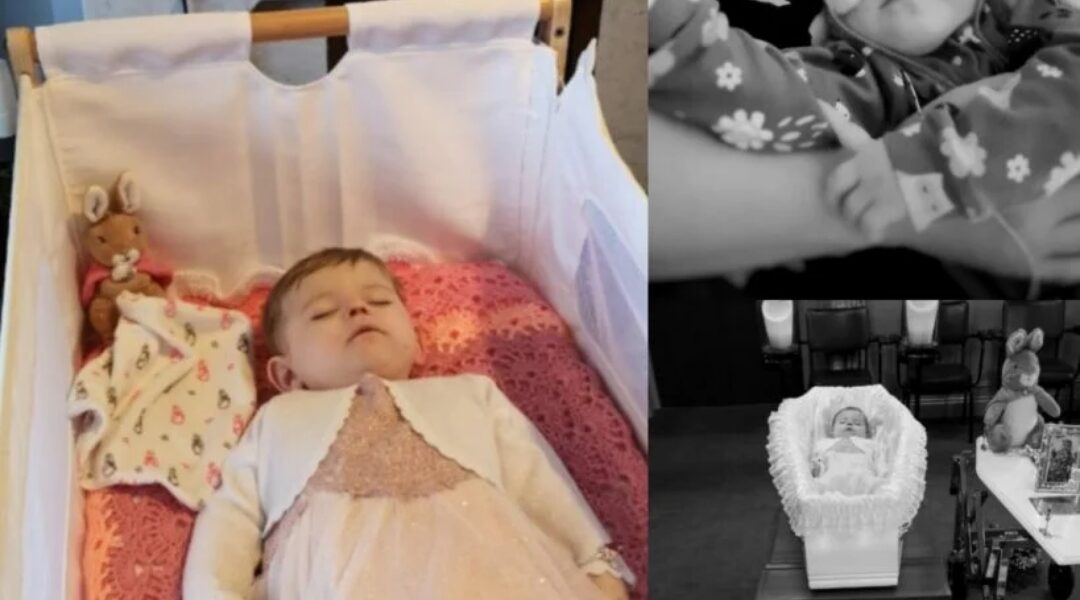

Alice was dressed like a tiny princess the last time her mother held her.
A shimmering pink dress hugged her small frame, delicate and soft.
A single Pandora heart bead rested on her wrist — the first of many that would never be added.
Each bead was meant to mark birthdays, milestones, moments of joy.
Instead, the family buried them with her.

Beside her teething ring, wrapped in a new pink blanket, Alice lay peaceful.
Her mother tucked the fabric carefully around her, a final act of love.
A last touch. A last whisper. The last thing she could ever do for her baby girl.
And even in death, Alice looked beautiful. Loved. Serene.
The days that followed blurred into a surreal mix of heartbreak and tenderness.
The house was full. Overflowing.
Friends, family, neighbors — all drawn by the news.

Everyone who had held Alice, kissed her cheeks, or simply loved her parents came rushing in.
The rooms were crowded with quiet tears and whispered prayers.
Hugs were exchanged. Casseroles were offered. Hands trembled in grief and solidarity.
And yet, beneath it all, the silence of her absence loomed.
A silence shaped exactly like a little girl who should have been laughing, toddling through the living room, grabbing fingers, lighting up the home.
Love filled the house, but Alice was gone.

Her mother remembers a moment that seared itself into her memory.
She stood by the window, heart pounding, staring at the driveway.
The hearse rolled slowly toward the house, its black frame stark against the afternoon light.
For a fleeting second, her mind drifted to a memory from another lifetime — her wedding day.
The limo had pulled up to the same driveway years before, excitement bubbling, a celebration waiting just outside the door.
Two cars. Two ceremonies. Two completely different days.

One was the happiest day of her life.
The other, the worst.
The contrast struck her so deeply she could barely breathe.
This time, she wasn’t opening the door to joy.
She was saying goodbye to her child.
The funeral director arrived, and his humanity became evident immediately.

He cried. Truly cried.
He admitted he had sobbed the entire drive from Dublin.
He had never encountered a case that affected him so profoundly.
His hands shook as he held the tiny coffin.
Someone in the house offered him tea and sandwiches.
A simple act, yet it felt like family, not duty.
Grief and kindness intertwined in every corner of the home.
The days were dreamlike.
Reality collided with memory over and over.

One moment, Alice’s laughter and bright eyes were recalled.
The next, the coffin. The flowers. The blanket tucked around her for the final time.
Grief arrived in waves — some gentle, some crushing.
Love became both the anchor and the weight.
Through it all, the family clung to the memory of Alice’s spirit.
Her tiny hands, the way she loved pink, the way she made every day brighter.

Even in absence, she left a presence that filled the house.
Every whispered prayer, every quiet tear, every memory shared became part of a collective embrace.
Her parents, shaking yet steadfast, held onto each other.
They realized that even strangers’ acts of kindness carried meaning, support, and humanity.
Alice’s siblings sat nearby, absorbing the moments, witnessing both loss and love in their rawest forms.
Her mother’s final act — the last tuck of the blanket, the placement of the heart bead — became a symbol of enduring motherhood.
A whisper of love. A goodbye no one should endure.
The coffin closed. A chapter ended.

Not just for Alice, but for everyone who loved her.
The world spun onward. Days passed.
The family healed slowly, painfully.
But Alice’s story remained, delicate and unforgettable.
A little girl dressed like a princess.
A bracelet never filled.
A home overflowing with grief and love.
Alice was here.
Alice was loved.
Alice will never be forgotten.

Every gesture, every moment, every shared tear now tells a story of fragility, beauty, and the human capacity to love in the face of unbearable loss.
Even in death, she left a mark on the hearts of everyone around her.
Her story spreads quietly, touching those who hear it with sorrow and awe.
It reminds us that love does not end with life.
That small hands can leave a lifetime of impact.
That loss can coexist with memories that shimmer and persist.

Her mother’s whispered words, the tiny bracelet, the pink blanket — these are now timeless.
A testament to a life too brief, yet immeasurably powerful.
Even in grief, the family finds strength in one another.
Love binds them. Memory sustains them.
Alice’s story will echo in every heart that knew her.
And even for those who never met her, her courage, her beauty, her fleeting presence will resonate.

Because some lives, though short, shine beyond measure.
Alice Turner’s life was one of them.
And though the world moves forward, her story remains — delicate, shimmering, unforgettable.
A princess. A heart bead never filled.
A love that will never fade.

57-Year-Old Elephant Gives Birth to Rare Twin Calves in India—A Miracle No One Believed Possible

In the dense, whispering forests of central India, the air was thick with humidity and the scent of damp earth. Yet, amid the ancient trees and winding rivers, a story was quietly unfolding that would leave conservationists and wildlife enthusiasts around the world breathless.
Anarkali, a 57-year-old female Asian elephant, had surprised the natural world. She was long past the age most elephants conceive. Her life had been measured in decades of sun-soaked migrations, encounters with predators, and narrow escapes from human conflict. Now, she was about to defy biology itself.
Reserve staff monitoring her movements noticed unusual signs. Her steps slowed, her posture shifted, her massive body readied itself. There were no humans in the clearing—only Anarkali, the forest, and the rhythm of something extraordinary.
Hours passed. The wind rustled leaves overhead, birds flitted cautiously between branches, and the forest seemed to hold its breath. Then, the first calf appeared. Small, trembling, and entirely dependent, it stumbled onto the soft forest floor. Staff exchanged glances. Even in elephant biology, this was rare.
But the forest had not yet finished its miracle. Just hours later, another calf emerged. Two tiny lives, born to a mother long past the age most would even hope for. Both girls. Both alive. Both immediately changing the narrative of what is possible in the wild.
Elephant twins are almost unheard of. Less than one percent of elephant pregnancies result in twins, and the odds of survival in the wild are even slimmer. A mother elephant must provide endless care, nourishment, and protection. Multiply that by two, and survival becomes a battle of nearly impossible odds.
Anarkali, though aged, moved with a purpose honed over decades. She nudged the first calf gently, adjusted her massive body to shield them from unseen threats, and remained vigilant. Her experience, the wisdom of age, may have been the edge that allowed both calves to survive.
The sanctuary’s staff watched quietly from a distance, knowing that intervention could disrupt the delicate balance. Nature, as fragile as it could be, was allowed to work uninterrupted. And nature delivered a miracle.
Both calves, though tiny and vulnerable, displayed an instinctual strength. Their trunks curled uncertainly, their legs wobbled, yet each step toward their mother carried determination. The forest echoed with soft trumpets—the first cries of new life breaking the silence.
For Anarkali, this was not just reproduction. It was a statement of resilience. A declaration that age does not define limits, and that life, given space and care, can still astonish.
Conservationists immediately recognized the magnitude of the event. For Asian elephants, populations are shrinking due to habitat loss, human encroachment, and poaching. Every birth is precious. Every survival is monumental. But twins? Especially from a mother this old? This was unprecedented.
The forest itself seemed to respond to the birth. Leaves shimmered in the wind, the river whispered along its course, and even the distant calls of other elephants seemed to carry reverence. It was a quiet celebration, one witnessed by the elephants themselves and the few humans who understood its significance.
Anarkali’s journey to this moment had not been simple. She had survived decades of challenges that would have felled a lesser elephant. Disease, drought, conflicts with humans, the burden of leadership in her herd—all weighed heavily. And yet, in a clearing under the Indian sun, she performed what many believed nature could not allow.
Reserve staff marveled at her care. With every step, Anarkali guided the calves, nudged them toward nourishment, and ensured they stayed close. She taught them balance. She demonstrated vigilance. She modeled survival.
Observers noted the subtle brilliance of her maternal behavior. She didn’t just feed or shield; she taught. Every movement was precise. Every trumpet of warning, every caress of a trunk, carried lessons she had learned over a lifetime.
The twins thrived under her watch. Their first weeks were critical, and Anarkali’s wisdom kept them safe. Predators, hidden dangers, and the vast forest itself presented risks. But the calves grew stronger, their legs more confident, their trunks more purposeful.
News of Anarkali’s miracle spread quickly through conservation circles. Wildlife organizations, zoologists, and ecologists around the world began to discuss the implications. Could this be a sign that older matriarchs retain reproductive potential longer than previously believed? Could safe, protected reserves provide conditions where the impossible becomes reality?
Social media soon caught wind. Photos from the reserve, taken from a safe distance, showed Anarkali with both calves at her side. Comments poured in:
“This is unbelievable!”
“Nature never ceases to amaze.”
“A 57-year-old elephant giving birth to twins… I can’t even.”
The story became viral. News outlets in the U.S., Europe, and Asia highlighted it. Even scientists who typically report with caution used words like miracle and extraordinary. People debated, marveled, and shared.
Every birth is critical, but these twins represented more than survival—they symbolized hope. In a world where elephant numbers are declining, where forests shrink, and where threats loom, Anarkali’s success was a reminder that life can still defy odds.
What makes the event even more striking is its quietness. There were no interventions, no technology, no human-assisted miracles. Just a wise, resilient mother, decades of experience, and a safe environment that allowed her instincts to take over.
For conservationists, this is a blueprint. Protect matriarchs. Protect their homes. Give them space to teach the next generation. The success of Anarkali and her twins illustrates that patience, protection, and respect for nature can yield results that are both astonishing and sustainable.
As the calves grew, they followed their mother through the forest, learning migration paths, water sources, and social cues. Every day was a lesson in survival. Every night was safety under the watchful care of a mother who had survived the hardest challenges.
Anarkali’s age may have been considered a limitation, but in truth, it was an advantage. She carried decades of wisdom—experience that allowed her to navigate risks, protect her young, and ensure the twins’ survival in a forest that shows no mercy.
Visitors to Panna Tiger Reserve, granted rare glimpses from a safe distance, have described scenes that are almost cinematic. Twin calves nestled against their mother, trunks brushing, ears flapping, learning the language of the herd. A 57-year-old matriarch leading not just her calves but generations of hope.
The story has sparked conversations about conservation policies. Protecting older female elephants isn’t just about preserving an individual—it’s about preserving knowledge, genetics, and the lifeline of the herd. Anarkali is living proof that matriarchs carry both wisdom and the potential to make history.
The calves, as they grow, will inherit this legacy. They are not just newborns; they are symbols of resilience. Each step they take through the forest, each trumpet, each playful interaction is a continuation of their mother’s triumph.
For the people who witnessed the births, the event was humbling. In a world of climate crises, habitat destruction, and species decline, such moments remind humanity that miracles still happen when we provide space, protection, and respect for nature.
The forest, for a brief moment, felt electric with life. Birds, insects, and other wildlife seemed to hum in unison with the soft trumpets of Anarkali and her calves. The sound carried hope beyond the trees, beyond the reserve, beyond India itself.
Every step Anarkali and her twins take is a reminder that nature is unpredictable, resilient, and astonishing. Against all odds, life finds a way. Even when science deems something unlikely, when statistics suggest impossibility, the heartbeat of the wild can defy expectation.
For wildlife enthusiasts worldwide, this story has ignited wonder. How often do such rare events occur? How many 57-year-old elephants carry life in the wild? How many twins survive in their critical early days? And how much does the protection of reserves influence these outcomes?
The answers are still emerging, but one thing is undeniable: Anarkali’s triumph is a testament to endurance, instinct, and the astonishing capacity of life to persist.
Conservationists hope this story sparks action. Protect forests. Protect elder matriarchs. Protect the unseen, the underestimated, and the overlooked. The future of species depends on understanding that every life matters—and sometimes, one life can make history.
As the twin calves grow, they carry the wisdom and strength of their mother. Each playful nudge, each synchronized step beside Anarkali, reminds observers that survival is more than genetics—it’s guidance, protection, and experience passed through generations.
Anarkali, the 57-year-old miracle, remains a symbol. A living reminder that age is not always a limitation. That survival requires both instinct and environment. That resilience, when paired with care, can defy the impossible.
Her story, the birth of her twin calves, and the quiet triumph of life in the wild has captivated the world. Scientists, animal lovers, and everyday people are talking, sharing, and marveling at the impossible made possible.
In the heart of India’s forests, life did not just continue—it multiplied.
And for those who hear the story, it is impossible not to feel awe, hope, and the stirring reminder that sometimes, nature still writes its own miracles.
Anarkali’s twins are more than calves. They are history. They are hope. They are proof that even when the odds are stacked against life, the extraordinary can happen.
In the soft, humid air of Panna Tiger Reserve, among the trees and rivers, a 57-year-old elephant achieved something nearly impossible. She gave life to twins. She defied expectation. She reminded the world why conservation matters.
And as Anarkali walks with her daughters through the forest, teaching, guiding, and surviving, her story continues—an eternal testament to resilience, hope, and the wonders that nature can deliver when we leave it room to breathe.