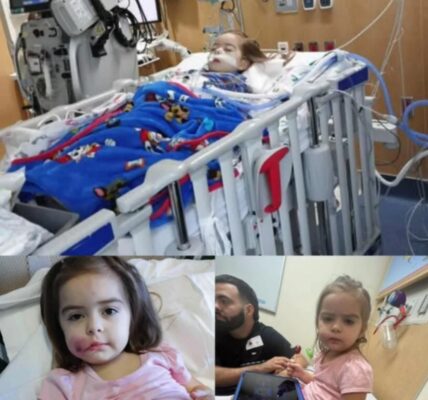

In the quiet hours of the night, something unimaginable happened for the Ensh family. Around 12:30 a.m., their tiny son, Jax, whose heart had been bravely beating for months, suddenly stopped.
The world froze. The monitors that had tracked his every breath went silent, and the words no parent ever wants to hear echoed through the ICU: “Clear… no pulse.”
Roman and his partner stood there, helpless yet present, as the medical team sprang into action. Thirty-seven minutes of relentless CPR followed, each second stretching into what felt like a lifetime.
Jax’s chest was opened right there on the ICU floor. The sight was horrifying, but also a testament to the medical team’s tireless effort to save a life.

Doctors and nurses fought with every tool at their disposal, placing Jax on ECMO—a machine that takes over the function of both heart and lungs. It filtered and oxygenated his blood, keeping the fragile body alive while his own heart rested.
Amid the chaos, Roman felt something unexpected: gratitude. “As terrifying as it was, I am grateful we were there,” he said. “We could see with our own eyes that they were doing absolutely everything possible to save our baby.”
Being present during every moment, rather than waiting helplessly in a separate room, gave the family a sense of connection. They could witness the dedication, the urgency, the life-saving care unfolding before them.
Though the situation was critical, the family held on to hope. Every breath, every flicker on the monitor, was proof that Jax’s heart was not yet done fighting.
Now, stable on ECMO and still on a ventilator, Jax’s tiny body relies on every machine and every carefully monitored line. Each piece of equipment is a lifeline, a fragile bridge between life and loss.
Doctors explained that, while frightening, these moments are not uncommon. Sometimes the body needs support to rest and regain strength, and that is exactly what ECMO provides.

Tests have offered cautious optimism. Jax’s EEG shows no signs of seizures, and his head ultrasound reveals no bleeding. The medical team believes neurological impact, if any, will be minimal.
But ECMO comes with risks. Blood thinners are required to prevent clotting, adding layers of complication to an already delicate situation. Every decision is measured, every movement carefully weighed.
Still, Roman and his partner cling to hope. They trust in their son’s resilience and the expertise of the team surrounding him. They believe Jax has the strength to fight through.
Roman’s plea is simple yet profound: “Please—pray.” He asks for prayers for Jax’s heart, brain, lungs, and overall strength. He asks for the protection of every machine keeping his son alive.
He urges the community to lift up the doctors and nurses, minute by minute, in prayers for endurance, precision, and success. Every breath Jax takes is a victory, and every prayer is a lifeline.
Through it all, Roman remains steadfast. “Our boy’s story does not end here,” he affirms. “Jax is going to show us just how hard he can fight.”
The road ahead is uncertain. Each day brings new challenges, new alarms, new decisions. But the family’s love and faith provide strength greater than fear.
Every update from the ICU is met with prayer, hope, and a profound respect for the fragility of life. The smallest victories—a breath without help, a flicker of movement—become monumental.

The Ensh family’s experience is a reminder of life’s unpredictability and the strength of human connection. Jax’s fight is fueled not only by his own resilience but by the love surrounding him.
Parents, grandparents, siblings, and friends form an invisible army, lending strength, hope, and courage to a child who cannot speak for himself.
Each day, Roman and his partner witness miracles in miniature. A stable heart rate, a controlled oxygen level, a tiny twitch—every detail matters.
Their gratitude is matched only by their fear. Each day is a delicate balance between hope and dread, optimism and exhaustion.
Yet even in the darkest moments, the family finds light. The relentless care of the ICU staff and the community’s prayers become a lifeline, sustaining them alongside Jax.
They are learning that hope can coexist with fear, that love can be both heavy and buoyant. Every heartbeat of their son is a reminder of why they fight.
Roman reflects on the surreal experience of watching life teeter on a thread. He acknowledges the terror, yet holds fast to faith that Jax is not finished yet.
Every member of the care team becomes part of their extended family. Every action, every decision, every adjustment contributes to the possibility of survival.
The vigilance required is exhausting, yet each family member remains committed. Their presence is constant, their love unwavering.
Jax’s fight has become a symbol of endurance, not just for his family but for all who hear his story. It is a living testament to resilience in the face of overwhelming odds.
The machines hum, the monitors beep, and life hangs in a fragile balance. Yet hope persists, fueled by love, prayer, and determination.
Every day brings incremental progress, small victories that matter more than words can capture. The tiniest improvement inspires a wave of gratitude and relief.
Jax’s parents know that each day on ECMO is a second chance. They are fully present for every moment, watching, praying, and cherishing what they can.
In a world where outcomes are uncertain, presence itself becomes a form of love. Witnessing their son fight is a gift, painful yet profound.
The Ensh family’s experience highlights the intersection of fragility and strength, terror and hope. It reminds the world of the power of human connection.
Each breath Jax takes, each beat of his heart, is a victory shared with everyone who believes in him.
Even in the ICU’s sterile environment, love permeates every corner, every monitor, every hand that touches his fragile body.
Roman continues to ask for community prayers, believing in the unseen force that sustains not just Jax, but the team fighting beside him.
He asks for protection over his son’s heart, lungs, and brain. He asks for strength for the staff who work tirelessly, hour by hour, minute by minute.
The fight is ongoing. ECMO is a bridge, not a cure, but it offers time—time that Jax, his family, and the community can use to hope, pray, and prepare.
Roman believes that Jax’s resilience is matched only by the power of love. That love, shared by parents, family, and strangers alike, is the force keeping him alive.
Every flicker of life, every small movement, every heartbeat becomes a symbol of courage. It is a story of human strength, compassion, and determination.
The parents are learning to balance fear with hope, watching their child as he rests, fights, and survives minute by minute.
In these moments, the importance of presence, of watching, of holding space for life cannot be overstated.
Jax’s story is a call to recognize fragility, to honor life, and to celebrate every second of endurance.
It is a story of trust in the hands of professionals, of hope that extends beyond what can be measured, and of a family united by love.
As prayers continue, and monitors beep softly in the early morning, the message is clear: Jax’s fight is ongoing, but so is his family’s faith.
They believe that this chapter will not be the end, but part of a journey that will see him stronger, healthier, and thriving.
Each day brings new hope, new challenges, and new reasons to believe in miracles.
Roman and his family remain steadfast, showing that even in the direst circumstances, love and faith create strength that nothing can break.
The community’s prayers are a lifeline, a reminder that no family should face such trials alone.
Every heartbeat, every breath, every moment on ECMO is a testament to courage.
It is a story of resilience that reaches far beyond the walls of the ICU.
It is a story of a boy whose fight inspires the world.
And it is a story of parents whose love fuels that fight, minute by minute, second by second.
Jax is not done. His story continues.
His parents will continue to stand by him, pray for him, and celebrate every victory, no matter how small.
Because every heartbeat is proof that life, hope, and love remain stronger than fear.
And as Jax fights, the Ensh family stands united, unwavering, and filled with hope that their little warrior will prevail.
Police Shut Down an Entire Road Because One Mother Bear Faced the Most Chaotic “Parenting Crisis” America Has Ever Seen

Nobody ever said motherhood was easy.
And on a cold afternoon in Connecticut, one exhausted mother proved that parenting struggles aren’t limited to humans — they exist just as fiercely, just as hilariously, and just as heartbreakingly in the animal world. What began as a routine drive for dozens of motorists turned into a full-blown spectacle when officers were forced to halt traffic in both directions, not for a crash, not for construction, but because a mother bear was dealing with the wildest, most chaotic “toddler meltdown” anyone had ever witnessed.
It was a scene so unbelievable that drivers stepped out of their cars. Cameras came out instantly. And within hours, the footage spread across America like wildfire.
It started with one sighting.

A police cruiser slowed down as a large shadow crossed the road. Officers expected a deer, maybe a coyote. Instead, a massive black bear emerged from the tree line with a tiny cub dangling from her jaws, clinging to her neck like a living teddy bear.
Behind her, another cub scrambled to keep up, wobbling on its short, fluffy legs. The pair made their way across the asphalt with determination, as if they had done this a hundred times. The mother reached the opposite side safely, placed her carried cub onto the ground, and turned back toward the woods.
Then chaos erupted.
Two additional cubs — the troublemakers, the rebels, the fur-covered tornadoes — refused to follow.
Instead of crossing the road, they began climbing a wooden pole and wrestling with each other like unsupervised toddlers discovering sugar for the first time. They paid absolutely no attention to their mother, to the cars waiting, or to the police now blocking the road in both directions.
Their mother froze.
She stood on the far side of the road, watching her children repeatedly ignore her calls. Her patience was visible… and visibly thinning.
Drivers could almost hear her thoughts.
Not today. Please, not today.

She growled softly, urging the cubs forward. One listened, hopping across the road in clumsy little leaps, finally reaching her. But the fourth? The smallest one? The stubborn one?
He looked right at his mother.
Then he turned around… and climbed even higher up the pole.
Gasps rippled across the entire line of cars.
The mother bear, already overwhelmed, trotted back across the road toward him. The cub refused to budge. She nudged him. He clung tighter. She pulled him. He squealed. She tried to drag him by his tiny ear, and the moment she finally got him free—another problem appeared.
The third cub, the one she thought she already handled… ran straight back across the road.
This was no longer a road crossing.
This was a hostage situation.
Police officers exchanged looks that said everything: We might be here awhile.
Drivers whispered, laughed, filmed, and cheered as the mother bear shuffled back and forth with the exhaustion of a single parent chasing toddlers through a grocery store aisle. Every time she retrieved one cub, another sprinted away. Every time she placed one down, another climbed the pole again. It was a one-bear relay race against pure childhood chaos.

At one point, the mother bear successfully dragged two cubs across the road, holding one by the neck and guiding the other with her paw. The moment she set them down, both bolted in opposite directions like popcorn kernels exploding out of a pan.
Police officers looked stunned. Motorists couldn’t stop laughing.
This wasn’t wildlife footage.
This was a sitcom.
A sitcom starring a mother on the brink.
But beneath the comedy, something else was happening — something deeply human. Every parent recognized the frustration, the exhaustion, the fear, the determination. It didn’t matter whether the children had two legs or four paws — this was motherhood in its rawest, truest form.
The mother bear tried another approach. She placed one cub firmly at her side, glared at him with the intensity of a parent who has repeated the same instruction ten times already, and stomped back across the road to retrieve the stubborn one again. For a moment, it seemed to work. He began walking toward her.

Then, halfway across, he froze.
He looked back at the pole.
And he ran straight toward it.
The crowd groaned out loud.
His sibling — the more cautious one who knew crossing was the right thing to do — hesitated, then reluctantly followed his brother back toward danger. Cameras recorded every second as the mother bear spun around, visibly fed up, ready to intervene for the eighth time.
One exhausted officer muttered under his breath, caught faintly on video:
“Ma’am, I feel your pain.”

The mother bear marched back again, grabbed the cub by his scruff, and dragged him like a suitcase across the road. His tiny legs dangled uselessly. The crowd nearly applauded. Then, unbelievably, the more obedient cub saw his chance to escape — and darted right back the way he came.
It felt like a slapstick movie. But it was real. Raw. Honest. Beautifully chaotic.
And it showed exactly why police did the right thing by stopping traffic completely.
A bear family on a busy road is a disaster waiting to happen — for the animals, for the drivers, for the community. But in that moment, the officers didn’t just enforce safety. They protected a mother fighting desperately to protect her children. They gave her space, time, and patience to do what mothers do best:
Get their babies home.
Finally — finally — after the longest five minutes of her life, she managed to get all four cubs on the same side of the road. The stubborn cub pouted. The energetic cub bounced in circles. The obedient cub stayed close. And the fourth — the one she had carried originally — looked like he wanted to crawl into her fur and disappear.

The mother bear gathered them together and led them toward the safety of the woods. But just when viewers thought the drama was over, the smallest cub turned around, poised to run back into the road.
Several people screamed “NO!” as if he could hear them.
His mother whipped her head around with the force of a thousand sleepless nights. The cub froze. Then he scurried after her like a child who knew he had pushed too far.
She herded her four wild, stubborn, impossible children into the forest. And when they disappeared from sight, the road finally reopened. Drivers exhaled. Officers shook their heads with a mix of amusement and sympathy. And the internet exploded with laughter, joy, and admiration when the video hit social media and racked up millions of views in hours.
Because despite how wild, chaotic, and comical it was… the moment was also deeply touching.
It reminded people that motherhood — in every species — is an unending job full of frustration and triumph. It showed that animals have family bonds just as fierce, loving, and messy as ours. It revealed the lengths a mother will go to protect her young, even when they fight her every step of the way.

It captured the innocence of cubs who saw the world as a playground.
The determination of a mother trying desperately to keep them safe.
And the compassion of a community willing to pause their day to give her the space to succeed.
In a world that often feels rushed, divided, and cold, this strange little traffic stop offered something rare:
A moment of pure, universal understanding.
Parents related.
Children laughed.
Officers sympathized.
And millions of viewers found themselves unexpectedly emotional as they watched a tired mother fight for her babies.

By the time the video hit its 11-million-view mark, it wasn’t just entertainment anymore — it had become a symbol of shared humanity across species. A reminder that patience, protection, and unconditional love look the same, whether in a suburban home or a forest road in Connecticut.
The mother bear didn’t know she was being filmed.
She didn’t know millions were cheering for her.
She didn’t know she had become the internet’s most relatable parent.
She only knew one thing:
Her children needed her.
And she was willing to cross the road — over and over again — until every last one of them got to safety.
And that, perhaps, is what made the world stop and watch.

Because even in the wildest chaos, even when toddlers become tiny tornadoes, even when mothers reach their breaking point, the love that holds a family together is stronger than fear, frustration, or danger.
It is instinct.
It is sacrifice.
It is motherhood in its purest form.
And on that winter day in Connecticut, everyone who witnessed it — whether on the roadside or through their screens — felt the truth of it in their hearts