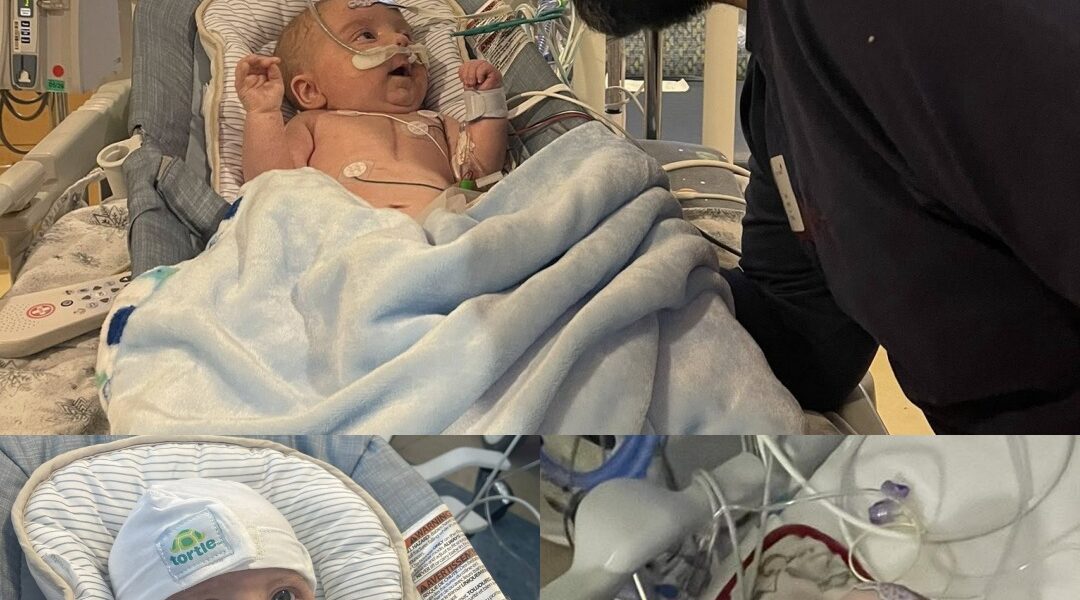

Today had been heavy.
The kind of day that weighed on every breath, every glance, every prayer whispered into the quiet hum of machines.
Jax was still holding on. But his tiny chest rose and fell harder than before, and the oxygen tube at his nose had to be turned up again. His mother sat by the bedside, her fingers wrapped gently around his small hand — the same hand that once clutched crayons and toy cars — now resting motionless beneath hospital sheets.

The monitors blinked in steady rhythm, each sound a reminder of how fragile everything was.
When the lab results came back, the room grew even quieter.
The infection they feared was real. His white blood cell count — 35. Way too high. Too dangerous for a little boy who had already been battling a stubborn virus that left him weak and pale.

The doctors ordered a blood culture, their voices calm but eyes shadowed with concern. They wanted to see if it had spread — if Jax’s small body was tipping toward sepsis, that silent, merciless enemy.
And as the team worked, the mother’s thoughts drifted.
She remembered the last time Jax was home, curled up on the couch with his favorite blanket, laughing at cartoons. She remembered his soft giggle — that sound that could erase a thousand worries.

Now the laughter had been replaced by the steady hiss of oxygen.
There was also a small shadow on his lung, one that looked like the beginning of pneumonia.
“Could that be what’s driving the infection?” she asked softly. The doctor nodded, his tone careful. “It might be. We caught it early, but we’ll have to watch closely.”
Early.
That word was a lifeline — thin, fragile, but still hope.

They started antibiotics immediately, fluids dripping slowly through the IV. The nurse smiled kindly, brushing a strand of hair from Jax’s forehead. “We’re going to get you feeling better, buddy,” she said, her voice warm but trembling just slightly.
Still, the waiting began.
The hardest part.
No one tells you how loud silence can be in a hospital room — the endless ticking of seconds as you wait for test results, for miracles, for good news that might not come.

3:30 a.m. That was when the blood culture would come back.
Until then, there was nothing to do but pray.
And pray they did.
“Please, God,” his mother whispered, “let this infection stop here. Don’t let it take him from us. Don’t let him get worse.”

Outside the window, night pressed against the glass — cold, endless, and full of questions no one could answer.
But then came Jax’s voice, soft and playful, breaking the heaviness in the air.
He was gossiping with the nurse again, asking her about her favorite ice cream flavor, his small grin glowing through the oxygen tubing. Even now — even in pain — Jax was being Jax.

A spark of light in a world that had been holding its breath.
The doctors often said that children like him — children who smiled through storms — taught them more about courage than any medical textbook ever could.
By morning, the nurses had started calling him “our sunshine.”
When the next set of labs came back, the numbers told a story no one dared to hope for just hours before.

His WBC count had started to fall — sharply. The antibiotics were working. The fever had eased. His oxygen saturation held steady, and his little body seemed to be fighting back.
By the second day, the doctors gathered at the foot of his bed, glancing at the monitors and sharing cautious smiles. “He’s responding well,” one said. “Really well.”
And then, something remarkable — they turned down the oxygen flow.

At first, his mother held her breath. But Jax didn’t falter. He kept smiling, his chest rising and falling easily.
By noon, they made the call.
“Let’s try him without oxygen.”
The nurse slipped the tubing away, freeing his face. For the first time in days, his cheeks looked like his own again — pink, soft, alive.

His mother’s tears came before she could stop them. “You did it, baby,” she whispered, pressing her lips to his forehead.
Jax grinned, whispering back with that familiar little spark, “Told you I’m strong.”
And he was.
The boy who had been hooked up to machines, surrounded by fear, was now breathing on his own.

When the blood culture finally came back — negative for sepsis — the whole room seemed to exhale at once. Relief filled the air, like sunlight breaking through after days of rain.
The doctors still wanted to wait a little longer, to be sure. “If everything stays stable, we may be able to discharge him by Friday,” the lead physician said gently.
Friday.
A word that suddenly felt like freedom.

Messages flooded in — friends, family, even strangers who had followed Jax’s journey online. “We’re praying for you.” “Stay strong, little warrior.” “You’ve got this, Jax!”
Every word, every heart, lifted them higher.
His mother posted a small update that evening:
“Jax and his prayer warriors did it again. 🤍 Today our sweet boy came off oxygen completely. His WBC count, which was almost three times higher than it should’ve been, is now back to normal. And so far, his blood culture is negative for sepsis. We’re hopeful we may be able to go home by Friday. Thank you for every prayer, every message, every ounce of love. Our miracle boy is fighting… and he’s winning.”

Those words carried across hundreds of screens — and into hundreds of hearts.
People who had never met Jax whispered his name in prayers that night. Nurses who had cared for him smiled quietly to themselves.
Because Jax wasn’t just another patient.
He was a reminder.
A reminder of how the smallest hearts could hold the greatest strength.

Of how faith and science, prayers and medicine, could stand side by side — both fighting for the same fragile miracle.
And through it all, Jax never lost his light.
Even when the machines beeped through the night, even when fear filled the corners of the room, he smiled. He teased. He thanked every nurse. He joked that the hospital food was “kinda gross but okay.”

He was joy personified — sunshine wrapped in hospital blankets.
And though his parents had spent countless nights by his bedside, hearts breaking and mending over and over, they knew this truth: their boy was a fighter.
The kind of fighter who teaches the world that miracles don’t always happen in thunder and lightning — sometimes, they come quietly, in the rhythm of a child’s steady breath.

As the sun rose over the hospital that Friday morning, Jax sat up in bed, tracing little hearts on his mother’s hand.
Outside, the world was waking.
Inside, healing had already begun.
Holding On in the Darkest Hours: Branson’s Story of Faith and Survival.1858

They were still in the trenches, and every day felt like an endless war.
Nothing had changed.

Nothing had lifted.
It was as if the same heartbreaking battle pressed repeat with no mercy, no pause, no relief.

Branson’s tiny body had been through storms that most adults would crumble under.
And yet, here he was — still fighting.
Still holding on, though the weight grew heavier with every passing hour.

That morning, his oxygen levels began to dip.
His chest rose and fell with uneven rhythm, the monitors telling a story no parent ever wanted to hear.
The nurses acted quickly, placing the tubing back against his face.

Once again, oxygen was his lifeline.
Once again, the family found themselves staring at a fragile thread between life and loss.

The doctors ordered tests.
They scanned.
They searched.
They looked for answers that weren’t there.

The chest x-ray came back clear.
So did the other tests.
No pneumonia.

No infection hiding in the lungs.
The culprit, they believed, was the same relentless virus — adenovirus — that had tormented him for weeks, refusing to release its grip.

It was like watching a wildfire spread, invisible but consuming everything in its path.
Every breath he fought for felt like borrowed air.
Every moment stretched like eternity.

The day before, Branson had received more donor cells.
The infusion dripped slowly into his arm, a small army entering his bloodstream with one hope — to strengthen his exhausted immune system enough to wage war against the invaders.

But his little body was so tired.
So weary.
It had carried too much, endured too much.

Not only was the adenovirus still present, but the BK virus had returned.
This, too, was brutal.
It was as though his body was a battlefield, and wave after wave of enemies kept arriving with no end.
The family stood helpless on the sidelines, praying the cells inside him would rise like soldiers and defend what little ground he had left.

Earlier in the week, the doctors had decided to take a closer look.
Branson had undergone both a colonoscopy and an endoscopy.

He was sedated, fragile under the lights, as the team worked carefully to understand the cause of his unrelenting stomach pain.
The results were crushing, though not surprising.

His intestines were severely inflamed.
His abdomen was filled with fluid and air.
This explained the stabbing pain, the constant nausea, the vomiting that left him too weak to lift his head.

The doctors said aside from that inflammation, everything else looked okay.
But even “okay” felt like a hollow word in the face of his suffering.

Most days, Branson now slept.
He barely ate.
He barely drank.
He seemed so frail, as if the weight of the world was pressing down on his thin shoulders.

His mother begged again about placing a feeding tube.
His body was malnourished, starved of the strength it needed.
But the doctors shook their heads.

His platelet counts were too low.
And with the vomiting, the risks were far too great.
So they waited.
Prayed.

Hoped that soon his counts would rise enough for him to get the nourishment his body so desperately needed.
Because he deserved strength.
He deserved healing.

The doctors explained something that cut deep.
They said Branson’s body was taking a harder hit than most children do after transplant.
The reason was simple, yet heartbreaking — all the harsh therapies he had endured in the United States before arriving here had left scars that could not be undone.

His body was battered before it had even begun this fight.
And now, every step forward was twice as hard.

For his parents, watching him suffer day after day was a pain words could not carry.
There were no sentences strong enough to hold the weight of it.

They lived with a constant ache — the ache of being unable to take the suffering away, the ache of watching a child’s innocence swallowed by endless procedures, endless pain.

They missed home.
Not in a casual way, but in a way that hollowed out their chests.
They missed Donald.
They missed Maddox and Maggie.

They missed their dog, whose joyful bark used to fill their evenings.
They missed their people, their routines, their life that had once been ordinary.
They longed for the sound of familiar voices, the smell of familiar rooms, the comfort of a life not measured by hospital beeps and medical charts.

Living this nightmare while the rest of the world kept spinning felt unbearable.
Everyone else moved forward.
Everyone else lived birthdays, dinners, games, and quiet evenings.

But for them, time stood still.
They were trapped in a moment that never seemed to end.

Still, in the silence of the night, when despair pressed in, they prayed.
They prayed that the new donor cells would take hold.
They prayed that Branson’s body would find the strength to turn a corner soon.

They prayed that the viruses would be cleared, the inflammation would subside, his pain would lessen.
They prayed his appetite would return, that his vision would sharpen again, that his small body would find strength where none seemed to remain.
“Please,” they whispered.
“Please let him feel good again. Please let him just be a kid again.”

Faith had become their anchor, though some days it felt impossible to hold on.
Still, they clung to it.
They clung to the prayers being lifted for their boy, believing that every single one was carrying them through.

This journey had broken them and remade them a thousand times over.
It had stripped away everything they thought they knew about control, about certainty, about tomorrow.
But it had also revealed the raw, unshakable power of love.

They ended each update with the same plea — pray, pray, pray.
Because they knew that prayer was not just words; it was a force that sustained them when they had no strength of their own.
It was the thread pulling them forward, day after day, moment after moment.

“Thank you,” they said again.
Thank you for every message.
Thank you for every prayer.

Thank you for every ounce of love and support.
Without it, they could not make it through a single day.

And so, in the trenches, with no end in sight, they continued.
One breath.
One step.