
Ellie’s journey began before she even took her first breath. At 20 weeks, during a routine scan, her parents were told she had a rare heart defect — transposition of the great arteries (TGA). It was a diagnosis that turned hope into fear in an instant.
Her mother, Lauren, recalls the day vividly. “I couldn’t believe it. Everything felt like it was slipping away,” she says. The doctors explained that without immediate intervention, Ellie’s chances were perilously low.
Ellie was induced at 39 weeks. She came into the world fragile but surprisingly strong. Her early response to treatment gave her doctors a glimmer of hope. A cancellation slot allowed her first life-saving surgery at just five days old.
The day before surgery, a new complication emerged. One of her coronary arteries was embedded into the aorta — a condition so rare that survival rates plummeted. The surgeons reassured Lauren and her family, but the uncertainty was overwhelming.

The operation was complex, but Ellie survived. Her parents celebrated, believing the worst was behind them. Yet their relief was short-lived. Pulmonary hypertension and chylothorax kept her sedated and tethered to machines, her tiny body still fighting.
Just as the family began to breathe, disaster struck again. On what should have been a routine attempt at breastfeeding, Ellie suffered a cardiac arrest. Miraculously, an anesthetist on the ward stabilized her, but this was only the beginning.
Ellie’s next cardiac arrest happened in the cath lab. ECMO, a form of life support, became her lifeline. The sight of their daughter cold and unresponsive in PICU shattered Lauren and her husband, but they refused to give up hope.
The surgeons devised a daring plan: a coronary artery bypass graft normally performed on adults, now adapted for a baby no bigger than a loaf of bread. They compared her coronary artery to the thickness of an arm hair. Against all odds, they succeeded.

For five more days, Ellie remained on ECMO. When she finally came off, the surgeons declared her heart had regained full ventricular function. “A miracle,” they called her. But Ellie’s fight was far from over.
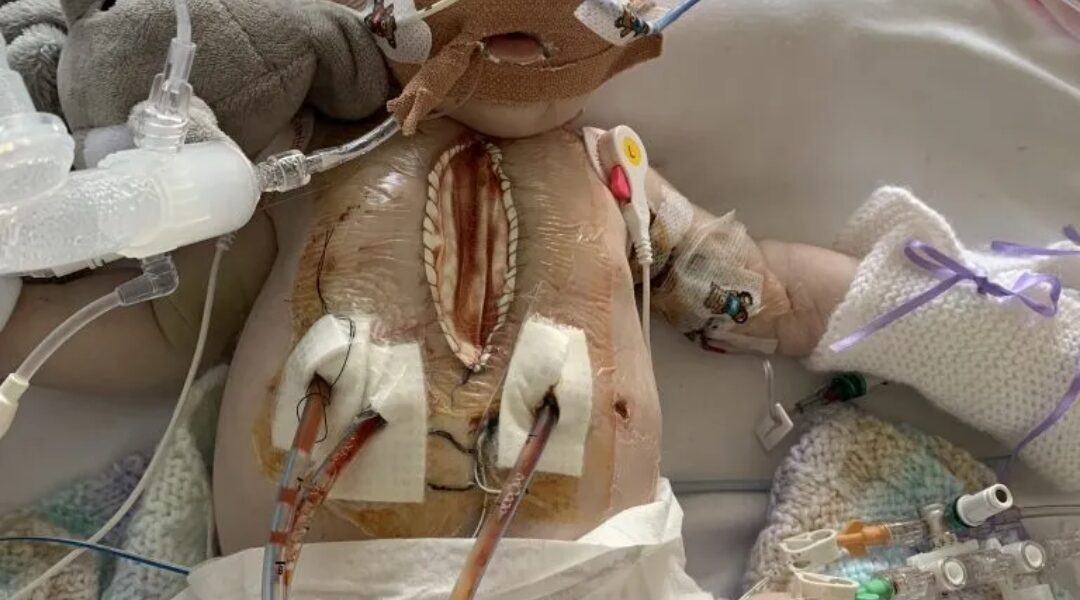
The following day brought necrotising enterocolitis (NEC), a devastating intestinal infection. Surgery was urgent, even with her chest still open from ECMO. The statistics were grim, but Ellie endured. A stoma was placed — a small reminder of the battles she had already won.
Recovery in PICU was relentless. A collapsed lung, repeated chylothorax, and diaphragmatic palsy challenged her tiny body. Each procedure and intervention demanded courage far beyond her age. Through it all, a dedicated medical team stood vigil.
Transitioning to the cardiac ward should have been a relief. Instead, feeding difficulties and stoma output slowed her progress. TPN, intravenous nutrition, became her main source of sustenance. Her parents stayed close, anxious yet determined.
Just before planned stoma closure, another crisis hit. Ellie developed rigors and a racing heart while resting. Tests revealed an infection in her Hickman line. Targeted antibiotics became her new armor in a seemingly endless battle.
Days later, Ellie was finally ready for surgery. The Hickman line was removed, her stoma closed, and her recovery accelerated. After twelve weeks in the hospital, Lauren and her husband brought Ellie home for the first time, their hearts heavy with exhaustion yet full of relief.
The family’s ordeal changed them forever. Ellie’s journey taught them the fragility and beauty of life, the importance of kindness, and the power of community. They have committed themselves to raising awareness for congenital heart disease, ensuring other families can face hospital journeys with information and support.
Ellie’s story is one of resilience beyond comprehension. Every setback was met with courage; every procedure was a battle she refused to lose. Her fight has inspired thousands to recognize the strength in even the smallest lives.

For Lauren, sharing Ellie’s story is both cathartic and purposeful. She hopes that through awareness, more children like Ellie can find the care and hope they deserve. “We will never take a single heartbeat for granted,” she says.
From the brink of death to miraculous survival, Ellie embodies hope. Her tiny heart endured impossibly complex surgery, repeated infections, and life-threatening complications. Each day she thrives is a testament to her will to live.
Ellie’s experience underscores a truth many take for granted: miracles often come in the quiet, relentless battles fought behind hospital doors. It is a story of tenacity, love, and unwavering faith in the human spirit.

Her family now looks to the future with cautious optimism. They know challenges remain, but every milestone — every smile, every breath, every beat — is victory. Ellie is living proof that even the smallest hearts can hold the greatest courage.
In the world of congenital heart disease, stories like Ellie’s are rare and precious. They remind us that science, skill, and hope together can defy the odds. And sometimes, against all probability, life prevails.
Ellie’s fight is far from over, but her survival is already a triumph. It’s a story that leaves the world in awe and families across the globe inspired. Every parent, doctor, and nurse involved witnessed the extraordinary strength of a life determined to endure.

From her first gasp to her homecoming, Ellie’s journey captures the essence of hope. Her parents share their story not to dwell on fear, but to shine a light on the miracles that happen when love, expertise, and faith collide.
Every heartbeat is a reminder. Every smile is a celebration. And every story like Ellie’s brings awareness, compassion, and hope to families facing similar battles.
Her fight continues, and so does the impact of her story. A tiny girl with an enormous heart has shown the world that courage knows no size, and miracles often arrive when we need them most.
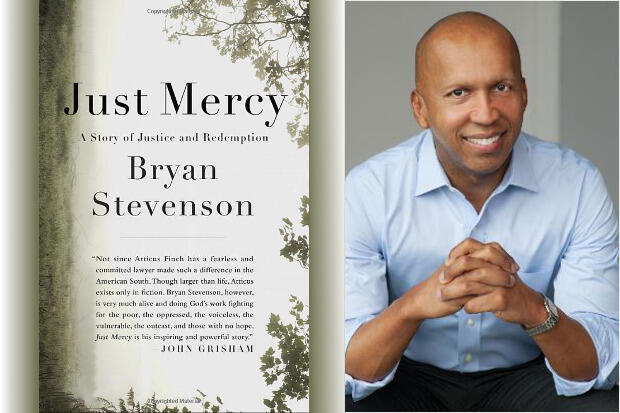
Bryan Stevenson – The Lawyer Who Fought for Mercy

When most people turn away from pain,
Bryan Stevenson walks toward it.
He spends his life sitting across from men and women condemned to die —
not to defend their crimes,
but to remind the world of their humanity.
Bryan Stevenson was born in 1959 in Delaware,
into a world that still whispered segregation.
He grew up poor, in a small town where black families lived in fear of white violence,
and opportunity seemed reserved for someone else.
But from an early age, Bryan had two things:
faith and empathy.
He once said,
“My grandmother taught me that each of us is more than the worst thing we’ve ever done.”
Those words became the foundation of his life’s work.
He studied at Harvard Law School —
but the more he learned about law,
the more he saw its failures.
In his final year, he visited a death row inmate in Georgia.
The man was shackled, terrified — yet when Bryan listened to him,
the prisoner’s fear faded into gratitude.
“Thank you for coming,” he said softly.
“You’re the first person who’s ever treated me like I’m not invisible.”
Bryan walked out of that prison and realized:
he didn’t just want to be a lawyer —
he wanted to be a witness to injustice.
In 1989, he founded the Equal Justice Initiative (EJI) in Montgomery, Alabama —
a place that had once been the heart of the slave trade,
and now was home to one of the highest execution rates in America.
He started with no money, no staff,
and an old phone that barely worked.
But people came.
Poor people.
Black people.
Children sentenced to die in adult prisons.
He defended them all.
He said,
“The opposite of poverty isn’t wealth.
The opposite of poverty is justice.”
His most famous case was Walter McMillian,
a Black man wrongfully convicted of murder
and sentenced to death for a crime he didn’t commit.
Bryan uncovered suppressed evidence, lies, and racial bias.
He fought for six years — and in 1993,
McMillian was exonerated and freed.
When Walter finally stepped out of prison,
he hugged Bryan and whispered,
“You gave me my life back.”
But Bryan shook his head.
“You gave me mine.”
Over the decades, he’s argued before the U.S. Supreme Court,
winning landmark cases that ended life-without-parole sentences for children.
He built the Legacy Museum and National Memorial for Peace and Justice —
a haunting tribute to the victims of slavery and lynching in America.
He wanted the nation to remember —
not to shame,
but to heal.
“We cannot recover from our history of racial injustice,” he said,
“until we confront it.”
Despite threats, insults, and exhaustion,
Bryan never stopped believing in mercy.
He visits prisons every week,
holds the hands of the condemned,
and tells them,
“Your life still has meaning.”
He’s been called a saint,
but he says he’s just stubborn —
stubborn about love,
stubborn about hope.
“You can’t understand the power of redemption,” he once said,
“until you’ve seen what broken people can become when someone simply believes in them.”
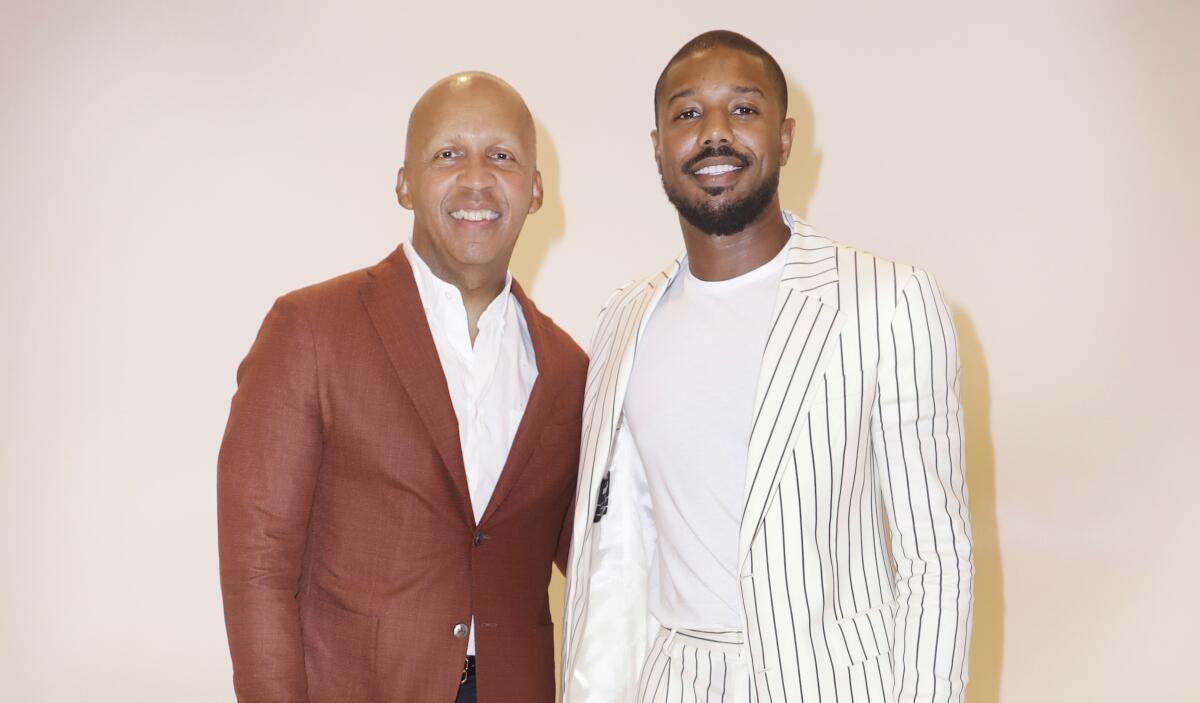
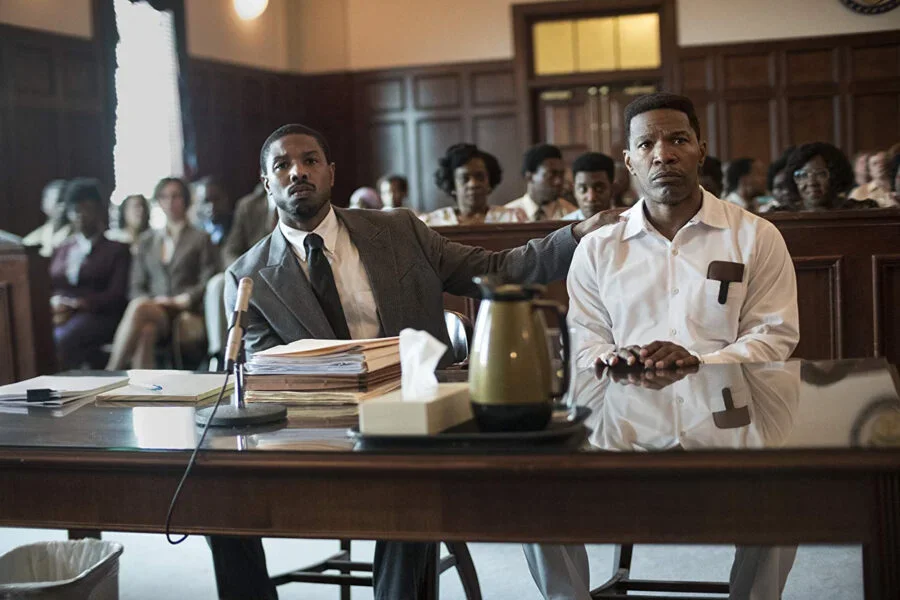
In 2019, his work was immortalized in the film Just Mercy,
starring Michael B. Jordan as Bryan and Jamie Foxx as Walter McMillian.
The movie moved millions —
but Bryan’s real impact can’t be captured on screen.
It lives in the 150 men freed from death row,
the children who will grow old because of his advocacy,
and the conversations about justice he sparked across the world.
He reminds us that mercy isn’t weakness —
it’s the most courageous form of strength.
He says,
“Each of us is more than the worst thing we’ve ever done.”
“Each of us is better than the injustice we’ve endured.”
Bryan Stevenson doesn’t just fight the law —
he rewrites what justice means.
Not revenge.
Not punishment.
But redemption.
Because in his world,
every life still matters,
and no soul is ever beyond grace.