
Imagine a person who once lost the ability to walk—someone who had to rely on a wheelchair, crutches, and the help of others for every step they took. Now, picture that same person standing tall, walking upright with ease, no crutches in sight, no wheelchair to slow them down—just the power of advanced robotics propelling them forward.
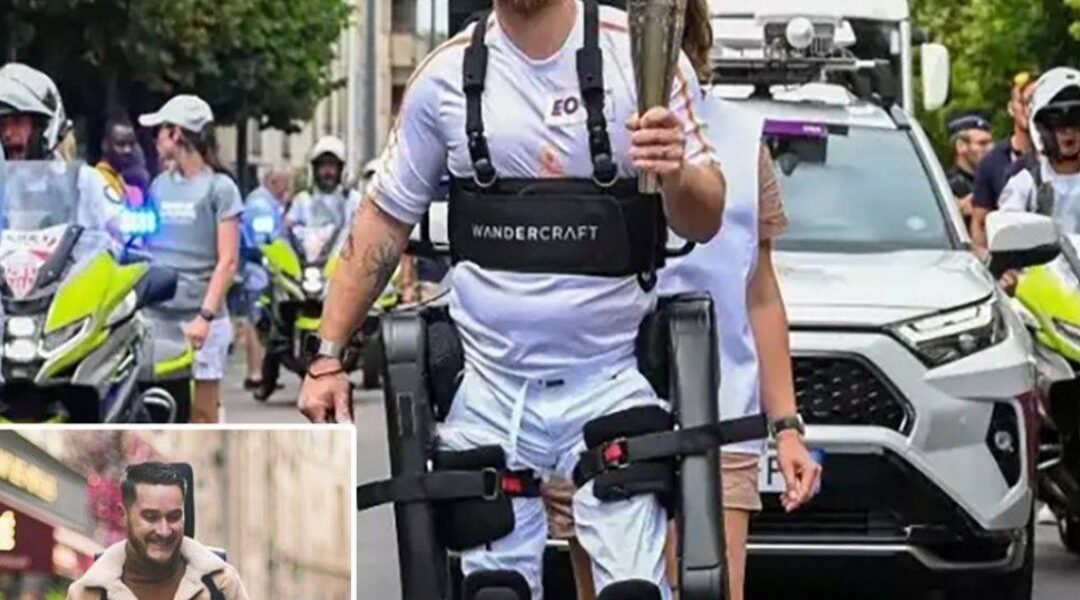
This is exactly what happened in 2024 when French athlete Kevin Piette, paralyzed after a life-changing accident, defied the odds and made history in Olympia, Greece. With the assistance of the Wandercraft robotic exoskeleton, Piette took steps that were once unimaginable—walking across the ancient stones of the Temple of Hera while holding the Olympic flame in his hands.
The moment was not just a personal triumph for Piette, but a groundbreaking milestone in the world of technology, athletics, and human potential. The exoskeleton, powered by artificial intelligence and automatic balance systems, didn’t just give Piette the ability to walk again—it redefined what’s possible for people living with disabilities.
For years, society has watched with empathy as those living with physical disabilities have fought for inclusion and accessibility. Technology has made great strides, but the idea of mobility for people who were once unable to walk was still largely confined to the realm of dreams. Yet, thanks to innovations like the Wandercraft exoskeleton, that dream is now a reality.
Piette’s historic walk wasn’t just about mobility; it was about a declaration—a message to the world that the future of inclusion is already here. In that fleeting yet monumental moment, the boundaries of possibility were pushed. The Temple of Hera, standing as a symbol of the strength, resilience, and power of the human spirit, became a perfect backdrop for this groundbreaking achievement. With each step Piette took, he demonstrated that the limitations of the past do not have to dictate the future.

What made this moment even more profound was its connection to the Olympic spirit. The Olympics have always been about breaking records, overcoming obstacles, and striving for excellence. Kevin Piette’s walk in Olympia was a living tribute to these ideals. By holding the Olympic flame—an eternal symbol of hope, unity, and perseverance—Piette wasn’t just walking forward in the exoskeleton. He was walking forward in human history.
This moment was about more than just a technological achievement. It was about the people who have been historically left behind or sidelined. Piette’s walk served as a reminder that no matter the obstacles, there are no limits to the human spirit. It told the world that people living with disabilities are capable of achieving incredible feats when they are given the right tools, support, and opportunity.
The Wandercraft robotic exoskeleton, which made Piette’s walk possible, isn’t just a device for mobility. It’s a tool that holds the power to change lives, allowing people to regain independence and reclaim the activities they once thought lost forever. With advanced sensors and AI, the exoskeleton automatically adjusts for balance, providing users with the ability to walk naturally—no longer relying on traditional methods of assistance.
Piette’s journey is a beacon of hope for the future, not just for those living with paralysis, but for anyone who has ever felt limited by the body they inhabit. It demonstrates that innovation, coupled with determination, can break down barriers and open doors to a more inclusive world. Piette’s walk across the Temple of Hera was not just a personal victory; it was a global declaration that the future of inclusion, accessibility, and mobility is already unfolding before our eyes—and it’s walking forward.

As Piette made his way across the historic site, he carried more than just the Olympic flame—he carried the hopes and dreams of countless others who have longed for the day when mobility would no longer be defined by their physical limitations. His steps echoed a message to the world: anything is possible if we dare to dream, innovate, and believe in the power of technology and humanity working together.
In that moment, the boundaries of what we thought was possible for people with disabilities shifted. And the world, watching from all corners, witnessed something more powerful than a historic walk—an inspiring declaration that the future is one of inclusion, strength, and limitless potential.
The future of inclusion is already here. And it’s walking forward. 💛⚡
Pola Stupar: An Unbreakable Spirit 423

At just sixteen years old, Pola Stupar faced a battle that no teenager should ever have to endure. Diagnosed with acute lymphoblastic leukemia, her world turned upside down almost overnight. For Pola and her family, life became a relentless cycle of hospital visits, treatments, and uncertainty. Childhood dreams of school dances, hanging out with friends, and exploring the world were abruptly replaced by fear, needles, and the sterile walls of hospitals.
The first rounds of chemotherapy were brutal. Pola endured days filled with nausea, fatigue, and pain that seemed endless. But even in those moments of despair, her spirit burned bright. She faced each challenge with quiet determination, refusing to allow the disease to define her. Her courage inspired not just her family, but everyone around her — doctors, nurses, and fellow patients.
Eventually, Pola’s battle required a bone marrow transplant, a procedure both life-saving and high-risk. The transplant brought hope, but it also brought a new adversary: graft-versus-host disease (GVHD). This condition occurs when the donor cells attack the recipient’s body, causing excruciating complications. For Pola, GVHD manifested in ways that made every movement agonizing. Her skin tore easily, her muscles weakened, and even walking became a monumental effort. Simple tasks that teenagers take for granted became daily battles.

Despite the relentless pain and the loss of a “normal” adolescence, Pola’s resilience never wavered. Every morning she faced the mirror, every step along the hospital corridors, every heartbeat was a defiance against the disease that tried to claim her life. She refused to surrender to fear or despair. Hospitals had taken much from her — her youth, her freedom, her dreams — yet her spirit remained unbroken.
Pola’s story is not just one of illness; it is a testament to the unbreakable human will. Each day she chooses life, even when her body protests. Each small victory — a step taken, a moment of laughter, a meal eaten despite nausea — is a triumph. Her courage radiates through the hospital rooms, inspiring other patients and families who witness her determination. She has become a symbol of hope, a reminder that even in the darkest moments, the human spirit can shine brilliantly.
Her family speaks with admiration and humility about her journey. “Pola shows us every day what strength really means,” her mother says. “She may be fragile physically, but her spirit is fiercer than anything I have ever seen. Every breath she takes, every small victory, is a lesson in courage and perseverance.”

Friends, teachers, and medical staff alike have been touched by Pola’s unwavering determination. They see in her a message far beyond her personal struggle: a universal reminder that even when circumstances are devastating, the choice to keep moving forward, to keep hoping, and to keep loving life is powerful beyond measure. Pola embodies resilience, inspiring those who know her story to confront their own challenges with courage and grace.
Pola’s battle also reminds us of the profound complexity of surviving cancer. Beyond the medical treatments, there is a psychological and emotional journey. Coping with the loss of normalcy, the limitations imposed by her body, and the fear of the unknown requires extraordinary fortitude. Pola navigates this every day, teaching us that strength is not only in physical recovery but in the relentless courage to face life fully, despite suffering.
Even now, Pola’s journey continues. Her days are filled with therapy sessions, medical appointments, and the painstaking effort required to regain strength and independence. Yet she meets each day with the same fierce determination that has defined her from the beginning. Her motto, whispered to herself during the toughest moments, is simple but powerful: “Not today.” Not today will she surrender, not today will she let the disease define her.

Pola Stupar’s story is more than a battle against leukemia or GVHD; it is proof of the unbreakable human spirit. It reminds us that courage can exist even in the most fragile of bodies, that hope can flourish amidst pain, and that one determined soul can inspire countless others. Her life is a testament to perseverance, love, and the extraordinary strength that resides within each of us when we refuse to give up.
As we share Pola’s journey, we honor her courage and determination. Each story told, each message of support, and each shared prayer adds to the community of hope surrounding her. Pola is not just surviving — she is teaching, inspiring, and showing the world that even amidst unimaginable challenges, life is worth fighting for.
Every breath Pola takes, every step she conquers, every smile she shares is a triumph — a celebration of resilience, spirit, and unyielding hope. Her story is a reminder that human will, love, and determination can overcome obstacles that seem insurmountable.

💌 Share to honor her courage, determination, and unbreakable spirit. Pola is living proof that no matter how hard life hits, the human spirit can remain uns