Migrant living in London tent city says being allowed into UK ‘felt like Christmas’

A Bulgarian national who arrived in the UK by small boat earlier this year has described the moment he entered the country.

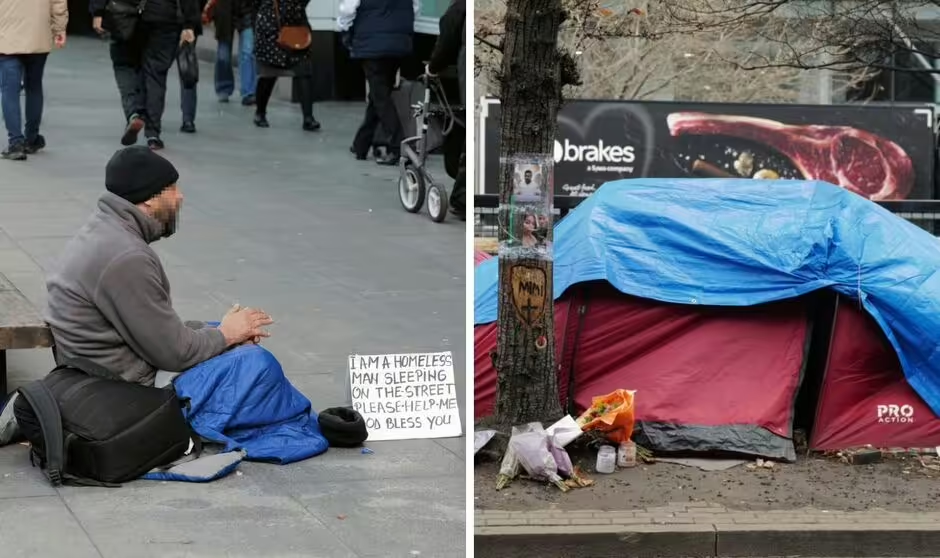
The man described entering the UK as ‘like Christmas’. (Image: w8media)
A resident of a London tent city who arrived by small boat this year says that entering the UK felt like Christmas. The Bulgarian national, who lives in a makeshift camp outside Warren Street station, told the Daily Express that the UK had long been his dream destination, thanks to the opportunities available in the country.
The man, who did not feel comfortable disclosing his name, is one of as many as 100 residents of the tent encampment, which has been described as “filthy” and “unsightly” by residents in the area where house prices average at £1.2million. Speaking in broken English, he described Britain as a “dream” destination for him and his neighbours in the tent city who are predominantly of Bulgarian and Romanian descent. He added: “Britain is very good. Where I am from, there is no money, nothing.”

The camp is made up of foreign nationals and English homeless. (Image: w8media)
Despite finding himself begging on the street across the road from the camp, the man said he had no regrets about entering the country.
He added: “I am very happy. Britain is very good.”
Another man, who gave his name as Igor and said he arrived via a small boat crossing two months ago, and described the danger that comes from living in the camp, with fights and violence happening “all the time.”
The aspiring bricklayer said: “Yes, there are lots of fights, all the time. This is not a good place to live, but we have nowhere else.”
Igor refused to say whether he had applied for asylum, given his recent entry into the country and the potential for being taken off the streets and into a hotel while his claim was being processed.
The expansion of the camp, which has accelerated significantly in recent months, contains a mix of Romanian and Bulgarian migrants at one end, and British nationals at the other.
Its presence has left locals seething, not only at the extreme amounts of rubbish that have accumulated in and around the camp, but also at the conditions that people have to endure.
Residents have called on Camden council and Transport for London, who partly own the site, to do more to close it down.

Locals have complained of significant rubbish attracting vermin (Image: w8media)

Residents who arrived by small boat say they have no regrets (Image: w8media)
Elderly resident Anne-Marie, who lives around the corner and has “led the charge” to have the camp removed, told the Daily Express that a small presence since before the pandemic has snowballed rapidly in recent months. She said: “The first ones appeared there and it was disgusting with rubbish piled high, but the council did actually do something about that.
“But those here now encourage other people to join and the council has done nothing to stop it.”
She added: “The litter and the filth is such a huge problem, attracting foxes and rats but it can also be extremely intimidating
“Particularly when the chaps are hovering around the station, they can be quite intimidating at night, especially for women on their own.”
Locals report that a handful of tents appeared before the pandemic, but say the current site is around ten times the size.
A TfL spokesperson said: “No one should be faced with sleeping rough on London’s streets. Euston road is a busy part of the road network that is not a safe place for people to stay and our focus is on the safety and welfare of everyone involved.
“We will continue to closely monitor the situation and work with partner agencies and Camden Council to explore and progress all options to ensure the safety and welfare of everyone currently sleeping rough there.
“This includes continuing to work with outreach partners who can help individuals access the available and appropriate support.”
A Camden Council spokesperson said: “We take residents’ concerns very seriously. This is not a situation that can continue, and we are concerned for the welfare of people who are sleeping rough here.
“Our urgent focus is on working with partners, including the landowners, to prioritise helping people who are sleeping rough here rebuild their lives away from the streets.
“This means finding suitable accommodation and providing the range of support they need, while making sure the area is safe, secure and maintained for everyone.”