When I left the orphanage, they told me that nobody left me anything, only the key to a tractor.

Miss Chen at the public library was gentle enough to let me use a computer for hours. She made me promise to show up for story hour sometimes and brought me tea when the lines at the bus station were long. She helped me figure out which bus route would take me north, and when I stepped off in Maplewood three hours later, the town smelled like frying bacon and old newspapers. Rosie’s Diner was a brick-scented haven—a jukebox with more memories than songs and a counter that gave kindness like coffee.
“It’s been empty a long time,” Rosie said after I laid the key on the counter. Her eyes peered into the brass as if the metal might speak back. “Cunningham farm, you say? That old place… Robert Cunningham kept to himself. Died a dozen years ago if he lived a day. Folks said he had a daughter once, a Sarah. She left town. Tragic sort of story, like a country song.”
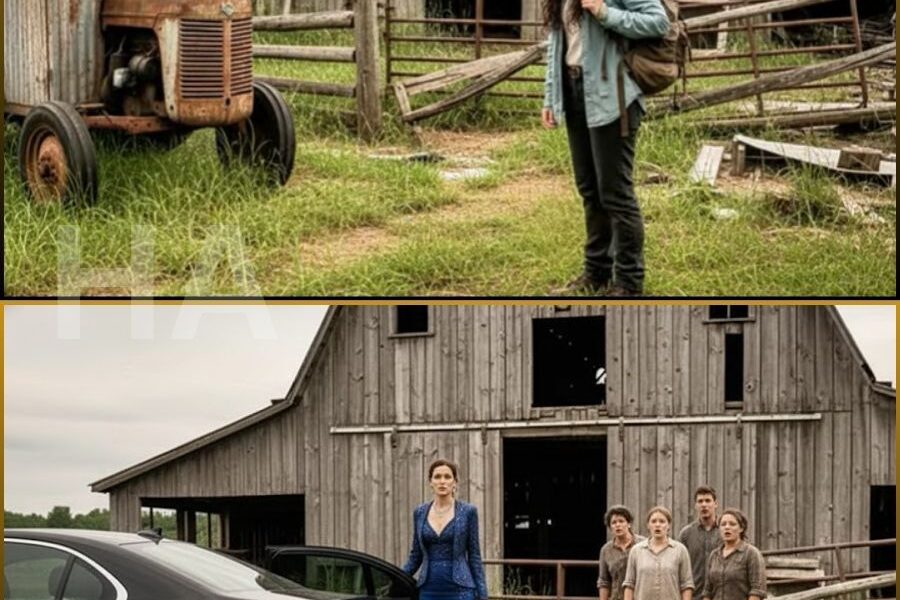
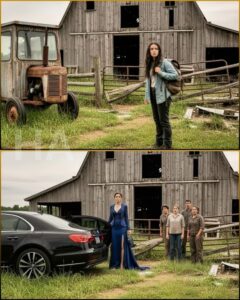
The bus driver who ferried me up Old Miller Road grumbled about the cost of gas but let me sit with my duffel on the floor and breathe. The driveway bent like an old arm and opened onto a yard where grass had learned to be wild again. Hillrest Farm presented itself in peeled paint and an air of patient waiting: a two-story house with shutters that had finally given up; a barn with more history than roof; a tractor tucked under a lean-to, green faded to the color of old money.
It wasn’t beautiful because someone had curated it. It was beautiful because it had kept existing. I approached the tractor with the reverence people usually reserve for icons or abandoned libraries. There was a plate bolted into the frame with a name—R. Cunningham, 1967—and below that, in smaller letters, “For Emma, always.”
The breath left me like a held note. The key in my hand had been the door, literally. I tugged up the tractor seat with force and the stubborn hinges surrendered. Under the seat, wrapped in oilcloth, I found a wooden box the size of a shoebox with dovetailed joins—Robert’s hands, careful even after he died. The brass lock was a perfect fit for the key.
The box opened on a small life. A photograph: a young woman holding a tiny bundle swaddled in that same yellow blanket. On the back, one neat line: Sarah and Emma, 3 days old. A letter in tremulous ink began, “My dearest Emma. If you are reading this, you found your way here, just like I hoped you would. My name is Robert Cunningham, and I—I am your grandfather.”
The letter was everything and nothing. It told me that Sarah had been his only child, that she had left at seventeen pregnant and frightened; that Robert had been too proud and stubborn and angry to chase her away; that he had tried, after she died, to find her because someone had told him she had a daughter. The state had said he was too old to care for a child. So he had done the only thing he could: he put his trust in time and traces. He had arranged for the farm to pass into my name if and when I could find it. He wrote of regret and hope and the small, fierce things people call love.
There were other things in the box, too—photographs, a journal, a stack of letters between Robert and someone named Claire (a neighbor? a sister? a friend), and a small brass key for the house. But the most disorienting detail was the way my life had been tracked by someone who’d never met me: photographs mailed to a man who kept a granddaughter’s face despite being denied the chance to hold her.
The lawyer in town—David Harrison, who smelled faintly of old paper and who had set aside a chair for my arrival—explained the trust to me with the clarity of a man who had read such complications into neat boxes for decades. Robert had structured it so that the property would transfer to me if I could produce the key and the letter. He’d set aside funds to cover taxes and maintenance for fifteen years. “He didn’t want the state to know,” David said, tapping a stamped line with a finger that left a trail of ink. “He wanted you to find him. To make this yours.”
“You mean he wanted a test?” I asked, feeling ridiculous and angry and deeply, impossibly grateful all at the same time.
“In a manner of speaking,” David said. “He wanted it to be you.”
Home is a complicated word for someone who spent childhood learning to be grateful for the minimum. The farmhouse smelled of cedar and dust and the things people keep to remember each other. Robert had kept Sarah’s room as sanctuary—child-sized bed, patchwork quilt, books on a shelf, a photograph of Sarah grinning like the whole world belonged to her for a minute. I carried the yellow blanket upstairs and laid it next to the quilt like two generations meeting.
I slept on the couch that first night, the house making conversational creaks and settling into new rhythms that included me. That was the small, private miracle: I woke up and the house recognized me as if it had been waiting. The tractor, which a mechanic coaxed back to life after three stubborn days, growled with the satisfaction of reclaimed purpose. I drove it in circles to test the soil and the air and my own trust in a thing I’d only just discovered I owned. It felt like calling across time and hearing someone call back.
There was more to the inheritance than land and lines on a map. In a loose floorboard of an equipment shed I found a metal box swollen with photographs—Sarah’s childhood, birthdays, river picnics. There were pictures of me as a baby, taken by someone who’d sent them across cities and time: a woman at a church, a neighbor holding a crying infant, a social worker carrying bundles to a bagged car seat. There was a journal in Sarah’s handwriting; the entries were at once ordinary—boy named Tom, the job at the diner—and then sharp and quiet, the sentences about fear and pregnancy and the decision to leave.
“I can’t bring her to Dad,” one line said, and the words hit like a knuckled blow. “Not after the way he looks at me. He deserves better than cleaning up my mess.”
It was an imperfect defense and a human motive, raw and combustible. Sarah had planned and protected and tried to heal in ways she could manage. She had not abandoned me for lack of love. She had been protecting two lives with the limited resources of a frightened, sick woman.
The town proved to be the kind of place that holds grudges and stitches hearts with the same hands. Rosie invited me to the diner and introduced me as a neighbor; she brought soup and the recipe for the easiest, most practical biscuits to fix a house and a mood. Rachel, whose grandmother had been friends with Robert, came with tea and a spit of gossip that softened into genuine warmth. Mr. Albright from across the road offered pliers and directions on where to find the best chains for winter. A woman named June, who ran the scrap-metal yard three towns over, let me trade an old radiator for a truckload of wood and told me the tale of every person who’d built this place into a home.
The kind of warmth the countryside gives is the kind that needs reciprocation. The farm needed fixing—roofing, plumbing, insulation. The tractor needed tires. The bank account in the trust shrank every time a contractor smiled and held up invoices. There were grant applications Emma had never imagined writing, and spreadsheets that blurred numbers into a language foreign to someone raised on hand-me-down rules and rationed allowances. I’d go into Rosie’s to warm my hands around a cup while I read community foundation instructions like some foreign scripture. The town’s people, in small, incremental gestures, became a network.
And then, as stories are wont to do, mine attracted attention.
The county had been quiet for years about Hillrest Farm. But old land, especially land with a tract large enough to slice into new parcels for development, never sits quietly forever. A man came with a slick suit and a softer smile, introducing himself as a real estate broker with an ambitious idea: a subdivision of country homes, a windbreak of new fences and new families with new cars. “It’s prime acreage, Miss Cunningham,” he told me in the diner, one hand resting on the Formica as if he owned the counters. “You could sell, rebuild, invest—turn what’s been a burden for years into something profitable.”
The word “sell” lodged into the paperwork on the kitchen table like a splinter.
He was not the first to come with numbers. Numbers are simple things. They sit across from the messy human parts and stare them down until they seem reasonable. The notion of selling the farm to pay off long-term debts and to invest in an easier life—an apartment, a degree, a move to the city—twined its way into my sleep, becoming a recurring shadow with reasonable terms and tidy checkboxes.
But there was another problem. Someone—someone with a claim—came forward. The name was faint on a yellowing fax: Marie Cunningham, a distant cousin, suddenly keen on genealogy and land. Her lawyer’s letter claimed that Robert had made informal promises to family members and that the trust had irregularities. It smelled of rusted entitlement and legal gaslighting. I had expected resistance of some sort; I had not expected the bitterness that would surface when land became actuarial rather than ancestral.
David Harrison, my lawyer, said it would be messy. He threaded through the legalese like a warden familiar with storms. “He wanted you to find it yourself,” David said, placing his palm over the map. “He wanted the person who would take care of it to be the one who discovered it. That’s maybe what’s getting contested now—the judge will have to see if Robert’s instructions were valid, if the trust was arranged correctly. People make dramatic claims.”
Contest it they did. Marie’s letter contained enough details to lodge a nuisance suit: breaches of form, questions about Robert’s competency, the timing of the trust’s establishment. The town that had offered plank benches and spare nails now offered subpoenas and judgment dates. The county courthouse turned into a theater where legal documents rustled and arguments took center stage. I read Marie’s affidavit and felt the world tilt to my left.
The legal timeline moved with the retro patience of a machine. Hearings were scheduled, affidavits filed. I sat in the courtroom with my lawyer, hands folded so hard the knuckles hurt, listening to a judge I’d half-expected to be benevolent and instead found to be an examiner with the glaze of calendar commitment.
Marie’s attorney had a way of speaking that made every truth a negotiation. “We challenge the validity of the trust instrument,” he said. “We believe the grantor’s competence was in question, and that distribution was not timely disclosed.”
David countered with the volume of intent. “Mr. Cunningham did what he could. There is an established trust. The bank and the title are clear. The records show a deliberate, well-documented effort to ensure the property would pass to his granddaughter under the conditions he set forth.”
Between pages of sworn statements, the judge looked at me—the very person the fight was ostensibly about—and asked soft, almost apologetic questions. “Ms. Cunningham, how long have you lived on the property?”
“Since I found the key,” I said. “About three weeks.”
It felt like admitting to trespassing to say the sentence aloud in front of men whose suits had never needed to learn how to hold a screwdriver.
The peak came, as complex narratives so often do, not in the courtroom but in its margins. A meeting in Rosie’s Diner where townspeople came in jeans and boots and fed me casserole and stubbornness. An open letter in the Maplewood Gazette (hand-typed by June, who thought legalese to be best answered with common decency) that pointed out something obvious: Hillrest Farm had been a farmer’s space for generations. Robert didn’t deserve to have the place turned into a grid of identical houses. It was his legacy, and—people said this with the blunt honesty that small towns possess—the law shouldn’t be used to steal heritage.
Neighbors offered depositions that mentioned Robert’s kindness, the way he fixed a tractor for someone with no money and refused payment; Rachel told the tale of him teaching her how to drive a truck across a field and the patience in his voice. They spoke of the letters he’d written, the photos he’d saved, the way he’d insisted the granddaughter would come find him. Little depositions became a chorus. The townspeople’s testimony—about a man’s intention, about a life lived quietly and deliberately—tilted jurors and judges in a way legal citations couldn’t.
At the hearing, when the judge read from a stack of character statements, I realized the fight was no longer just about a piece of paper. It was about whether a life of small, careful love could be honored against claims made by those who arrived after the fact.
The judge ruled in my favor. The trust, he decided, met the legal standard; the test of time and intention had weight. Marie shook her head as if the world had been unfairly changed. Her lawyer clenched his jaw. I felt guilty and raw and bewildered and elated all at once.
The victory did not dissolve the practicalities of keeping a farm. The trust money would help in the short term, and grants and loans would be necessary for long-term sustainability. There were winter mortgage payments to design out of thin air and a roof that leaked like a sieve. But victories make space for breath. In the days after the ruling, people uncovered old seeds in the barn and taught me how to read a soil test. Mr. Albright helped me fence a small pasture. Rosie taught me to find joy in making big pots of stew for volunteers who came with tools and a willingness to elbow into work.
The human climax of the story wasn’t the judge’s gavel. It was the morning I woke to find a pile of letters on the kitchen table—dozens of them, from people across the state who’d read about Hillrest in the Gazette. The letters were messy and generous, baby-step pledges: a woman in Vermont sending heirloom tomato seeds; a retired carpenter offering to volunteer for the summer; someone sending money they could afford to give to help the roof. Strangers and neighbors alike curated a chain of small mercies that stitched the place into something living.
When winter settled hard and the fields, stripped of their late fall gold, took on the muted blues of frozen breath, I worked alongside Rosie and Rachel and the men who’d known Robert when he was young. We cleared the yard of the detritus left by neglect and used the trust money to get permanent repairs started. I enrolled in community college courses online, agribusiness at first because I wanted to understand the language of soil and the math of planting. I read books like they were prayers.
On the first day of spring—really spring, with its sticky mud and the sense of possible things—we planted seeds in rows that looked ridiculous but honest. The tractor, polished and regaining its dignity, moved slowly across the fields. I sat on its seat with hands that had once trembled at the weight of a key, and the world felt full of the kind of responsibility that was also a privilege.
There were quiet conversations I’d have for the rest of my life. Questions about why Robert had been afraid to step forward when Sarah left; apologies to be accepted and given for things tied together in bitterness and shame; forgiveness that was messy and sometimes resisted. I learned that love is often unglamorous: letters written in the middle of the night, savings tucked into jars hidden under floorboards, small acts that mean nothing to the office that issues forms but everything to a person who receives a photograph.
One evening, standing on the porch with the yellow blanket over my shoulders and the quilt folded across my lap, I looked across the acreage as the sun put gold on the trees. Rachel came with two mugs of tea and a smile that had learned the shape of contentment. Rosie swung by to drop off a pot of stew, and Mr. Albright, who wore a hat like an exclamation point, helped me hang a new mailbox painted in a bright impossible red.
“You missed the hearing, you know,” Mr. Albright said, nudging me with a gruff elbow. “You were supposed to be in front of the judge, but you sat right here on the porch, because you said you needed to see your land before you spoke.”
“I needed to remember who I was speaking for,” I answered. “This is where I belong now.”
The small house breathed in and out, its old bones quiet and steady. There were faces in the windows that had nothing to do with legal ownership: neighbors who’d brought pie and offered spare blankets for storm nights; kids who’d learn the dizzying joy of catching frogs in the pond; an elderly woman who came every Tuesday to play the old record player in the living room and teach me hymns Robert had liked.
In the thick center of the first summer that felt like mine, I held a little ceremony that was nothing and everything. We invited the town. Rosie tabbed the announcement onto the diner board. June drilled holes in new fence posts. A woman with a blue hat brought a cake smashed with marigolds because she said a party needed the smell of summer. We stood in a ring near the old tractor, where the brass plate caught sunlight, and I read Robert’s letter aloud.
“For Emma, always,” he had written. For a long time I had heard the words as some small pronouncement of legal thing. Now they sounded like a vow. I read to the people who’d become my life—Rosie and Rachel, Mr. Albright, June with her scrap-metal hands, the mechanic who’d mended the tractor, David who had worried over every clause like a guardian. I read the parts about hope and regret and the clumsy human faith he’d placed in a finder’s key.
At the end, a hush went through the circle. Then a woman with a baby on her hip—one of the families from the nearby town—stepped forward and hugged me. “Thank you for keeping it,” she whispered. “There are few places like this left.”
That’s the truth, I suppose. Home isn’t a tidy line in a county book. It doesn’t arrive like a box that says “yours.” It arrives like weather: slowly, sometimes violently, often when you have to get up to meet it. It arrived for me in the form of a tractor key and a stubborn old man’s plan, and then in the form of neighbors who showed up with shovels and pies. It arrived in courtroom testimony that tied intention to legal form, in letters mailed by strangers who believed small towns deserved protection, and in the steady work of repainting and planting. It arrived, finally, in the quiet knowledge that people existed who would stand for me—not because they had to but because they wanted to.
There were unanswerable questions that remained and always would—why Sarah had moved as far as she did, why she had been so frightened, why Robert had been so proud that he chose to watch from a distance. But the answers to those questions did not have to be full and perfect for me to keep living. Imperfection, it turned out, was an inheritable trait too.
Years later, when I sat on the tractor with a toddler who had Claire’s laugh and Rosie’s resilience, I told the child a story about a yellow blanket and a man named Robert who loved from the edges and a mother who had been brave in her own flawed way. The child’s hands were sticky from jam, and he leaned his head against my shoulder with the kind of absolute trust that made every scar feel like a map.
“You know,” I said, to no one and to everyone, “the tractor really did know.”
It had been a key—literal brass, stamped and worn—and the thing it opened was more than a door. It had been a thread, a coaxing note, a test of whether a girl would come find what had been kept safe for her. It had been the shape of a promise that a life could be preserved, even if love looked from afar.
When I went back to visit Mrs. Patterson at Riverside years later, I took a pie and a handful of seedlings. The children were younger now, bright-eyed and suspicious in the way only children born into systems can be. I sat with them in a circle and told the story in a softer voice, leaving out the parts that might weigh them down. Afterward, Mrs. Patterson patted my hand and said, “You found what a lot of kids here never do. You kept it.”
“I had help,” I said.
“You made your own help,” she said, and in her eyes the fluorescent hum didn’t sound so tired anymore.
The tractor sits under the lean-to, a little less rusted, a little more patient. The farmhouse keeps time by the sun and the roofline. The pond reflects clouds and, occasionally, the curious face of a child. Hillrest Farm is not an end to wandering, but a place to lay things down and keep them—seeds and stories both.
When the phone rings now and someone asks the way to Hillrest, I tell them to follow Old Miller Road until the trees open and then listen for the sound of a tractor like someone sawing a quiet bell. If they come with hands willing to work, and a heart willing to hold the small, awkward, courageous kind of love people learn to give when the world teaches them scarcity, I tell them to stay. We have room.
I still sleep sometimes with the yellow blanket draped over the foot of my bed. It is threadbare and soft as truth. It was a map once, and now it is a story I can tell without being hollow. The tractor hums in the morning like a throat clearing. The plate on the frame still reads R. Cunningham, 1967. Beneath it, the words that had started the whole thing: For Emma, always.
And always, I find myself thinking, is precisely the kind of word a small town understands. It is the kind of word people show by bringing ladders to broken roofs and quilts for strangers, by reading legal affidavits into a chorus that bends a judge’s ear, by teaching a girl to read soil and balance a budget, and by taking an old grief and turning it into a home.
We did not fix everything. We did not smooth out the edges where life had cut and scarred and left questions like stones. We learned instead that there are ways to carry what has been lost and ways to fold what is remaining into a place that will hold the next person who needs it.
I keep the key in a small wooden box on a shelf now—an item to be shown to another curious child or perhaps placed under a tractor seat for some ancestry-minded soul to find. Once, walking past the tractor at dusk, I paused and ran my fingers over the brass plate. The metal had warmed from the day’s sun. For a long time I pressed my palm there and whispered, “Thank you,” to a man I had never met, and to a mother who had loved and feared enough to protect in her own imperfect way.
Some stories end with a neat bow. Mine ended with a field of work and a ring of people who came to fix a roof, and with a child nap-sitting in my lap who dreamed in yellow. The key had said the tractor knows. It hadn’t told me everything. It had only opened a path.
That, in the end, is how family works—one person handing what they can through a crack in time, another trusting that it’s worth following. And when you take that road and reach a house that’s been waiting, you arrive, perhaps, with a little less loneliness in your pack and a great deal more to do.